Org Design for Growing Companies: Scaling Guide (2026)
Marshall Solutions Group · reviewed by CJ Marshall
Stop being the bottleneck. Our guide to organizational design for growing companies helps you build a scalable structure for 2.5x growth and lasting alignment.
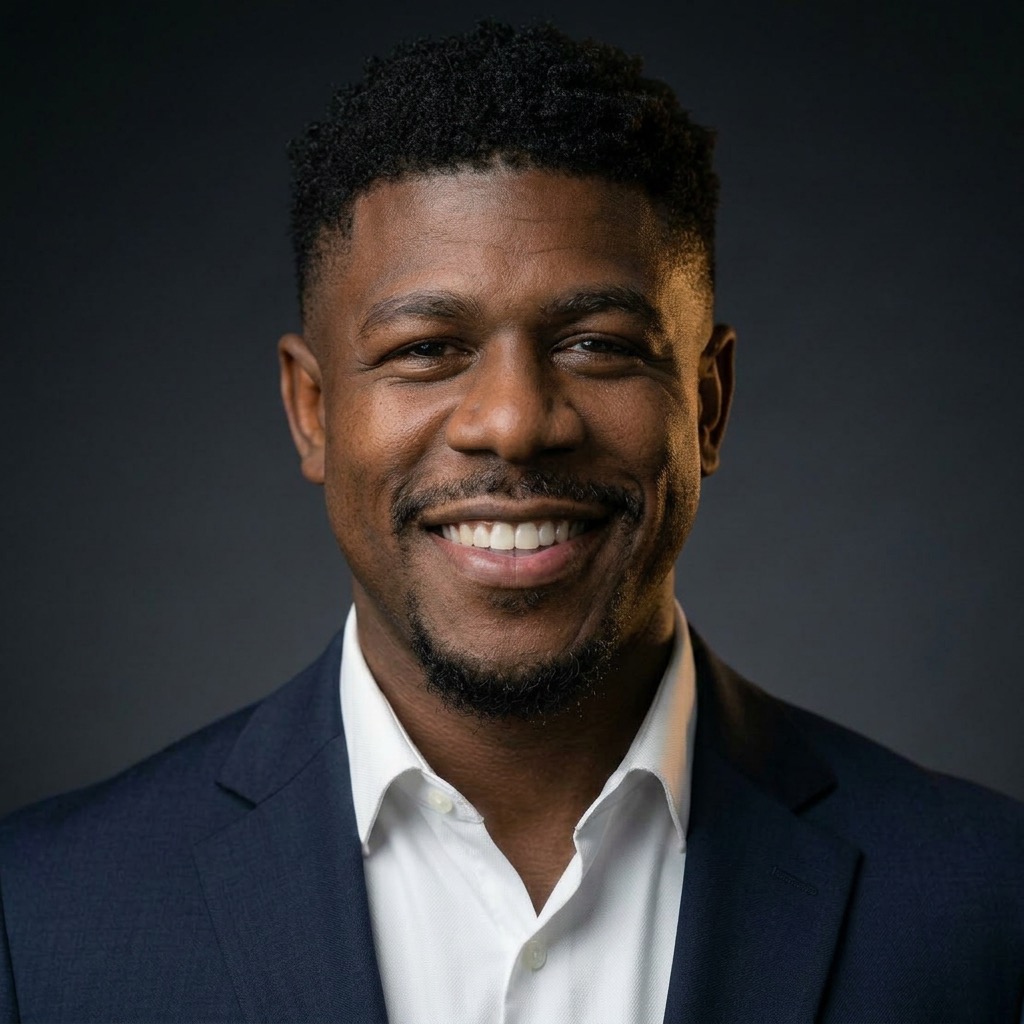
Article by
Chelvis “CJ” Marshall
Chelvis “CJ” Marshall is Founder & Managing Partner of Marshall Solutions Group, a management consulting firm specializing in Strategy & Operations, Organizational Leadership & Change, and Program & Project Management. A retired U.S. Navy Senior Chief who advanced from E-1 to E-8 in 10 years, CJ later transitioned into Fortune 500 enterprise leadership, negotiating more than $20M in contracts within three years. He brings operator-level experience leading teams, complex programs, and mission-critical operations. His work centers on being the bridge between leadership and execution—helping organizations translate strategic direction into disciplined execution, stronger accountability, and measurable results.
Your presence in every meeting isn't a sign of leadership; it's a structural failure. Most founders take pride in being the primary decision-maker, yet they eventually become the very bottleneck that stalls momentum. Effective organizational design for growing companies isn't about drawing boxes on a chart; it's about hardwiring accountability into the operational rhythm. Strategy looks perfect on paper but fails during execution because middle management lacks clear authority. You're working harder. The company is drifting.
You'll learn how to transition from founder-led chaos to a disciplined, scalable structure that aligns leadership with measurable execution. With the SBA restructuring size standards in late 2026, scaling requires more than just adding headcount; it requires systems. We'll examine how to build self-managing structures that support 2.5x revenue growth and move beyond the bottleneck. Stop being the operator. Start building a machine that executes.
Key Takeaways
- Identify and eliminate the "Founder Bottleneck" by shifting from individual heroics to a disciplined, self-managing structure.
- Implement a practical framework for organizational design for growing companies that aligns leadership with high-stakes execution.
- Utilize an Operational Performance Assessment to uncover hidden EBITDA and streamline how your organization delivers results.
- Prioritize implementation over mere planning by applying rigorous change management principles to ensure lasting organizational alignment.
Table of Contents
Why Traditional Organizational Structures Break During Rapid Scaling
Growth creates friction. Scaling a business from 20 to 100 people isn't just about hiring more hands. It requires a fundamental shift in your Organizational architecture. In its simplest form, organizational design for growing companies is the deliberate alignment of people, processes, and strategy to eliminate friction. Without this alignment, you hit the "Founder Bottleneck." This occurs when every decision, from tactical hiring to high-level strategy, requires your personal approval. It doesn't just slow things down; it actively destroys enterprise value by making the company dependent on a single point of failure.
Structural decay shows itself through missed deadlines, declining margins, and a toxic silo mentality. Mid-market firms often struggle when departments stop collaborating and start competing for resources. Generic business coaching fails to fix these deep-seated operational inefficiencies because it treats the symptoms, not the system. You don't need a cheerleader. You need a disciplined framework that turns strategy into measurable results.
The Crisis of Accountability in Founder-Led Organizations
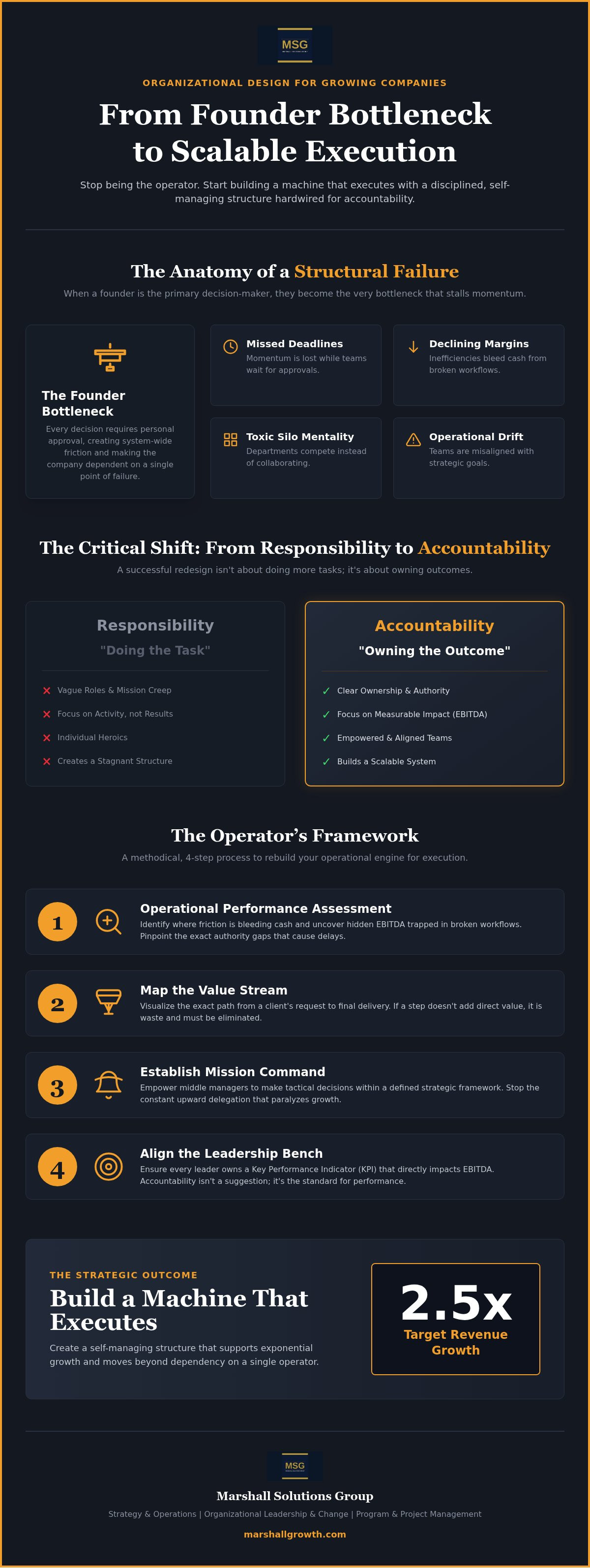
There's a critical distinction between responsibility and accountability. Responsibility is simply doing the task. Accountability is owning the outcome. In many growing firms, roles are so vague that "mission creep" becomes inevitable. People do what they think is right, but they aren't aligned with the strategic goal. This operational drift is a silent killer in mission-critical environments. We use our Leadership & Operations Assessment to pinpoint exactly where these authority gaps exist. Without clear ownership, your strategy remains a wish list rather than a roadmap for execution.
The Operator’s Framework: Designing for Execution and Accountability
Effective organizational design for growing companies isn't an HR exercise. It's a tactical rebuild of your operational engine. We move beyond theoretical charts to hardwire execution into the company's DNA. This process follows a methodical, four-step framework designed for speed and precision.
- Step 1: Conduct an Operational Performance Assessment. We identify where friction is bleeding cash and uncover hidden EBITDA trapped in broken workflows.
- Step 2: Map the Value Stream. You need to see the exact path from a client's initial request to the final delivery. If a step doesn't add value, it's waste.
- Step 3: Establish Mission Command. We empower middle managers to make tactical decisions within a defined strategic framework. This stops the constant upward delegation that paralyzes growth.
- Step 4: Align the leadership bench. Every leader must own a KPI that directly impacts EBITDA. Accountability isn't a suggestion; it's the standard.
Success requires more than a new structure; it requires an operator's eye for detail. If your current system feels like it's fighting against you, it probably is. You can connect with our team to see how an embedded operator can streamline your path to 2.5x growth.
Establishing PMO Governance for Strategic Alignment
Federal contractors and mission-critical enterprises face unique pressures that standard business models often ignore. A Program Management Office (PMO) provides the governance needed to manage complex portfolios. By integrating federal program management best practices, you create a repeatable system for success. You don't necessarily need a full-time executive to lead this. A Fractional COO provides the necessary oversight and veteran discipline without the enterprise-level price tag. This approach ensures your organizational design for growing companies remains durable as you scale toward new revenue milestones.
Executing the Redesign: From Strategic Blueprint to Disciplined Reality
A blueprint is just paper. Real organizational design for growing companies succeeds or fails during the implementation phase. Most firms hire expensive talent to fill seats in a broken system. We take a "skin in the game" approach. Implementation matters more than the design itself. If the transition doesn't happen on the shop floor or in the project site, the strategy is dead on arrival. We use the Prosci ADKAR model to navigate the change management curve. Awareness and desire must precede ability. Without team buy-in, the most logical structure will face silent sabotage.
Discipline sustains growth. You must translate strategy into action through a rigorous battle rhythm. This includes weekly tactical syncs and Quarterly Business Reviews (QBR) that focus on variance, not just status updates. We build sustainable SOPs that survive personnel turnover and market shifts. Systems run the business. People run the systems. When the structure is durable, the departure of a single manager doesn't trigger an operational crisis.
Building a Culture of Ownership Through Operational Excellence
We reject "deck-and-disappear" consulting. Transformation requires an embedded operator who stays to ensure the new gears mesh. We reinforce accountability through company-wide scorecards that track leading indicators, not just lagging financials. This creates a culture where performance optimization is everyone's job. Operational discipline is the consistent execution of established systems under pressure. It isn't about rigid rules; it's about maintaining standards when the stakes are highest.
Stop Managing Chaos and Start Scaling Execution
Growth without discipline is a slow-motion wreck. We've explored how owner-dependency stalls momentum and how a rigorous approach to organizational design for growing companies breaks that cycle. It requires shifting from vague roles to hardwired accountability. Real transformation happens when strategy meets the shop floor. It’s about establishing a Mission Command where middle managers own outcomes, not just tasks. Systems run the business; people run the systems.
Marshall Solutions Group brings 60+ years of leadership experience and veteran-led discipline to your operation. As an SBA-certified SDVOSB, we understand the high stakes of mission-critical industrial and federal sectors. We don't just hand over a deck; we stay to ensure the new structure holds under pressure. Speak with Marshall Solutions Group about aligning your organization for growth. Your company is capable of more. Let's build the system that proves it.
Frequently Asked Questions
What are the first signs that a company has outgrown its organizational design?
The primary indicator is the "Founder Bottleneck," where every decision stalls waiting for owner approval. You'll also see missed project deadlines, declining profit margins, and a rise in "silo" mentality across departments. When leadership spends more time firefighting than executing strategy, it's a clear signal that your current organizational design for growing companies is no longer fit for purpose.
How does organizational design for federal contractors differ from commercial firms?
Federal contractors must prioritize PMO governance and compliance over simple commercial agility. Design for these firms must account for rigorous reporting, risk management, and the ability to execute within mission-critical environments. Socioeconomic status, such as being an SBA-certified SDVOSB, also influences how leadership is structured to enhance teaming opportunities and meet specific federal program management requirements while maintaining operational excellence.
Can a Fractional COO help with organizational redesign?
A Fractional COO provides the embedded leadership necessary to stabilize and scale a company without the overhead of a full-time executive. They act as an operating partner who stays through the implementation phase to ensure systems actually work. By conducting assessments and mapping value streams, they help transition from founder-led chaos to a disciplined structure that aligns leadership with measurable business outcomes.
How long does it typically take to implement a new organizational structure?
Implementation timing depends on the complexity of the change management curve and the depth of the redesign. While a blueprint can be drafted quickly, true transformation requires moving through the Prosci ADKAR phases of awareness and ability. Sustainable shifts usually occur in phases, starting with a leadership assessment and followed by disciplined weekly and quarterly reviews to ensure new systems become permanent operational habits.
Disclaimer
The information provided in this article is for general informational and educational purposes only and does not constitute legal, financial, accounting, engineering, or other professional advice. Marshall Solutions Group, Inc. makes no representations or warranties regarding the completeness or applicability of this information to any specific situation. Readers should consult appropriately qualified professionals before making decisions requiring specialized professional advice.