Federal Program Management Best Practices: An Operator’s Guide to Execution (2026)
Marshall Solutions Group · reviewed by CJ Marshall
Move beyond compliance. Master federal program management best practices to drive mission success, improve CPARS ratings, and execute with precision in 2026.

Article by
Chelvis “CJ” Marshall
Chelvis “CJ” Marshall is Founder & Managing Partner of Marshall Solutions Group, a management consulting firm specializing in Strategy & Operations, Organizational Leadership & Change, and Program & Project Management. A retired U.S. Navy Senior Chief who advanced from E-1 to E-8 in 10 years, CJ later transitioned into Fortune 500 enterprise leadership, negotiating more than $20M in contracts within three years. He brings operator-level experience leading teams, complex programs, and mission-critical operations. His work centers on being the bridge between leadership and execution—helping organizations translate strategic direction into disciplined execution, stronger accountability, and measurable results.
Checking boxes on a PMIAA checklist won't save a failing $500M portfolio. Many leaders find themselves buried under bureaucratic friction where compliance is prioritized over actual mission success. You've likely felt the frustration of watching a critical program stall because the gap between policy and performance is too wide. It's a common trap in the federal space, but implementing effective federal program management best practices can bridge that divide.
This guide moves beyond theory to provide an operator's perspective on execution. You'll learn how to master the transition from mere bureaucratic compliance to mission-critical reliability using proven frameworks. We'll explore how to streamline your PMO governance, drive accountability across complex portfolios, and secure the high CPARS ratings that reflect true excellence. With the 2026 updates to OMB Uniform Guidance and the new PMBOK 8th Edition standards, the margin for error has disappeared. It's time to lead with precision.
Key Takeaways
- Shift focus from rigid compliance to mission-critical execution by leveraging the 2026 PMIAA standards and the latest OMB guidance.
- Master federal program management best practices by adopting a Mission Command model that balances centralized strategy with empowered, decentralized execution.
- Integrate proactive risk management frameworks to identify and neutralize operational friction before it impacts your CPARS ratings or program delivery.
- Utilize the tactical discipline of operator-led PMO support to ensure accountability and reliability across your most complex federal portfolios.
Table of Contents
Navigating Federal PMO Standards: Beyond PMIAA Compliance
Federal program management is a coordinated effort to manage related projects to achieve specific mission benefits. While the Program Management Improvement Accountability Act (PMIAA) provides the foundational framework, many agencies treat it as a bureaucratic hurdle. By 2026, PMIAA aims to professionalize the federal workforce through standardized practices and clear career paths. However, compliance alone doesn't deliver results. This Program Management Overview clarifies the distinction between simple project oversight and the complex strategic alignment required for large-scale success.
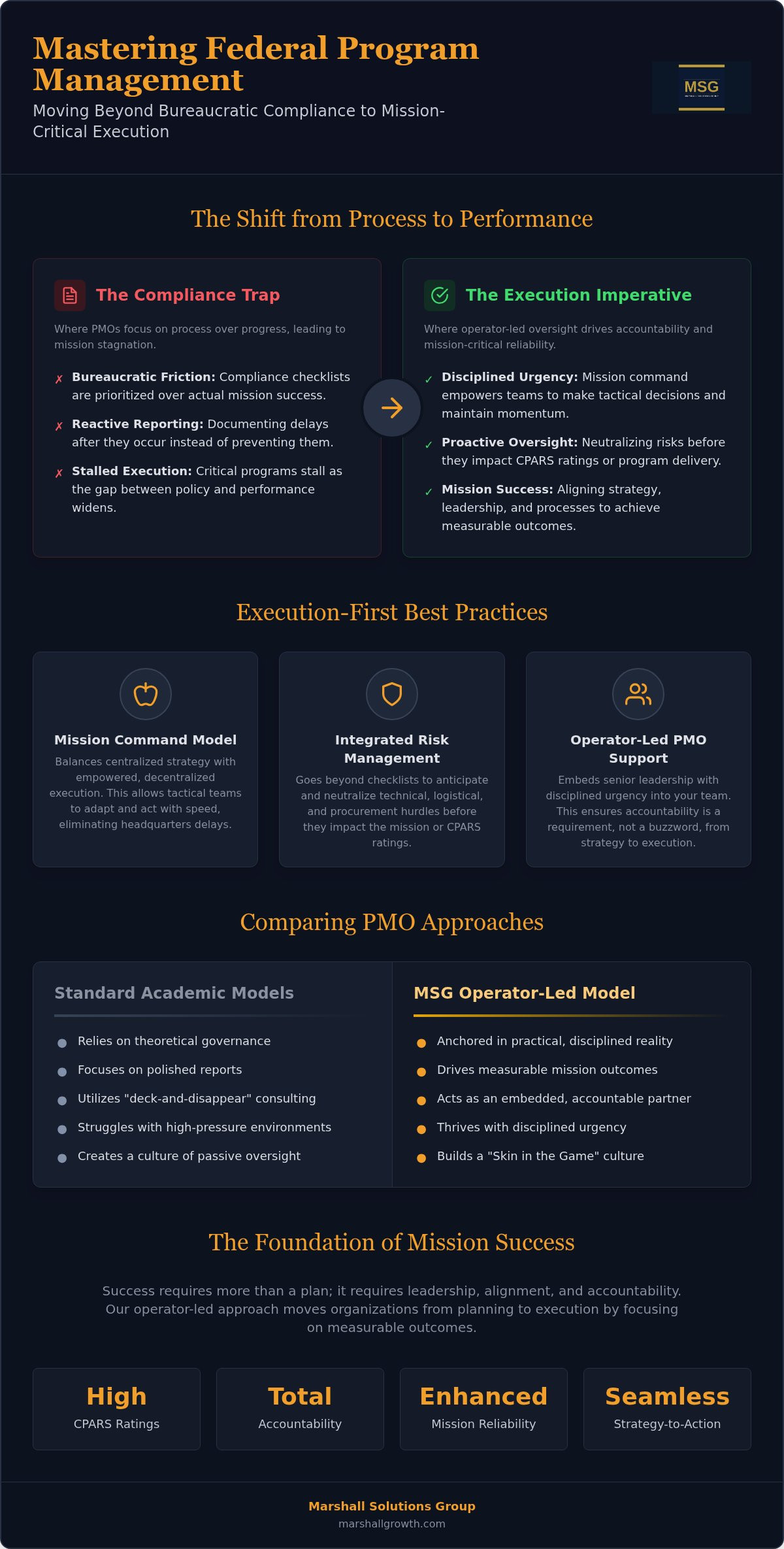
Compliance-only PMOs fail because they focus on reporting rather than resolving. They document delays instead of preventing them. This reactive posture creates a lack of accountability that stalls mission-critical execution. True federal program management best practices require operator-led oversight that understands the mechanics of growth. Academic governance might look polished on a slide deck, but it lacks the disciplined urgency needed for high-pressure environments.
The Reality of OMB M-18-19 and Coordinated Governance
OMB Memo M-18-19 requires major agencies to designate Program Management Improvement Officers (PMIOs) to spearhead these efforts. Despite this mandate, standardized models often collapse when portfolios become siloed. To avoid these failures, leaders must implement federal program management best practices that span the entire organization. Our Strategy to Action: Operator’s Execution Guide (2026) provides the framework to ensure strategy translates into measurable outcomes.
Execution-First Best Practices for Mission-Critical Programs
Execution isn't about following a manual. It's about owning the mission. To master federal program management best practices, leaders must prioritize Mission Command. This framework empowers decentralized execution while maintaining a centralized strategy. It allows teams on the ground to make tactical decisions without waiting for a distant headquarters to weigh in. Speed is a requirement, not a luxury.
We implement Integrated Risk & Compliance Management (IRCM) to pre-empt mission-impacting failures. This system goes beyond standard checklists. It builds a "Skin in the Game" culture where the PMO is accountable for outcomes, not just the reports that describe them. Instead of documenting why a project failed, we focus on identifying the friction points that cause failure in the first place. Utilizing Lean Six Sigma principles ensures that federal workflows remain lean, efficient, and focused on continuous process improvement.
Risk Management and Performance Optimization
A robust risk management plan must anticipate technical, logistical, and procurement hurdles long before they manifest. We don't just manage risk; we neutralize it. This proactive stance allows for significant margin improvement and performance optimization within the contract scope. Performance optimization is the alignment of people and processes to mission-critical KPIs. By refining these mechanics, we move from passive oversight to active mission delivery. If your organization is struggling to bridge the gap between policy and performance, it may be time to evaluate operator-led execution support to restore operational discipline.
Building Accountability: The Role of Operator-Led PMO Support
Academic models often rely on "deck-and-disappear" strategies where consultants provide a plan and vanish before execution begins. We do the opposite. Senior military command experience brings a level of disciplined urgency that high-pressure federal environments demand. This isn't just about oversight; it's about embedded partnership. By applying federal program management best practices, we ensure that every strategic initiative is anchored in reality. Accountability isn't a buzzword. It's a requirement for mission success. It's the difference between a high CPARS rating and a failed delivery. To evaluate your current standing, utilize our Operational Performance Assessment to identify gaps in your PMO health.
Scaling Execution with SBA-Certified SDVOSB Partners
Teaming with an SBA-certified SDVOSB and VOSB (certified June 2026) offers prime contractors a significant strategic advantage in federal facilities and infrastructure projects. Beyond meeting socioeconomic goals, these partnerships inject veteran-like discipline into complex portfolios. We've proven this track record by overseeing 1,500 personnel across three countries. We maintain an active SAM registration through August 2027 and operate under CAGE code 20LB9 to support seamless procurement. This level of readiness ensures that we remain a reliable ally, especially when navigating the rigorous standards of federal program management best practices. It's about providing management-level oversight that actually moves the needle. For real-world examples of our "skin in the game" implementation, view the Marshall Solutions Group LinkedIn page.
Move Beyond Compliance to Mission Delivery
Transitioning from bureaucratic checklists to disciplined execution requires more than just a plan. It demands a leadership-first approach that prioritizes accountability and operational reliability. By integrating federal program management best practices, organizations bridge the gap between policy and performance. We've proven this model with 60+ years of leadership experience and zero mission-impacting failures on $500M platforms. As an SBA-certified SDVOSB and VOSB, we bring the skin in the game necessary to navigate high-pressure federal environments effectively.
Don't let operational friction stall your mission. It's time to align your strategy, people, and processes around measurable outcomes. Speak with Marshall Solutions Group about your federal program execution challenges. Results matter now. Let's get to work.
Frequently Asked Questions
What is the Program Management Improvement Accountability Act (PMIAA)?
The PMIAA is a foundational law designed to professionalize program management within the federal government. It requires agencies to designate a Program Management Improvement Officer (PMIO) and develop standards-based policies. By establishing a formal career path and standardizing practices, the act aims to reduce waste and improve mission outcomes. It's the baseline for modern federal program management best practices.
How does federal program management differ from project management?
Program management is the coordinated oversight of a group of related projects to achieve strategic mission benefits that wouldn't be possible if managed individually. While project management focuses on specific deliverables, schedules, and budgets, program management aligns multiple initiatives with high-level agency goals. This holistic approach ensures that individual projects don't operate in silos, creating a more durable and integrated framework.
Why is an operator-led PMO better than traditional management consulting?
Traditional consulting often follows a deck-and-disappear model where firms provide a plan but avoid the friction of implementation. An operator-led PMO brings senior military command experience to the field. We prioritize execution over theory and stay through the implementation phase. This skin in the game approach ensures high accountability and reliability in high-pressure, mission-critical environments.
What are the key KPIs for federal program performance?
Success is measured by mission-critical reliability and measurable outcomes rather than just task completion. Key KPIs include CPARS ratings, budget adherence, and schedule variance across the entire portfolio. However, effective federal program management best practices also track integrated risk mitigation and the alignment of personnel to strategic goals. We focus on performance optimization metrics that prove the program is delivering tangible value.
Disclaimer
The information provided in this article is for general informational and educational purposes only and does not constitute legal, financial, accounting, engineering, or other professional advice. Marshall Solutions Group, Inc. makes no representations or warranties regarding the completeness or applicability of this information to any specific situation. Readers should consult appropriately qualified professionals before making decisions requiring specialized professional advice.