Federal Program Management: Moving Beyond Compliance to Mission Execution
Marshall Solutions Group · reviewed by CJ Marshall
Shift your federal program management from compliance-driven friction to mission execution. Learn to align goals and achieve predictable, high-stakes perform...

Article by
Chelvis “CJ” Marshall
Chelvis “CJ” Marshall is Founder & Managing Partner of Marshall Solutions Group, a management consulting firm specializing in Strategy & Operations, Organizational Leadership & Change, and Program & Project Management. A retired U.S. Navy Senior Chief who advanced from E-1 to E-8 in 10 years, CJ later transitioned into Fortune 500 enterprise leadership, negotiating more than $20M in contracts within three years. He brings operator-level experience leading teams, complex programs, and mission-critical operations. His work centers on being the bridge between leadership and execution—helping organizations translate strategic direction into disciplined execution, stronger accountability, and measurable results.
Most federal programs don't fail because of a lack of rules. They fail because leadership treats compliance as the finish line rather than the baseline. You're likely navigating the pressure of meeting the 5% SDVOSB subcontracting goal while trying to prevent mission-impacting failures in high-stakes environments. It's a difficult balance. Bureaucratic requirements often create operational friction, leaving leaders to wonder why their cross-functional teams lack true accountability.
We understand that a plan is only as good as its execution. You'll learn how to bridge the gap between rigid mandates and operational reality through leadership-driven federal program management. This article breaks down the transition from a state of fire-fighting to disciplined, predictable performance. We'll explore how to align your socioeconomic goals with measurable outcomes, ensuring your program meets every requirement without compromising the mission.
Key Takeaways
- Identify and avoid the "Deck-and-Disappear" trap by transitioning from theoretical consulting plans to active, hands-on implementation.
- Establish a high-performing framework for federal program management that shifts your focus from reactive compliance to proactive mission execution.
- Implement a structured two-step PMO model to define clear governance and oversight, effectively eliminating the friction of cross-functional accountability.
- Leverage strategic SDVOSB partnerships to exceed socioeconomic set-aside goals while integrating elite operational discipline into high-stakes prime contracts.
Table of Contents
Bridging the Execution Gap in Federal Program Management
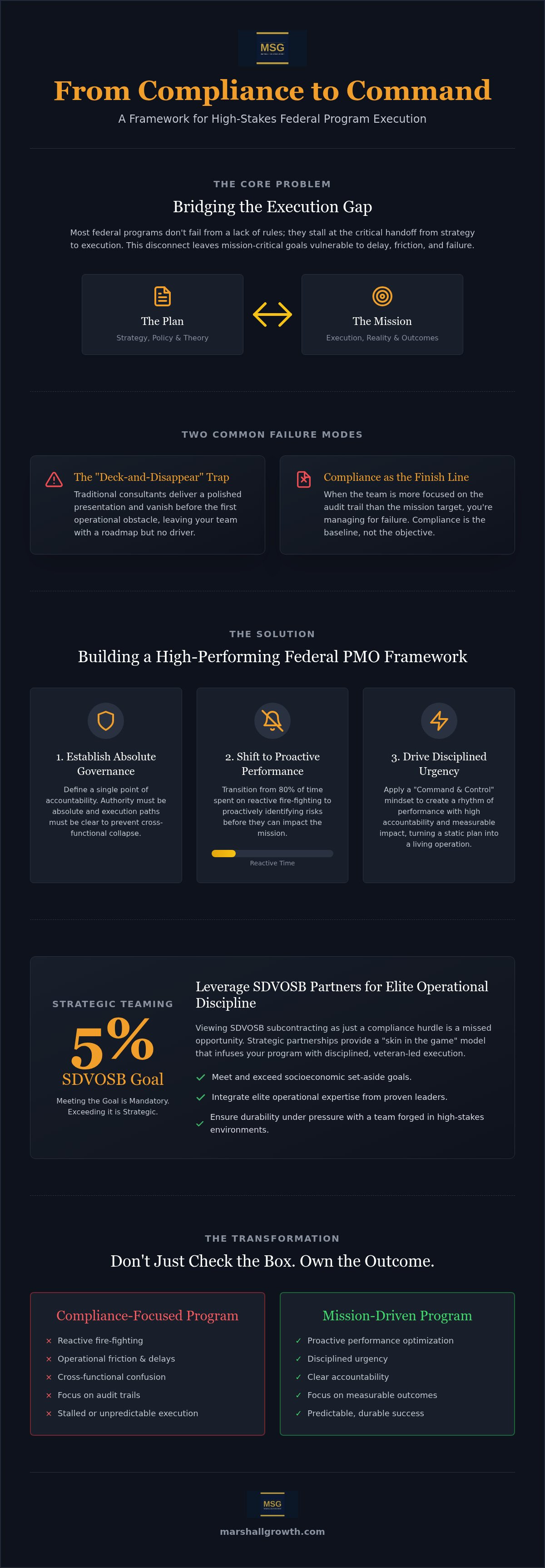
Most federal programs stall at the same point: the handoff from strategy to execution. Leaders often find themselves with a robust plan but no movement on the front lines. This disconnect occurs when Program Management is treated as a reporting function instead of a driving force. It's a failure of alignment that leaves mission-critical goals vulnerable to delay and friction.
Beware the "Deck-and-Disappear" trap. Many traditional consultants specialize in high-level theory. They deliver a polished presentation, collect a fee, and vanish before the first operational obstacle arises. This leaves your team with a roadmap but no driver. Effective federal program management requires an embedded partner who stays through the implementation phase. You don't need another presentation; you need a steady hand on the controls.
We apply a "Command and Control" mindset to the PMO. This isn't about rigid bureaucracy. It's about disciplined urgency. High accountability. Measurable impact. It creates a rhythm of performance that transforms a static plan into a living operation. When every team member knows their role and the stakes involved, execution becomes predictable. Strategy is useless without a disciplined path to implementation.
Why Policy Compliance Isn't Enough for Mission Success
Frameworks like FAC-P/PM provide a necessary baseline, but they're often too academic for high-stakes defense or industrial environments. Compliance is just a checklist; it's not a strategy for victory. To move beyond the basics, you need a Leadership & Operations Assessment to identify the operational blind spots policy alone can't fix. Don't just check the box. Own the outcome. If your team is more focused on the audit trail than the mission target, you're managing for failure instead of success.
Building a High-Performing Federal PMO Framework
Governance isn't a suggestion; it's the structure that prevents collapse. In federal program management, authority must be absolute and execution paths must be clear. Cross-functional teams often fail because they lack a single point of accountability. Define who owns the decision, not just the task. Establish delivery oversight that tracks progress in real time rather than waiting for quarterly reviews.
Transition your team from reactive fire-fighting to proactive performance optimization. Most PMOs spend 80% of their time fixing yesterday's mistakes. Shift that energy toward identifying risks before they impact the mission. When every associate understands how their specific task supports the broader objective, you eliminate wasted effort and redundant processes. Alignment is the difference between a group of individuals and a high-performing unit.
Governance Models for Mission-Critical Environments
Stabilizing complex programs requires rigorous SOP development and continuous business process improvement. These aren't just documents; they are the mechanics of durability. Implementing operator-led management consulting services ensures your federal program management structure is built by people who have lived through the stressors of high-stakes environments. This tactical approach links PMO support directly to margin improvement and measurable performance metrics. If your framework doesn't improve the mission outcome, it's just overhead. You can align your operations for execution by focusing on these core pillars of durability.
Strategic Teaming: Leveraging SDVOSB Partners for Growth
Teaming with a Service-Disabled Veteran-Owned Small Business (SDVOSB) is often viewed as a compliance hurdle. That's a missed opportunity. While meeting the 5% statutory goal for SDVOSB subcontracting is mandatory, the real value lies in elite operational expertise. We don't just help you meet a quota. We provide a "skin in the game" model that aligns our incentives with yours. If the program fails, we fail. This level of shared responsibility is rare in traditional consulting but essential in high-stakes federal program management.
Our leadership is forged in high-pressure environments. When you're managing a 500 million dollar transformation program with nearly 1,000 associates, you need command experience. Our team includes retired U.S. Navy leadership with a track record of zero mission-impacting failures on naval platforms. This isn't theoretical. It's disciplined, veteran-led execution that stabilizes complex systems and ensures durability under fire. We speak the language of the mission because we've lived it.
Enhancing Prime Contractor Performance Through Expert PMO Support
Adopting a Strategic Gov Program Management approach opens doors to more competitive market opportunities. Primes often struggle with the "Deck-and-Disappear" consultants who provide plans without staying for the work. We offer an "Operator-Led" advantage that moves beyond the slide deck. We stay embedded through implementation, ensuring that every process improvement translates into measurable margin growth. It's leadership-driven federal program management designed to help you scale while maintaining total mission integrity. We don't just advise; we execute alongside you.
Move Toward Disciplined Execution
Federal programs require more than a compliance checklist. They demand the same level of command and control found in high-stakes operational environments. By bridging the execution gap and establishing a high-performing PMO, you move beyond passive reporting toward actual mission success. Effective federal program management transforms socioeconomic goals into tactical advantages. You need a partner who values results over theory.
Marshall Solutions Group brings 60+ years of combined military and Fortune 500 leadership to your team. We are an SBA-certified SDVOSB and VOSB with a track record of managing $500M programs with zero mission-impacting failures. We don't just deliver slide decks; we stay until the mission is complete. It's time to stop fire-fighting and start leading with disciplined urgency. Schedule an Operational Assessment with Marshall Solutions Group to stabilize your operations. Your organization is ready for a higher standard of performance.
Frequently Asked Questions
What is the difference between project management and federal program management?
Project management focuses on specific deliverables with defined timelines. In contrast, federal program management involves a group of related projects managed in a coordinated way to achieve mission-critical outcomes. While a project manager tracks a schedule, a program manager ensures long-term strategic alignment across the entire portfolio. It's the difference between completing a single task and owning the total success of an agency mission.
How does teaming with an SDVOSB benefit prime contractors on federal projects?
Prime contractors gain a strategic advantage by meeting the 5% SDVOSB subcontracting goal while gaining access to elite operational leadership. Teaming with a certified partner ensures that socioeconomic requirements don't compromise performance. This partnership provides access to leaders with command experience who understand high-stakes environments, reducing operational risk and enhancing performance on complex contracts through shared responsibility and veteran-led discipline.
What are the common reasons for federal program failures in mission-critical sectors?
Programs often stall when leadership treats compliance as the finish line rather than the baseline. Common failures include a lack of clear governance, reactive fire-fighting instead of proactive risk management, and the inability to align cross-functional teams around measurable outcomes. When a program lacks disciplined oversight and high accountability, operational friction builds up, eventually leading to delays and mission-impacting failures in high-stakes environments.
How does Marshall Solutions Group approach PMO support for federal agencies?
We provide leadership-driven federal program management by embedding seasoned operators directly into the organization. Our PMO support focuses on establishing clear lines of authority, implementing proactive risk management, and stabilizing systems through rigorous process improvement. We don't just offer advice; we provide the tactical oversight required to move from high-level planning to disciplined, predictable mission execution that delivers measurable results.
Disclaimer
The information provided in this article is for general informational and educational purposes only and does not constitute legal, financial, accounting, engineering, or other professional advice. Marshall Solutions Group, Inc. makes no representations or warranties regarding the completeness or applicability of this information to any specific situation. Readers should consult appropriately qualified professionals before making decisions requiring specialized professional advice.