Managing Government Contract Modifications: An Operator’s 2026 Guide
Marshall Solutions Group · reviewed by CJ Marshall
Stop treating contract changes as paperwork. Our 2026 guide to managing government contract modifications protects your margins and CPARS ratings with discip...

Article by
Chelvis “CJ” Marshall
Chelvis “CJ” Marshall is President & Founder of Marshall Solutions Group, a management consulting firm specializing in Strategy & Operations, Organizational Leadership & Change, and Program & Project Management. A retired U.S. Navy Senior Chief who advanced from E-1 to E-8 in 10 years, CJ later transitioned into Fortune 500 enterprise leadership, negotiating more than $20M in contracts within three years. He brings operator-level experience leading teams, complex programs, and mission-critical operations. His work centers on being the bridge between leadership and execution—helping organizations translate strategic direction into disciplined execution, stronger accountability, and measurable results.
A contract modification isn't just a piece of paper. It's a direct threat to your bottom line if you treat it as an administrative afterthought. Most operators view changes as a necessary headache or a legal hurdle. You've likely seen field operations clash with contract administration while costs mount and payments stall. Managing government contract modifications requires more than just filling out Standard Form 30. It demands a disciplined framework that bridges the gap between leadership and execution.
We know the friction. You want to keep the mission moving, but uncontrolled scope creep eats your profit. This guide provides the operational mechanics to protect your margins and CPARS ratings. We'll show you how to maintain stability during scope shifts, ensure full cost recovery for out-of-scope work, and strengthen your relationship with the Contracting Officer. You'll learn to handle 2026 regulatory shifts with the precision of a seasoned operator.
Key Takeaways
- Treat modifications as operational risks rather than administrative paperwork by mastering the distinctions between bilateral agreements and unilateral directives under FAR Part 43.
- Protect your profit margins by implementing a strict intake process for managing government contract modifications that halts out-of-scope work until it is fully authorized.
- Perform rigorous operational impact analyses to verify how scope shifts affect resource allocation, schedules, and your overall CPARS rating.
- Secure mission-critical stability through operator-led PMO support that bridges the communication gap between field technicians and the Contracting Officer.
Table of Contents
The Strategic Impact of Managing Government Contract Modifications
A contract modification is a formal change to the terms, scope, or pricing of a government agreement, governed by FAR Part 43. It's an operational reality, not an anomaly. Mastering the process of managing government contract modifications allows you to distinguish early between bilateral agreements and unilateral directives. The Changes Clause provides the legal foundation for these shifts, but the administrative process often masks the underlying financial risk. Unpriced changes are profit killers. When work begins before pricing is finalized, you invite labor inefficiency and immediate margin erosion.
Effective execution in managing government contract modifications is also a direct investment in your CPARS rating. Precision. Order. Stability. The government evaluates how you handle volatility. If you can't manage shifts without operational friction, your past performance reflects that instability. Mission success depends on your ability to pivot without compromising the baseline agreement or the relationship with your Contracting Officer.
Identifying Scope Creep Before It Impacts Performance
Scope creep is the primary driver of unrecovered costs in federal infrastructure projects. It often starts with "constructive changes," where verbal government direction subtly exceeds the written Statement of Work. These aren't always formal requests; they're field-level nudges that expand your obligations without expanding your budget. Detecting these deviations requires a rigid baseline for operational readiness. You must know exactly what you're contracted to do before you can identify what you're being asked to do extra. Stop the leak before it drains the program's viability.
Operationalizing Change: A Tactical Framework for Scope Management
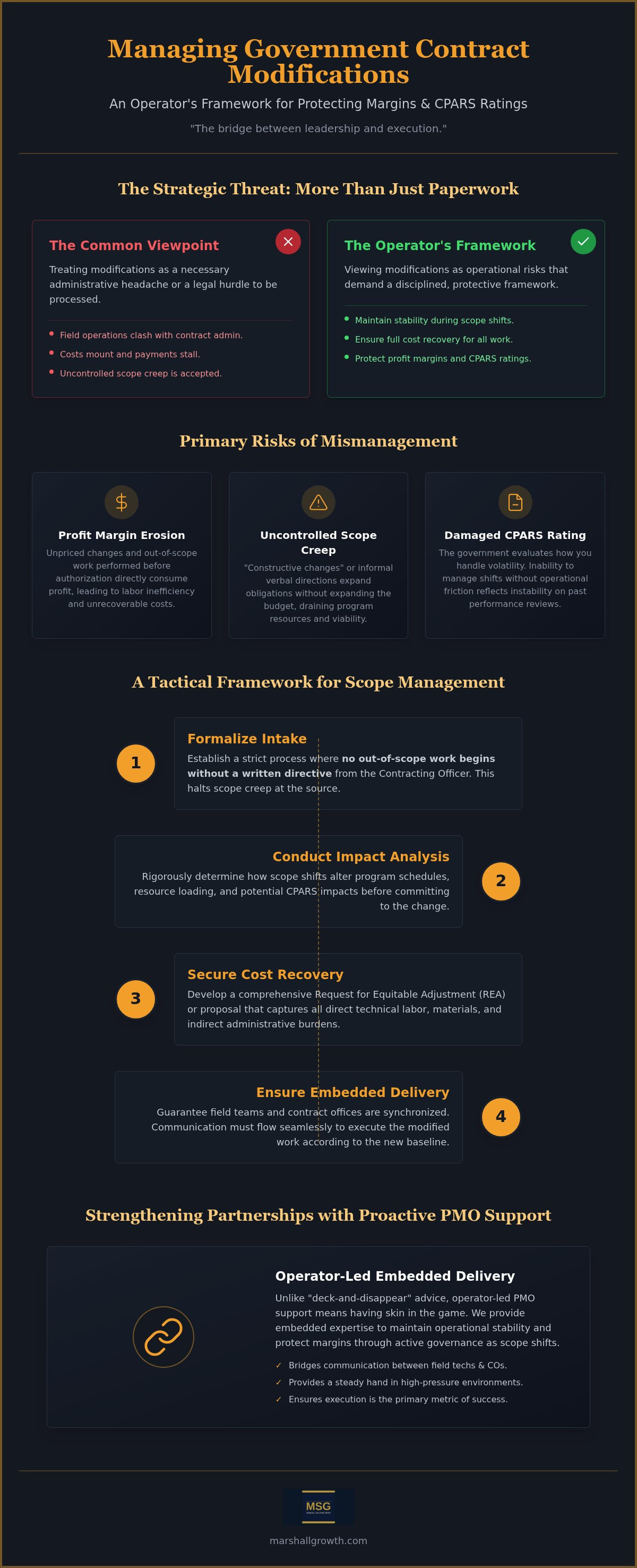
Execution is where strategy often dies. Managing government contract modifications requires a rigid, four-step tactical framework to ensure operational shifts don't become financial liabilities. Discipline. Documentation. Recovery. Use this sequence to maintain control:
- Formalize intake: Establish a strict process where no work begins without a written directive.
- Impact analysis: Determine how scope shifts alter your program schedule and resource loading.
- Cost recovery: Develop an REA that captures both technical labor and administrative burdens.
- Embedded delivery: Ensure field teams and contract offices move in lockstep during execution.
Securing full cost recovery depends on high-fidelity documentation when managing government contract modifications. Per the Federal Acquisition Regulation (FAR) Part 43, your records must be precise to withstand audit and justify price adjustments. This isn't just about the work performed; it's about the cost of the disruption itself. If you're seeing margin pressure, an operations assessment can identify where your execution is failing.
Implementing Project Controls to Protect Program Margins
Rigorous project management oversight is your best defense against margin erosion. Use project controls to track labor hours and materials against specific modification orders in real-time. This creates cross-level fluency between your field leads and office administrators. For deeper strategies on protecting your bottom line, see our guide on SME Cost Optimization: An Operator’s 2026 Framework. Don't let operational friction dictate your financial outcome.
Strengthening Prime Partnerships Through Proactive PMO Support
Prime contractors in mission-critical sectors often struggle under the weight of high-volume modifications. Managing government contract modifications at this scale requires more than administrative tracking; it demands operator-led PMO support. Most consulting firms offer "deck-and-disappear" advice. We prioritize embedded delivery. We have skin in the game. This approach ensures that as scope shifts, operational stability remains intact and margins are protected through active governance.
Teaming with an SBA-certified SDVOSB provides a distinct performance advantage. It's not just about socioeconomic profiles. It's about senior-level command experience. Our leadership brings 60+ combined years of experience, including U.S. Navy engineering command, to every engagement. We bridge the communication gap between field technicians and agency decision-makers. We speak both languages fluently. This creates a steady hand in high-pressure environments where execution is the only metric that matters.
Deploying Operator-Level Expertise for Mission-Critical Compliance
Mission success requires disciplined systems. Our leadership has directed 10 operations across three countries with zero mission-impacting failures on naval platforms. We apply Lean Six Sigma principles to streamline the negotiation process, ensuring that managing government contract modifications doesn't become a bottleneck. This tactical precision allows primes to focus on delivery while we handle the mechanics of change. For a deeper look at our methodology, read our Operational Readiness Assessment guide. We don't just advise; we execute.
Securing Operational Stability in a Volatile Federal Market
Government contracts are never static. Success in 2026 requires moving beyond passive compliance and toward active governance. You've seen how unpriced changes erode margins and how poor documentation can tank CPARS ratings. Mastering the mechanics of managing government contract modifications is the only way to ensure your program remains profitable and performant. It requires a steady hand and a proven framework. As an SBA-certified SDVOSB with 60+ years of combined leadership experience, we provide the operator-led PMO support necessary for mission-critical execution. We don't just advise from the sidelines; we embed within your team to bridge the gap between leadership and the field. Stop letting scope creep dictate your financial future. Schedule a Leadership & Operations Assessment with Marshall Solutions Group today. Let's get your operations back on a disciplined path toward growth.
Frequently Asked Questions
What is the difference between a bilateral and unilateral contract modification?
A bilateral modification is a supplemental agreement requiring signatures from both the contractor and the Contracting Officer to change contract terms. A unilateral modification is signed only by the Contracting Officer. These are typically used for administrative updates, exercising options, or issuing change orders under the Changes clause. Managing government contract modifications effectively requires recognizing which type you've received to determine your negotiation leverage.
How should a contractor handle a change order that hasn't been priced yet?
You must immediately establish a separate cost center to track all labor, materials, and administrative hours associated with the change. Start documenting the operational impact before work begins to ensure full cost recovery later. Notify the Contracting Officer in writing that the change is unpriced. This discipline prevents margin erosion and provides the data needed for a successful Request for Equitable Adjustment.
Can a government contractor refuse a unilateral modification?
Contractors generally cannot refuse a unilateral modification issued under the Changes clause. You're legally obligated to perform the work while the price or schedule adjustment is negotiated. Refusing to perform can result in a termination for default and a negative CPARS rating. Your protection lies in the formal REA process, which allows you to recover costs after the work is directed.
What are the common triggers for a Request for Equitable Adjustment (REA)?
Common triggers include government directed scope shifts, differing site conditions, or delays caused by agency inaction. Constructive changes, where verbal direction from field personnel exceeds the Statement of Work, are also frequent drivers. Managing government contract modifications involves identifying these triggers early to prevent unrecovered costs. We use operator led PMO support to catch these shifts before they impact mission critical execution.
Disclaimer
The information provided in this article is for general informational and educational purposes only and does not constitute legal, financial, accounting, engineering, or other professional advice. Marshall Solutions Group, Inc. makes no representations or warranties regarding the completeness or applicability of this information to any specific situation. Readers should consult appropriately qualified professionals before making decisions requiring specialized professional advice.