Operational Due Diligence: Operator-Led Guide for M&A
Marshall Solutions Group · reviewed by CJ Marshall
Go beyond the balance sheet with our operator-led operational due diligence checklist. Uncover execution risks and hidden EBITDA for a bulletproof M&A integr...

Article by
Chelvis “CJ” Marshall
Chelvis “CJ” Marshall is Founder & Managing Partner of Marshall Solutions Group, a management consulting firm specializing in Strategy & Operations, Organizational Leadership & Change, and Program & Project Management. A retired U.S. Navy Senior Chief who advanced from E-1 to E-8 in 10 years, CJ later transitioned into Fortune 500 enterprise leadership, negotiating more than $20M in contracts within three years. He brings operator-level experience leading teams, complex programs, and mission-critical operations. His work centers on being the bridge between leadership and execution—helping organizations translate strategic direction into disciplined execution, stronger accountability, and measurable results.
Most M&A failures aren't found in the balance sheet; they're buried in the shop floor and the back office. You know that financial audits only tell half the story. EBITDA looks great on paper until you realize the founder is the only person who knows how the supply chain actually works. We're moving beyond surface-level metrics to provide a rigorous, operator-led operational due diligence checklist designed to expose execution risks and identify hidden EBITDA in industrial and federal sectors.
Success requires more than a good plan; it requires leadership, alignment, and accountability. Identify. Align. Execute. This guide breaks down how to evaluate leadership scalability, process durability, and contract retention risks to build a bulletproof 100-day integration plan. Stop guessing and start executing.
Key Takeaways
- Verify the repeatability of EBITDA by looking beyond the balance sheet into the mechanics of daily execution.
- Use an operational due diligence checklist to assess leadership alignment and confirm that strategic objectives are understood at every level of the organization.
- Uncover hidden operational friction and execution risks by auditing process maturity and the durability of existing standard operating procedures.
- Build a high-accountability 100-day integration plan that bridges the gap between pre-deal assessment and post-acquisition performance optimization.
Table of Contents
Defining Operational Due Diligence: More Than a Back-Office Audit
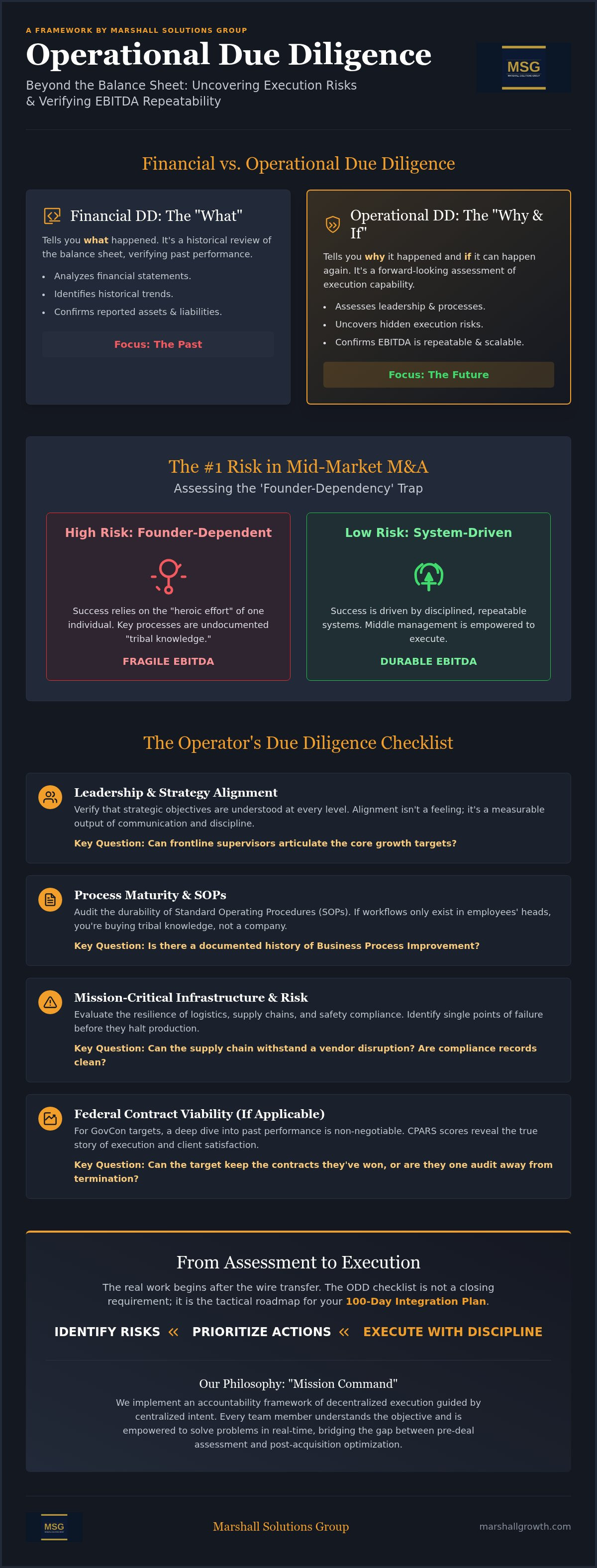
Financial due diligence tells you what happened; operational due diligence (ODD) tells you why it happened and if it can happen again. It's a tactical deep-dive into the target company's leadership, core processes, and internal systems. The goal isn't just to verify assets. It's to confirm that the organization possesses the "Command and Control" capacity to sustain and scale current EBITDA under new ownership. Without a rigorous operational due diligence checklist, you're essentially buying a black box. You need to know if the machine keeps running once you take the keys.
Misaligned leadership or fragmented standard operating procedures (SOPs) are the primary drivers of post-merger value destruction. If the target's success relies on tribal knowledge rather than documented workflows, that EBITDA is fragile. When the "how" is broken, the "what" eventually disappears. Operational failure isn't just a setback; it's a total erosion of the deal's original thesis. A comprehensive operational due diligence checklist bridges the gap between financial optimism and operational reality.
Assessing the 'Founder-Dependency' Trap
Founder-dependency is the #1 risk in mid-market industrial acquisitions. Many organizations thrive on the "heroic effort" of a single individual rather than the disciplined output of repeatable systems. If the founder is the only person capable of solving a production bottleneck or navigating a federal contract dispute, the business isn't a scalable asset. We evaluate the leadership bench to determine if middle management has the authority and discipline to execute without direct supervision. This transition is the difference between a successful exit and a costly integration failure.
The Operator’s Operational Due Diligence Checklist for 2026
A rigorous operational due diligence checklist ignores the glossy pitch deck; it looks at the shop floor. First, verify leadership and strategy alignment. If the frontline supervisors can't articulate the core growth targets, the strategy is a hallucination. Alignment isn't a feeling. It's a measurable output of communication and discipline. We look for evidence that the strategic vision has been translated into daily tasks for every operator in the facility.
Next, audit process maturity. We look for a documented history of Business Process Improvement. If workflows only exist in employees' heads, you're buying tribal knowledge, not a company. For federal contractors, this includes a deep dive into federal program management and CPARS history. Past performance scores tell you if the target can actually keep the contracts they've won or if they're one audit away from a termination for cause.
Mission-Critical Infrastructure & Risk Management
Evaluate the resilience of logistics and supply chain support. Identify single points of failure in the vendor base. One missing specialized component can halt an entire production line. For industrial firms, review safety and compliance records to prevent hidden liabilities that emerge post-close. These records often hide the true cost of neglected maintenance or poor training. Use an operational due diligence checklist to stress-test these systems before the wire transfer.
Execution is the highest form of strategy. For a more granular breakdown of execution pillars, consult our Leadership & Operations Assessment checklist. If you need a partner to evaluate these systems, a Strategy & Operations Consulting engagement can provide the clarity you need to close with confidence.
From Assessment to Execution: Bridging the Post-Acquisition Gap
The real work begins after the wire transfer. Too many deals stall because the findings from the operational due diligence checklist are treated as a closing requirement rather than a tactical roadmap. Your 100-day plan must dictate the immediate priorities for organizational change and performance optimization. If the audit revealed a fragmented supply chain or a leadership gap, those are your day-one targets. You can't wait for the quarterly board meeting to address friction that is already eroding your EBITDA. Identify. Prioritize. Execute.
Alignment requires more than a shared vision; it requires shared stakes. Ensure the remaining leadership team is motivated by measurable outcomes rather than just the deal payout. "Deck-and-disappear" consulting fails because it lacks the skin in the game required for implementation. You need an operating partner who stays through the transition to ensure accountability and discipline. Strategy is useless without a steady hand to guide the execution. We don't just deliver reports; we deliver results.
Implementing an Accountability Framework
We utilize a "Mission Command" philosophy. This means decentralized execution guided by centralized intent. Every team member understands the objective; they have the authority to solve problems in real-time. Use your operational due diligence checklist findings to build a company-wide scorecard. Track leading indicators of operational health, such as cycle times and first-pass yield, rather than just lagging financial data. To see how these audit findings translate into margin improvement, review our Operational Performance Assessment guide. Execution isn't a one-time event. It's a daily habit of alignment and accountability. Performance optimization is the standard, not the exception.
Secure Your Acquisition Performance Through Disciplined Execution
Closing a deal is just the starting line. To ensure your investment scales, you must move beyond the balance sheet and audit the actual mechanics of the organization. A rigorous operational due diligence checklist provides the clarity needed to identify hidden EBITDA and mitigate the risks of founder-dependency or broken workflows. Success isn't found in a pitch deck; it's forged through leadership alignment and process durability.
At Marshall Solutions Group, we bring military-grade discipline to every assessment. Our veteran-led team combines Navy engineering precision with a track record of managing $500M federal transformation programs. We don't just deliver a report and disappear. We provide fractional COO support that stays through implementation to ensure your 100-day plan actually delivers results. Speak with an MSG Operator about your next assessment and turn your acquisition strategy into a high-performance reality.
Frequently Asked Questions
What is the difference between financial and operational due diligence?
Financial diligence audits the past; operational diligence stress-tests the future. While financial teams verify historical EBITDA, our operational due diligence checklist evaluates the systems and leadership required to maintain those margins. We look at the production engine, not just the bank statement. This confirms if the target organization is a repeatable business or a collection of lucky circumstances.
How long does a thorough operational due diligence process take?
The timeline for an operational assessment typically aligns with the broader financial diligence window. We focus on high-impact areas like leadership alignment and process maturity to deliver actionable insights before the deal closes. This methodical approach ensures that the findings are integrated into the 100-day plan without slowing down the transaction. Efficiency and accuracy are the priorities.
What are the most common operational red flags in founder-led companies?
Founder-dependency is the primary red flag. If the business relies on the "heroic effort" of one individual rather than documented systems, it’s a fragile asset. Other risks include tribal knowledge replacing SOPs and a middle management bench that lacks decision-making authority. If the founder is the only problem-solver, the company cannot scale post-acquisition. Accountability must be decentralized.
How does operational due diligence impact the final purchase price?
Findings from an operational due diligence checklist directly influence the deal's valuation and structure. Identifying hidden operational friction or compliance gaps in federal contracts often leads to price adjustments or specific earn-out conditions. Conversely, verifying a robust, scalable infrastructure can justify a higher multiple. We provide the data required to negotiate from a position of tactical strength.
Disclaimer
The information provided in this article is for general informational and educational purposes only and does not constitute legal, financial, accounting, engineering, or other professional advice. Marshall Solutions Group, Inc. makes no representations or warranties regarding the completeness or applicability of this information to any specific situation. Readers should consult appropriately qualified professionals before making decisions requiring specialized professional advice.