How to Build a Founder Transition Plan That Scales Beyond You
Marshall Solutions Group · reviewed by CJ Marshall
Build a founder transition plan to move from daily operations to a visionary role. Learn the framework to increase EBITDA and secure your company's future va...

Article by
Chelvis “CJ” Marshall
Chelvis “CJ” Marshall is President & Founder of Marshall Solutions Group, a management consulting firm specializing in Strategy & Operations, Organizational Leadership & Change, and Program & Project Management. A retired U.S. Navy Senior Chief who advanced from E-1 to E-8 in 10 years, CJ later transitioned into Fortune 500 enterprise leadership, negotiating more than $20M in contracts within three years. He brings operator-level experience leading teams, complex programs, and mission-critical operations. His work centers on being the bridge between leadership and execution—helping organizations translate strategic direction into disciplined execution, stronger accountability, and measurable results.
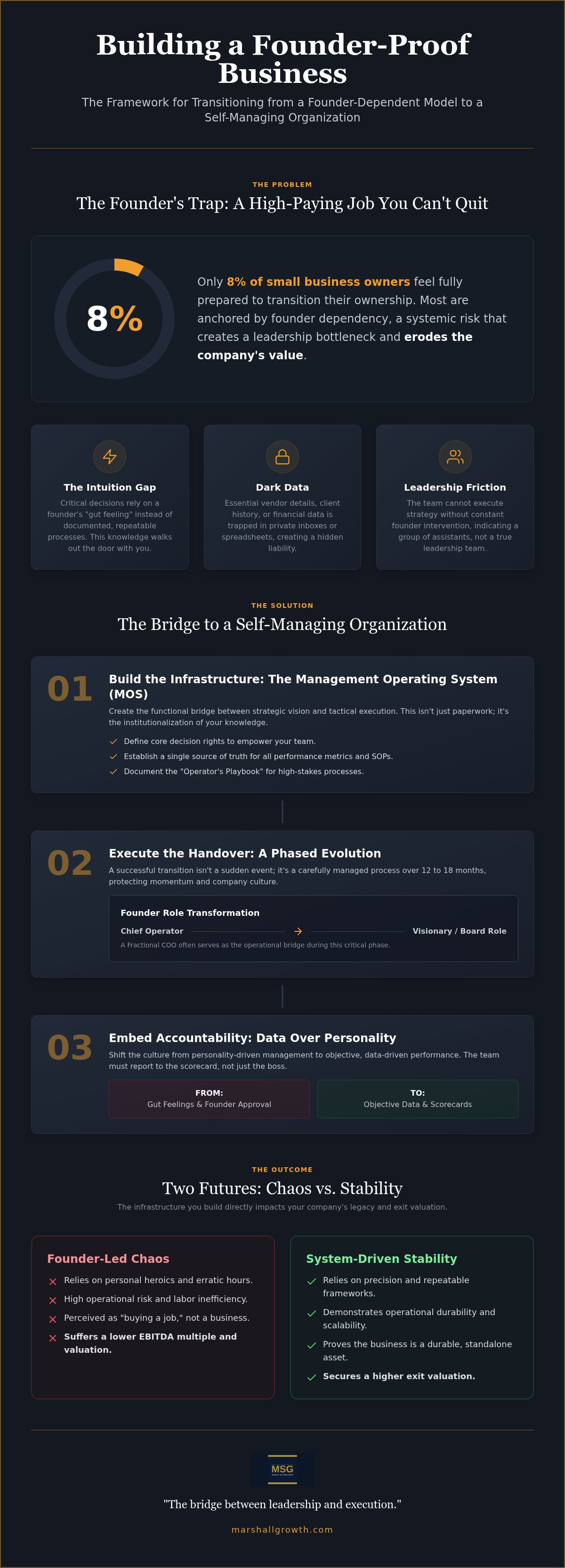
Only 8% of small business owners feel fully prepared to transition their ownership. Most founders eventually realize their business is actually a high-paying job they can't quit because the entire operation lives inside their head. You want the freedom of an exit, but the fear of operational collapse keeps you anchored to the daily grind. It's a leadership bottleneck. It erodes value.
This article provides the operational framework required to build a founder transition plan that scales. You'll learn how to move from a founder-dependent model to a self-managing organization without losing momentum. We'll examine the systems required to stabilize your leadership team, increase your EBITDA, and ensure your company remains a durable asset long after you've stepped away from the desk.
Key Takeaways
- Shift from a founder-dependent model to a structured Management Operating System that secures your operational knowledge within the business.
- Define specific decision rights to empower your leadership team and eliminate the bottlenecks caused by constant founder approval.
- Build a founder transition plan that follows a 12-to-18-month phased exit to protect company momentum and increase exit valuation.
- Integrate fractional leadership to serve as the operational bridge while you move from Chief Operator to a Visionary or Board role.
Table of Contents
The Founder’s Trap: Why Traditional Succession Plans Fail
Most Succession planning efforts fail because they prioritize legal paperwork over operational reality. A signed contract won't keep the lights on if the company's brain is sitting in your office. Founder dependency is a systemic risk. It's the single point of failure that prevents mid-market companies from scaling. If you're involved in every tactical decision, you've created a bottleneck that kills momentum, erodes value, and stalls your founder transition plan before it starts.
Financial consequences are real. Business brokers report that retirement is the leading motivation for sales, yet research shows only 8% of owners feel prepared to step away. Buyers discount companies where the owner is the primary driver of revenue or operations. They aren't buying a business; they're buying your job. A high-value founder transition plan must prove the business can breathe without you. Without it, your EBITDA multiple will suffer due to perceived labor inefficiency and high operational risk.
Identifying Operational Red Flags Before the Handover
Before initiating a handover, you must identify where the business is tethered to your persona. These red flags indicate a lack of operational durability:
- The Intuition Gap: If a decision requires your specific gut feeling, it isn't a documented process. It's a secret.
- Dark Data: Critical vendor details or client history trapped in your private inbox is a liability that disappears when you leave.
- Leadership Friction: If your team can't execute a monthly strategy without your weekly intervention, you have a group of assistants, not a leadership team.
Building the Infrastructure for a Self-Managing Company
A successful founder transition plan requires more than a willing successor. It demands a Management Operating System (MOS). This is the functional bridge between your strategic vision and the team's tactical execution. Without a structured system, your replacement is likely to fall into common traps for new leaders, such as decision paralysis or over-correction. You must define core decision rights immediately. Your team needs to know exactly what they can approve without your intervention.
Replace ad-hoc check-ins with a disciplined cadence of high-impact business reviews. This shifts the culture from "founder-dependent" to "results-dependent." Establish a single source of truth for all performance metrics and operational SOPs. If it isn't documented, it doesn't exist. This level of clarity is what separates a chaotic startup from a durable enterprise. To ensure your systems are ready, a professional Leadership & Operations Assessment can identify hidden bottlenecks and prepare the organization for scale.
Documenting the Operator’s Playbook for Your Successor
Focus on high-stakes processes first. Document how the company wins work, delivers service, and manages risk. Documentation is not an administrative burden; it is the institutionalization of your excellence. Contrast the two possible futures for your firm. Founder-led chaos relies on personal heroics and erratic hours. System-driven stability relies on precision and repeatable frameworks. Moving the "how" from your head to a centralized playbook is the only way to ensure your founder transition plan scales beyond your presence. If you are ready to stabilize your handover, you should evaluate your operational readiness before you step away.
Executing the Handover: From Visionary to Embedded Leadership
Execution is where most strategies fail. A successful founder transition plan isn't a sudden hand-off; it's a phased evolution. We utilize an "Embedded Delivery" model. This involves integrating a Fractional COO to stabilize the operation while you shift from Chief Operator to a Visionary or Board role. This transition should typically span 12 to 18 months. It allows for testing new systems under fire while you're still available to course-correct. You need a partner who understands the friction of real-world operations, not just the theory of management.
Don't settle for a consultant who delivers a slide deck and disappears. You need allies with skin in the game who stay through the implementation phase. This ensures the founder transition plan actually takes root in the company's daily rhythm. It protects your legacy and prevents a vacuum of power. Before you begin this journey, a Leadership & Operations Assessment provides the baseline data needed to identify execution gaps and leadership bottlenecks before they become fatal.
Setting Accountability Frameworks for the New Leadership Team
Your team must stop reporting to "the boss" and start reporting to the scorecard. This removes personality-driven management. It replaces gut feelings with objective data. This shift forces high accountability and prevents the "founder-dependency" trap from reforming under a new name. Use an Operational Readiness Assessment to audit your mission-critical processes before the final handover. Build a leadership bench that speaks credibly to both the boardroom and the field technician. This dual-language capability ensures your strategy translates into action at every level of the organization.
Operationalizing Your Exit Strategy
A successful founder transition plan is the difference between a business that survives and one that thrives. You've learned that legal documents are secondary to a functional Management Operating System. By defining decision rights and shifting from personality-driven management to data-driven scorecards, you secure the company's future. This transition requires disciplined execution and a steady hand to navigate the friction of change. It's about turning your vision into a durable, self-sustaining asset.
Marshall Solutions Group provides the operational bridge you need. As a veteran-owned and operator-led firm with over 60 combined years of leadership experience, we understand high-stakes environments. We are an SBA-certified SDVOSB focused on tactical implementation. Don't leave your legacy to chance. Build your transition plan with an operator-led assessment. Your company is ready to scale beyond you. It's time to build the systems that make it possible.
Frequently Asked Questions
What is the most common reason a founder transition plan fails?
The primary reason a founder transition plan fails is the lack of operational infrastructure. Most owners prioritize legal succession over the institutionalization of their daily decision-making. If the business relies on your personal heroics or "gut feeling" to function, it will stall once you exit. Failure occurs when the successor inherits a list of tasks instead of a scalable Management Operating System.
How long does it typically take to transition a founder out of daily operations?
A professional transition typically requires 12 to 18 months of disciplined execution. This timeframe allows for a phased exit where the founder moves from Chief Operator to a Visionary or Board role. It provides enough space to implement a new founder transition plan that includes accountability frameworks and tests the leadership team's performance. Rushing this process creates power vacuums and risks immediate operational collapse.
Should I hire a successor from within the company or look externally?
Your choice depends on the current leadership bench's readiness. In a 2026 survey, 78% of family business executives expect a transition within the decade, yet only 23% believe internal successors are ready. This gap is why the number of firms appointing non-family CEOs is projected to double to 26%. You must evaluate if your team can speak credibly to both the boardroom and the field.
What role should the founder play after the transition plan is complete?
The founder should transition into a Visionary or Board Member role focused on long-term strategy rather than tactical execution. This prevents the "Bottleneck Effect" from re-emerging. Once the handover is complete, you must stop being the boss and start respecting the new leadership's scorecard. Your value lies in mentorship and high-level governance, ensuring the company's legacy remains durable as it scales.
Disclaimer
The information provided in this article is for general informational and educational purposes only and does not constitute legal, financial, accounting, engineering, or other professional advice. Marshall Solutions Group, Inc. makes no representations or warranties regarding the completeness or applicability of this information to any specific situation. Readers should consult appropriately qualified professionals before making decisions requiring specialized professional advice.