SME Cost Optimization: An Operator’s 2026 Framework
Marshall Solutions Group · reviewed by CJ Marshall
Facing margin erosion? Our operator's framework offers cost optimization strategies for SMEs that protect growth, unlike reactive cuts that stall momentum.

Article by
Chelvis “CJ” Marshall
Chelvis “CJ” Marshall is President & Founder of Marshall Solutions Group, a management consulting firm specializing in Strategy & Operations, Organizational Leadership & Change, and Program & Project Management. A retired U.S. Navy Senior Chief who advanced from E-1 to E-8 in 10 years, CJ later transitioned into Fortune 500 enterprise leadership, negotiating more than $20M in contracts within three years. He brings operator-level experience leading teams, complex programs, and mission-critical operations. His work centers on being the bridge between leadership and execution—helping organizations translate strategic direction into disciplined execution, stronger accountability, and measurable results.
84% of mid-market companies are prioritizing cost optimization in 2026. Most will fail because they treat it as a desperate exercise in amputation rather than precision surgery. You've likely felt the squeeze as national diesel prices hit $5.85 a gallon and labor costs continue to climb. It's a high-stakes environment where inefficient processes and leadership bottlenecks erode your margins daily. You want to trim the fat, but you're rightfully afraid that cutting too deep will stall your momentum. This operator's framework shifts the focus from reactive slashing to strategic operational alignment. By implementing the right cost optimization strategies for SMEs, you can protect your bottom line while funding the next phase of your growth. We'll examine how to turn your current operational friction into a streamlined system that supports disciplined execution and long-term stability.
Key Takeaways
- Differentiate between strategic resource alignment and reactive panic cutting to protect your organization’s long-term capability.
- Discover how to implement effective cost optimization strategies for SMEs by standardizing SOPs and eliminating redundant labor cycles.
- Transition from founder-led chaos to operational stability by placing the right leaders in roles that enforce high accountability.
- Build a Mission Command structure to move from strategy to execution, ensuring your optimization initiatives produce measurable results without drifting.
Table of Contents
Beyond the Scalpel: Why Strategic Cost Optimization Beats Traditional Cost Cutting
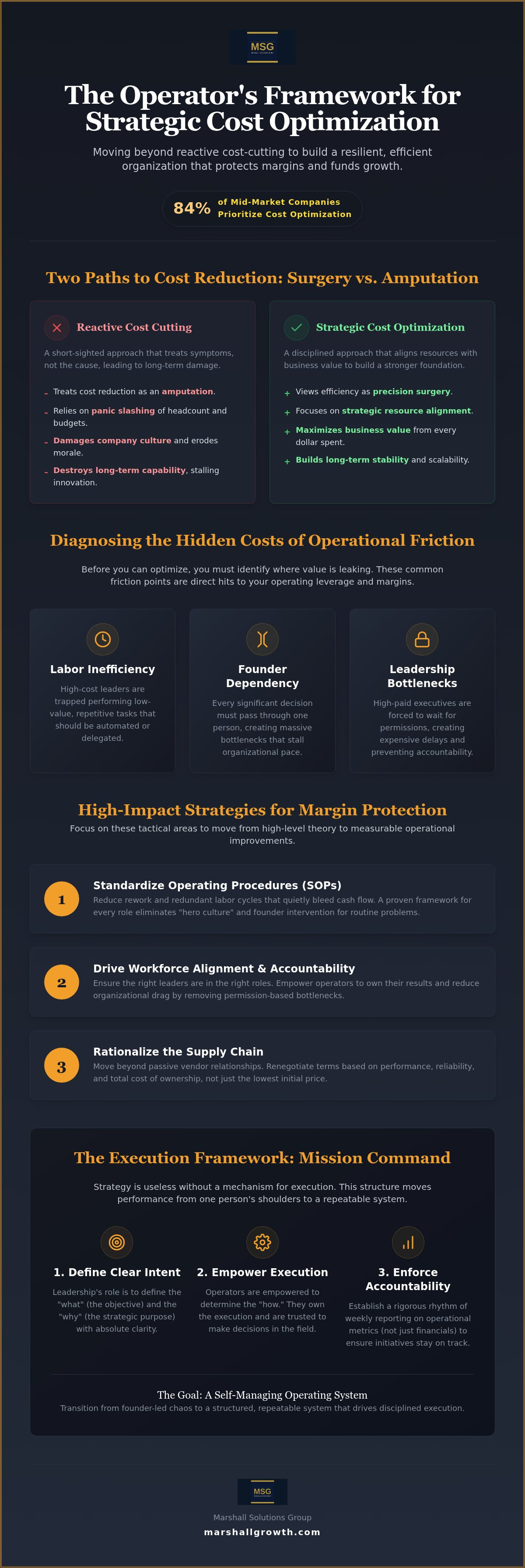
Most leaders mistake cost cutting for cost optimization. They aren't the same thing. Cutting is an amputation; optimization is precision surgery. True optimization is the strategic alignment of your resources to maximize business value while ruthlessly removing waste. It's about ensuring every dollar spent supports your mission. When you approach this as an operator, you don't just look at P&L line items. You look at the mechanics of the work itself.
Panic cutting is a common trap. When margins slip, the first instinct is to slash headcount or gut marketing. This reaction often damages company culture and destroys long-term capability. You end up with a skeleton crew that's too exhausted to innovate. Effective cost optimization strategies for SMEs avoid this by focusing on efficiency rather than just reduction. You shouldn't just spend less; you should spend better.
A primary driver of margin erosion is labor inefficiency. This occurs when high-cost leaders perform low-value, repetitive tasks. If your COO is managing basic data entry or your CEO is approving every minor expense, you're hemorrhaging money. This mismatch is a direct hit to your operating leverage and prevents your organization from scaling.
Identifying the Hidden Costs of Operational Friction
Founder dependency creates massive bottlenecks that stall growth. When every decision must pass through one person, the organization loses its ability to move at pace. These delays are expensive. You can diagnose these gaps using a Leadership & Operations Assessment to identify where your team is stuck. Operational friction is the gap between strategic intent and field execution. Identifying these friction points allows you to implement cost optimization strategies for SMEs that actually produce results.
High-Impact Cost Optimization Strategies for Growing Organizations
Execution is the only strategy your customers ever see. To protect your margins, you must move beyond high-level theory and focus on tactical implementation. Start with process improvement. Standardizing SOPs is one of the most effective cost optimization strategies for SMEs, as it reduces the rework and redundant labor cycles that quietly bleed your cash flow. When every team member follows a proven framework, you eliminate the "hero culture" that relies on founder intervention to solve routine problems.
Workforce alignment is equally vital for long-term stability. You must ensure the right leaders are in the right roles to drive accountability. Leadership bottlenecks occur when founders refuse to delegate, forcing high-paid executives to wait for permissions. This inefficiency is a choice. By empowering operators to own their results, you reduce the drag on your organization. Additionally, you should rationalize your supply chain. With diesel prices at a record $5.85 a gallon, you can't afford passive vendor relationships. Renegotiate terms based on performance and reliability, not just the lowest initial price.
Streamlining Mission-Critical Processes to Improve Gross Margin
"Deck-and-disappear" consulting fails because it lacks the "skin in the game" required for real change. Strategic slides don't fix broken workflows; embedded leadership does. You need an Operational Performance Assessment to identify exactly where your EBITDA is leaking. This methodical approach ensures your cost optimization strategies for SMEs actually take hold. If you're ready to stop the erosion and start scaling, consider how an operator-led partnership can stabilize your systems for the long term.
Executing the Plan: Moving from Strategy to Operational Excellence
Strategy is useless without a mechanism for execution. To stabilize your margins, you must adopt a "Mission Command" structure. This isn't about micromanagement. It's about clear intent. Leadership defines the "what" and the "why," then empowers operators to handle the "how." This shift is fundamental to successful cost optimization strategies for SMEs. It moves the burden of performance from the founder's shoulders to a structured, repeatable system.
Establish a rigorous rhythm of accountability. Without it, cost-saving initiatives drift and eventually disappear. You need weekly reporting cycles that track specific operational metrics rather than just lagging financial indicators. If a process improvement doesn't reflect in your operating leverage within a defined window, you pivot. This isn't an accounting drill; it's a leadership discipline that ensures your team remains focused on the mission.
The ultimate goal is a self-managing operating system. You want to move from a state where the founder is the primary decision-maker to one where the framework drives the action. This transition creates a durable organization capable of sustaining efficiency even during periods of high-stakes growth. It replaces founder-led chaos with disciplined, predictable output.
The Role of Leadership Accountability in Sustaining Efficiency
Stabilizing operations during a transformation often requires a steady, external hand. A Fractional COO provides the expertise needed to implement these changes without disrupting your daily output. You need senior team members with direct operational command experience, people who have managed complex systems and know how to avoid the pitfalls of scaling. Before committing to your next growth phase, review the Operational Readiness Assessment to prepare your team. Preparing for scale requires more than capital; it requires a team ready to execute cost optimization strategies for SMEs with precision and speed.
Stabilize Your Operations and Fund Your Future Growth
Operational stability is the bedrock of scalability. By moving from reactive cutting to disciplined cost optimization strategies for SMEs, you eliminate the friction that erodes your bottom line. You've seen how standardizing SOPs and establishing a Mission Command structure shifts the burden from your shoulders to a repeatable system. It's time to stop covering for inefficiency and start investing in execution. As a veteran owned and operator led firm, Marshall Solutions Group brings 60 plus years of combined leadership experience from high stakes federal and industrial environments. We don't just deliver a plan; we stay through implementation to ensure your organization is built to last. Schedule your Operational Performance Assessment with Marshall Solutions Group today to secure your margins. You have the vision; let's build the engine that powers it.
Frequently Asked Questions
What is the main difference between cost cutting and cost optimization?
Cost cutting is a reactive reduction of expenses that often damages long-term capability. In contrast, cost optimization is the strategic alignment of resources to maximize value while removing waste. Effective cost optimization strategies for SMEs focus on improving efficiency and operating leverage rather than just slashing line items. It's the difference between a desperate amputation and a precise surgical intervention designed to fund future growth.
How can an SME identify hidden operational waste without a full audit?
Look for operational friction points where your high-cost leaders are performing low-value tasks. If your CEO is stuck in daily data entry or minor approvals, you have a leadership bottleneck. These dependencies create delays that cost real money. You can identify these gaps by tracking how often routine decisions require founder intervention, which signals a lack of standardized systems and redundant labor cycles.
When should a growing company consider a fractional COO for cost management?
Consider a fractional COO when your leadership team lacks the bandwidth to move from strategy to execution. If you're experiencing margin erosion from inefficient processes or if your founder is the single point of failure, you need embedded leadership. A fractional operator provides the disciplined urgency required to implement cost optimization strategies for SMEs while stabilizing your internal systems for national scale.
Will cost optimization negatively impact our company culture?
Optimization actually improves culture by replacing chaos with order and stability. Reactive cutting breeds fear and exhausts your best people. Strategic optimization removes the frustration of broken processes and leadership bottlenecks. When your team has clear SOPs and a Mission Command structure, they can focus on high-value work. This creates a high-accountability environment where your associates feel empowered rather than overwhelmed.
Disclaimer
The information provided in this article is for general informational and educational purposes only and does not constitute legal, financial, accounting, engineering, or other professional advice. Marshall Solutions Group, Inc. makes no representations or warranties regarding the completeness or applicability of this information to any specific situation. Readers should consult appropriately qualified professionals before making decisions requiring specialized professional advice.