Operational Performance Assessment: The Operator’s Guide to Execution and EBITDA Growth (2026)
Marshall Solutions Group · reviewed by CJ Marshall
Go beyond surface metrics. This guide provides a leadership-driven operational performance assessment to fix execution gaps and drive real EBITDA growth.

Article by
Chelvis “CJ” Marshall
Chelvis “CJ” Marshall is Founder & Managing Partner of Marshall Solutions Group, a management consulting firm specializing in Strategy & Operations, Organizational Leadership & Change, and Program & Project Management. A retired U.S. Navy Senior Chief who advanced from E-1 to E-8 in 10 years, CJ later transitioned into Fortune 500 enterprise leadership, negotiating more than $20M in contracts within three years. He brings operator-level experience leading teams, complex programs, and mission-critical operations. His work centers on being the bridge between leadership and execution—helping organizations translate strategic direction into disciplined execution, stronger accountability, and measurable results.
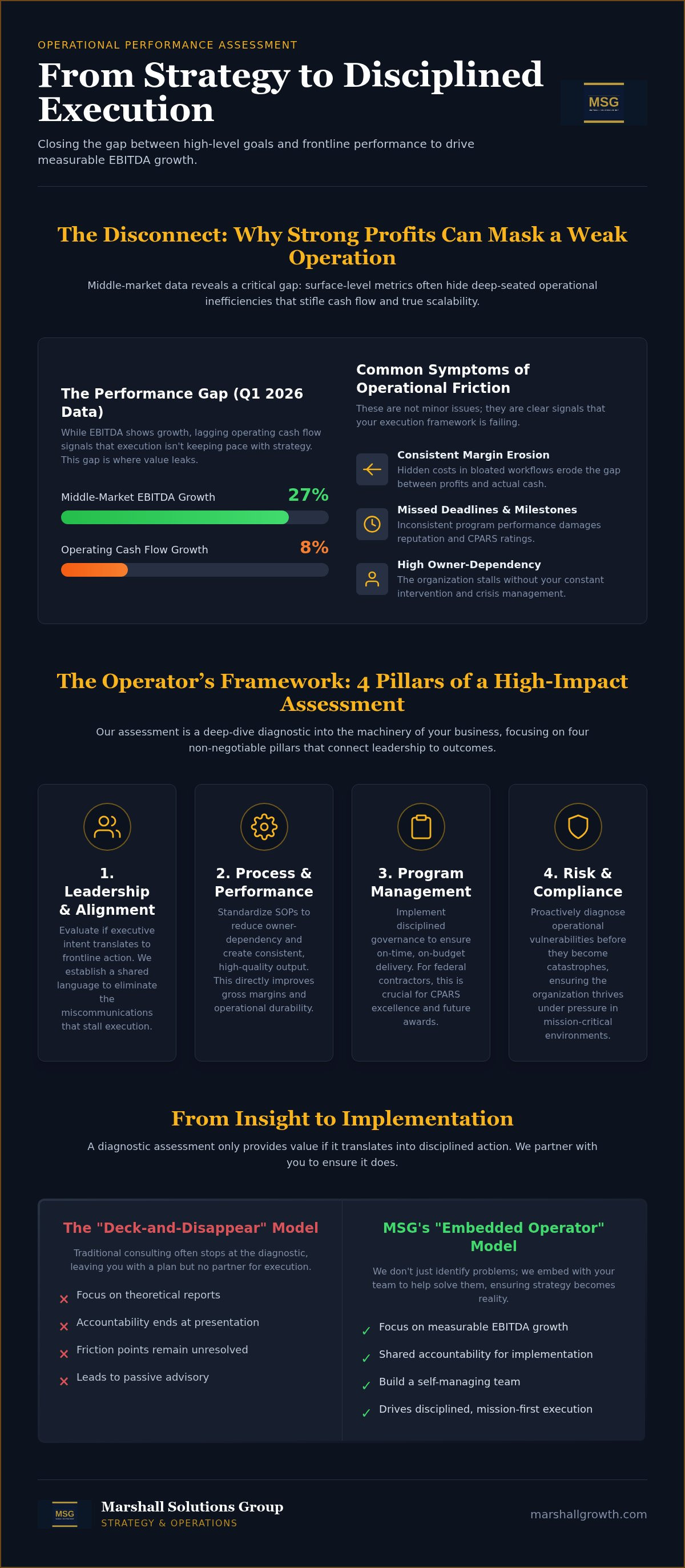
By Q1 2026, middle-market EBITDA grew 27 percent while operating cash flow lagged at just 8 percent. This disconnect proves that surface-level metrics often mask deep-seated operational rot. You've likely felt the friction: missed deadlines, inconsistent federal program performance, and the exhaustion of being the only person who can solve a crisis. A meaningful operational performance assessment must go beyond the balance sheet to evaluate the mechanics of your execution. It's about identifying why your team hesitates and where your margins are leaking.
You deserve an organization that scales without requiring your constant intervention. This guide provides a leadership-driven framework to align your people and processes around measurable outcomes. We'll examine the 2026 federal performance appraisal updates and the SBA size standard shifts that demand higher accountability. You'll learn how to build a self-managing team that turns strategy into disciplined action and delivers the EBITDA growth your hard work warrants.
Key Takeaways
- Identify the specific friction points between your high-level strategy and frontline execution through a targeted operational performance assessment.
- Establish a shared language between your executive suite and operational teams to eliminate the miscommunications that erode gross margins.
- Reduce owner-dependency and prepare for rapid scaling by standardizing SOPs that drive consistent performance across federal programs.
- Transition from passive advisory to disciplined execution by leveraging an "Embedded Operator" model that prioritizes measurable EBITDA growth over theoretical reports.
Table of Contents
Beyond the Dashboard: Why Most Operational Performance Assessments Fail
An operational performance assessment isn't a collection of vanity metrics or pretty charts. It's a deep-dive diagnostic. It scrutinizes the alignment between your leadership, your strategy, and your daily processes. Most assessments fail because they focus on data without accountability. We call this the "deck-and-disappear" consulting trap. You receive a massive presentation, but the friction remains. Real performance measurement requires a partner who stays to see the implementation through.
Strategic agility is impossible without an honest baseline of your current operational discipline. You can't pivot if your foundation is cracked. You must identify the hidden bottlenecks before you can expect to scale to 2.5x revenue. By Q1 2026, middle-market EBITDA grew 27 percent while operating cash flow lagged at just 8 percent. This gap reveals that many companies are profitable on paper but failing in execution. To address this, you need a leadership-driven operational assessment that delivers measurable results.
The Gap Between Strategy and Execution
Great plans often stall in the transition from the boardroom to the field. This happens when the "why" gets lost in the "how." We utilize the concept of Mission Command to bridge this gap. It empowers middle management to execute your intent without needing constant oversight. It creates a self-managing team that solves problems before they reach your desk. Watch for operational red flags like consistent margin erosion, missed federal milestones, or high owner-dependency. These aren't just inconveniences. They are clear signals that your execution framework is failing and requires an immediate performance audit.
The Operator’s Framework: 4 Pillars of a High-Impact Assessment
A rigorous operational performance assessment rests on four non-negotiable pillars. We don't just look at spreadsheets; we look at the machinery of your business. Pillar 1 focuses on Leadership and Alignment. We determine if your executive suite speaks the same language as your front line. Misalignment creates friction that stalls execution and breeds resentment. Pillar 2 addresses Process Improvement and Performance. We focus on standardizing SOPs to reduce owner-dependency. This directly improves gross margins and builds the durability required for rapid growth.
Pillar 3 evaluates Program and Project Management. For federal contractors, this ensures CPARS excellence. Since the April 1, 2026, revisions to past performance frameworks, agencies now use CPARS data across the entire acquisition lifecycle. This makes disciplined governance a survival trait. Pillar 4 centers on Risk and Compliance. In mission-critical environments like aerospace or defense, we use an Operational Performance Risk Assessment to diagnose vulnerabilities before they become catastrophes. This methodical approach ensures your organization thrives under pressure.
Diagnosing Operational Inefficiencies and EBITDA Leaks
Hidden costs often hide in bloated workflows and underdeveloped workforces. These leaks erode the gap between your reported profits and actual cash. Organizational design isn't just about boxes on a chart; it's about long-term scalability and maximizing exit value. An operational performance assessment is not an audit of what you do, but a diagnostic of how your leadership enables, or hinders, execution. If you're ready to stop the bleed and professionalize your operations, it's time to partner with an operator-led advisory.
Moving from Diagnostic to Execution: Implementation with Skin in the Game
An operational performance assessment only provides value if it translates into disciplined action. Traditional firms often deliver a "deck" and disappear. We operate differently. Our "Embedded Operator" model means we don't just point at problems; we help fix them. This is the essence of Bridging Research and Practice in Performance Measures. For federal prime contractors, partnering with a Service-Disabled Veteran-Owned Small Business (SDVOSB) like MSG brings more than just compliance. It brings a culture of mission-first accountability and veteran-led discipline.
Once the diagnostic phase is complete, we move immediately into Change Management in Business Process Improvement. This isn't a slow, theoretical rollout. It's about establishing a "Mission-Critical" execution rhythm. We align your leadership team around a 90-day sprint to address the highest-impact leaks first. This ensures that the momentum from the operational performance assessment isn't lost to daily distractions or organizational inertia.
Selecting the Right Performance Partner
You need an advisor who has actually led organizations through high-stakes transitions. Academic credentials can't replace the grit of managing 1,500 personnel or negotiating $10M+ enterprise contracts. We've done both. Evaluate the ROI of fractional COO support against the cost of one-off consulting projects that never stick. A fractional leader provides the steady hand needed to scale without the overhead of a full-time executive hire. We focus on results. We prioritize execution. We deliver the EBITDA growth your organization is capable of achieving when the right systems are in place.
Professionalize Your Execution for Durable Growth
Execution is the only strategy your customers and stakeholders ever see. An operational performance assessment is the first step toward eliminating the friction that erodes your margins and burns out your leadership. By aligning executive intent with frontline action and standardizing core processes, you transition from a founder-dependent business to a scalable enterprise. Marshall Solutions Group brings over 60 years of combined military command and Fortune 500 leadership to your organization. As an SBA-certified SDVOSB and VOSB, we don't just deliver a report; we embed with your team to drive measurable EBITDA growth. It's time to stop managing chaos and start leading a disciplined operation. Speak with an MSG Operator about your Operational Assessment today. You have the vision. We provide the execution framework to make it permanent.
Frequently Asked Questions
What is the difference between an operational audit and a performance assessment?
An operational audit focuses on backward-looking compliance and financial accuracy to ensure rules were followed. In contrast, an operational performance assessment is a forward-looking diagnostic of your leadership, strategy, and execution mechanics. We analyze how your team actually works rather than just checking boxes. This process identifies the specific friction points that prevent scaling and provides a tactical roadmap for implementation.
How long does a typical operational performance assessment take for a mid-market firm?
A comprehensive operational performance assessment for a mid-market firm typically spans eight to sixteen weeks. The initial diagnostic phase moves quickly to identify immediate EBITDA leaks and leadership misalignments. We then transition into the standardization of SOPs and governance frameworks. This timeline ensures we gather deep data without overstaying our welcome, allowing us to move from theory to high-impact execution as fast as possible.
Will an assessment disrupt my daily operations or federal contract delivery?
No, our "Embedded Operator" model is designed to minimize friction and support your ongoing mission. We understand high-stakes environments because our leaders have managed mission-critical systems where failure wasn't an option. We work alongside your team to observe real-world execution without halting your federal contract delivery. Our goal is to strengthen your governance and CPARS standing while your personnel stay focused on their primary requirements.
How does an operational assessment directly improve my EBITDA margin?
We improve EBITDA margins by identifying hidden costs in bloated workflows and poor workforce development. By standardizing SOPs and reducing owner-dependency, we eliminate the inefficiencies that cause margin erosion. Our framework bridges the gap between reported EBITDA and actual operating cash flow, which lagged at just 8 percent in early 2026 for many firms. This ensures your revenue growth translates into durable profit and higher enterprise value.
Disclaimer
The information provided in this article is for general informational and educational purposes only and does not constitute legal, financial, accounting, engineering, or other professional advice. Marshall Solutions Group, Inc. makes no representations or warranties regarding the completeness or applicability of this information to any specific situation. Readers should consult appropriately qualified professionals before making decisions requiring specialized professional advice.