Operational Readiness Assessment: The Operator’s Guide to Mission-Critical Execution (2026)
Marshall Solutions Group · reviewed by CJ Marshall
Stop guessing if your strategy can be executed. This guide provides an operational readiness assessment to measure capacity, fix bottlenecks, and scale effec...

Article by
Chelvis “CJ” Marshall
Chelvis “CJ” Marshall is President & Founder of Marshall Solutions Group, a management consulting firm specializing in Strategy & Operations, Organizational Leadership & Change, and Program & Project Management. A retired U.S. Navy Senior Chief who advanced from E-1 to E-8 in 10 years, CJ later transitioned into Fortune 500 enterprise leadership, negotiating more than $20M in contracts within three years. He brings operator-level experience leading teams, complex programs, and mission-critical operations. His work centers on being the bridge between leadership and execution—helping organizations translate strategic direction into disciplined execution, stronger accountability, and measurable results.
Most strategic plans fail because they assume the organization has the actual muscle to lift them. It's a hard truth many leaders learn only after a major contract stalls or margins erode under the weight of operational friction. You likely understand that a vision is only as strong as your team's ability to execute it. When founder-led bottlenecks and single points of failure persist, even the best strategy remains purely theoretical. This guide provides a framework for a rigorous operational readiness assessment that moves you past basic checklists and into measurable capacity.
We'll examine how to identify execution gaps, eliminate friction, and build the operating leverage required for high-stakes scaling. You'll learn to evaluate your systems with the discipline of an operator, ensuring your organization is prepared for the mission ahead rather than just hoping for the best. It's time to stop guessing about your capacity and start measuring your ability to perform under pressure.
Key Takeaways
- Define the gap between your strategy and actual execution capacity to identify where your organization is most vulnerable during a growth surge.
- Implement a 5-step operational readiness assessment to align your leadership team and ensure systems can scale without collapsing into chaos.
- Move beyond theoretical plans by documenting scalable SOPs that eliminate founder-led bottlenecks and remove single points of failure.
- Drive measurable financial impact by using operational discipline to reduce labor inefficiency, protect margins, and improve operating leverage.
Table of Contents
Defining Operational Readiness in Mission-Critical Environments
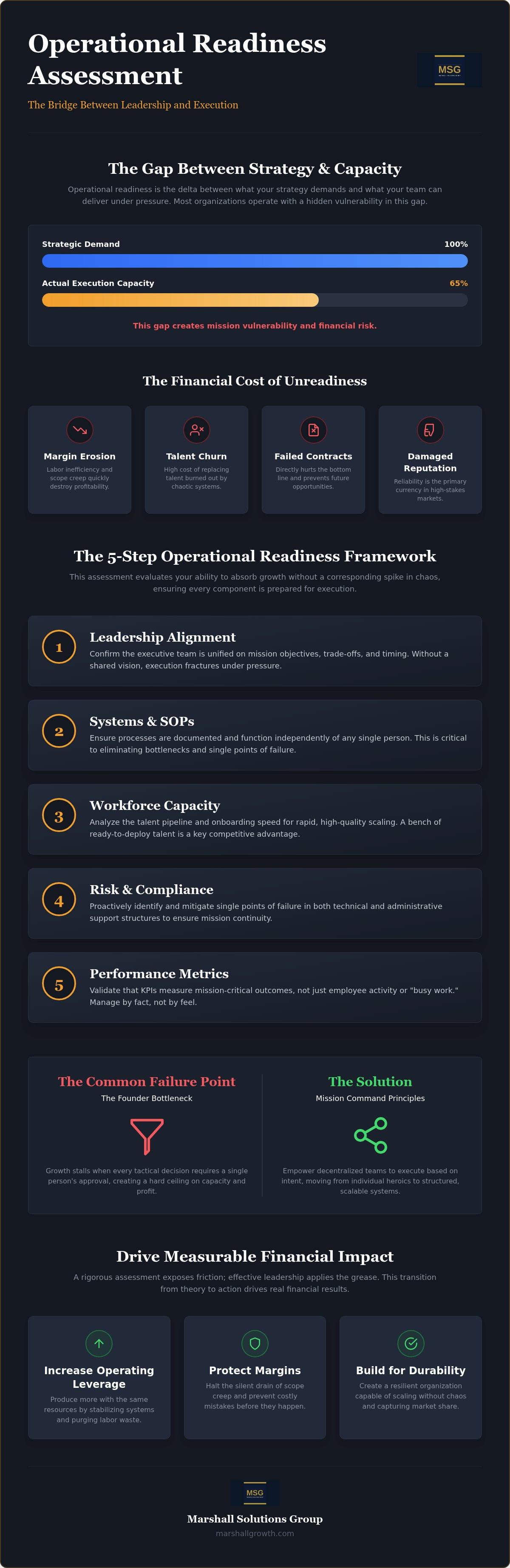
Operational readiness isn't a binary state or a checked box. It's the delta between what your strategy demands and what your team can actually deliver under pressure. Most organizations operate in a "Business as Usual" state, where systems handle routine tasks but buckle during growth surges or high-stakes program launches. Being "Mission Ready" requires a different level of structural integrity. It's the difference between a team that maintains the status quo and one that can execute a complex transformation without collapsing.
The financial cost of unreadiness is steep. When you lack a formal operational readiness assessment, you're essentially gambling with your EBITDA. Margin erosion happens quickly through labor inefficiency, scope creep, and the high cost of replacing talent. Failed contract delivery doesn't just hurt the bottom line; it destroys your reputation in markets where reliability is the primary currency. You can't scale a mess; you can only amplify it.
The Shift from Theoretical Strategy to Operator-Led Execution
Strategic plans often fail at the first point of contact with daily operations. They look good in a presentation but lack the mechanics for execution. We apply "Mission Command" principles to solve this, empowering decentralized teams to execute based on intent rather than waiting for permission from a bottlenecked founder. True operational readiness is the bridge between leadership intent and field-level execution. It ensures that every operator understands the objective and has the documented systems to achieve it. By prioritizing action over theory, you eliminate single points of failure and create a durable organization capable of scaling without chaos.
The 5-Step Operational Readiness Assessment Framework
Executing a high-stakes mission requires a repeatable architecture. A professional operational readiness assessment breaks down this organizational health into five critical domains. Without this data, you are managing by feel rather than by fact. We evaluate firms based on their ability to absorb growth without a corresponding spike in chaos. This framework ensures that every component of your organization is prepared for the next level of execution.
- Leadership Alignment: Confirm the executive team is unified on mission objectives, trade-offs, and timing.
- Systems & SOPs: Ensure processes are documented and function independently of any single person's head.
- Workforce Capacity: Analyze the talent pipeline and onboarding speed for rapid, high-quality scaling.
- Risk & Compliance: Identify single points of failure in both technical and administrative support structures.
- Performance Metrics: Validate that KPIs measure mission outcomes, not just employee activity or busy work.
Evaluating Organizational Capacity and Leadership Bench Strength
The "Founder Bottleneck" is the most common failure point we identify during an operational readiness assessment. Growth stalls when every tactical decision requires a single person's approval. This dependency creates a ceiling on your EBITDA and mission capacity. To break this cycle, you must treat workforce development as a proactive readiness tool. For federal contractors, having a bench of ready-to-deploy talent is the difference between winning a contract and being able to execute it effectively. You can reference our Leadership & Operations Assessment for a specific checklist on identifying these leadership gaps. Moving from individual heroics to structured systems is the only way to protect your margins during a surge. If you want to evaluate your firm's current capacity, a formal Leadership & Operations Assessment will provide the objective data needed to move forward. Measure the mission. Protect the margin. Build for durability.
Implementing Readiness to Drive Margin and Scalability
Identifying gaps is a waste of capital if you don't have the stomach for corrective action. A rigorous operational readiness assessment exposes the friction; leadership must then apply the grease. This transition drives real financial results. Operational efficiency is a direct contributor to EBITDA. It works by purging labor waste and halting the silent drain of scope creep. When systems are stabilized, operating leverage increases. You produce more with the same resources. This is how firms move from surviving to dominating their market.
During high-stakes transformations, the role of a Fractional COO becomes vital. They provide the structural stability needed to prevent systems from reverting to old, inefficient habits. They bridge the gap between high-level vision and daily output. This leadership layer ensures that the changes identified in your assessment actually take root in the organization's culture. It's about maintaining momentum when the initial excitement of a new strategy fades.
Bridging the Gap Between Intent and Execution with Embedded Support
Traditional consulting offers a map; embedded delivery provides the driver. We favor a "Skin in the Game" model because it ensures that strategy doesn't just sit in a slide deck. It lives in the field. For instance, firms have secured $10M enterprise contracts specifically because they proved their operational discipline through a readiness overhaul. They didn't just promise capacity; they demonstrated a repeatable, durable system. You can evaluate the financial consequences of these transitions in our Operational Performance Assessment guide. Readiness is the foundation of scale. Execution is the only strategy your customers actually see. Move beyond theory. Build for impact.
Securing Your Organization's Future Performance
Strategy is only as effective as the systems supporting it. A rigorous operational readiness assessment identifies the bottlenecks that drain margins and stall growth. By aligning your leadership team and documenting scalable SOPs, you move from founder dependency to professional execution. This transition isn't just about stability; it's about building the operating leverage required to handle high-stakes surges and complex federal contracts. Marshall Solutions Group provides the steady hand needed to bridge the gap between intent and results. As a veteran-owned, SDVOSB-certified firm with experience managing transformation programs exceeding $500M, we specialize in the mechanics of execution. We stay through the implementation to ensure your systems hold under pressure. It's time to stop guessing about your capacity and start building a durable, mission-ready organization.
Schedule a Leadership & Operations Assessment with Marshall Solutions Group to evaluate your firm's scalability and secure your next mission.
Frequently Asked Questions
What is the difference between an operational audit and a readiness assessment?
An operational audit looks backward at past compliance to find errors. An operational readiness assessment looks forward to evaluate your organization's capacity to execute a specific mission. One focuses on what happened; the other determines if you have the systems to handle what's coming next. It's about future performance, not historical record-keeping. Operators value capacity over mere compliance.
How long does a typical operational readiness assessment take?
The duration depends on the mission scope and the complexity of your current systems. A focused evaluation might take a few weeks. A comprehensive deep dive into a large enterprise can span several months. The goal isn't a fast checklist; it's a rigorous analysis of leadership, SOPs, and workforce capacity. We prioritize accuracy to ensure every single point of failure is identified.
Can a small business perform a readiness assessment without external help?
Small businesses can use internal frameworks to check SOPs. However, internal teams often struggle with the "Founder Bottleneck" because they're too close to the friction. An external operator brings the objective discipline needed to identify gaps leadership might overlook. Professional assessments provide the accountability required to transition from individual heroics to a structured system that functions without constant founder intervention.
How does operational readiness impact federal contract eligibility?
Operational readiness is a prerequisite for high-stakes federal programs. Prime contractors look for partners who demonstrate a "Mission Ready" state through documented processes and workforce stability. Being an SBA-certified SDVOSB strengthens your profile for teaming. However, a formal operational readiness assessment proves you can deliver on contract requirements without mission-impacting failures. Reliability remains the primary currency in federal procurement.
Disclaimer
The information provided in this article is for general informational and educational purposes only and does not constitute legal, financial, accounting, engineering, or other professional advice. Marshall Solutions Group, Inc. makes no representations or warranties regarding the completeness or applicability of this information to any specific situation. Readers should consult appropriately qualified professionals before making decisions requiring specialized professional advice.