Change Management in Business Process Improvement: An Operator-Led Guide
Marshall Solutions Group · reviewed by CJ Marshall
Stop BPI failure. Our operator-led guide to change management in business process improvement turns resistance into results. Learn to align teams and execute.

Article by
Chelvis “CJ” Marshall
Chelvis “CJ” Marshall is Founder & Managing Partner of Marshall Solutions Group, a management consulting firm specializing in Strategy & Operations, Organizational Leadership & Change, and Program & Project Management. A retired U.S. Navy Senior Chief who advanced from E-1 to E-8 in 10 years, CJ later transitioned into Fortune 500 enterprise leadership, negotiating more than $20M in contracts within three years. He brings operator-level experience leading teams, complex programs, and mission-critical operations. His work centers on being the bridge between leadership and execution—helping organizations translate strategic direction into disciplined execution, stronger accountability, and measurable results.
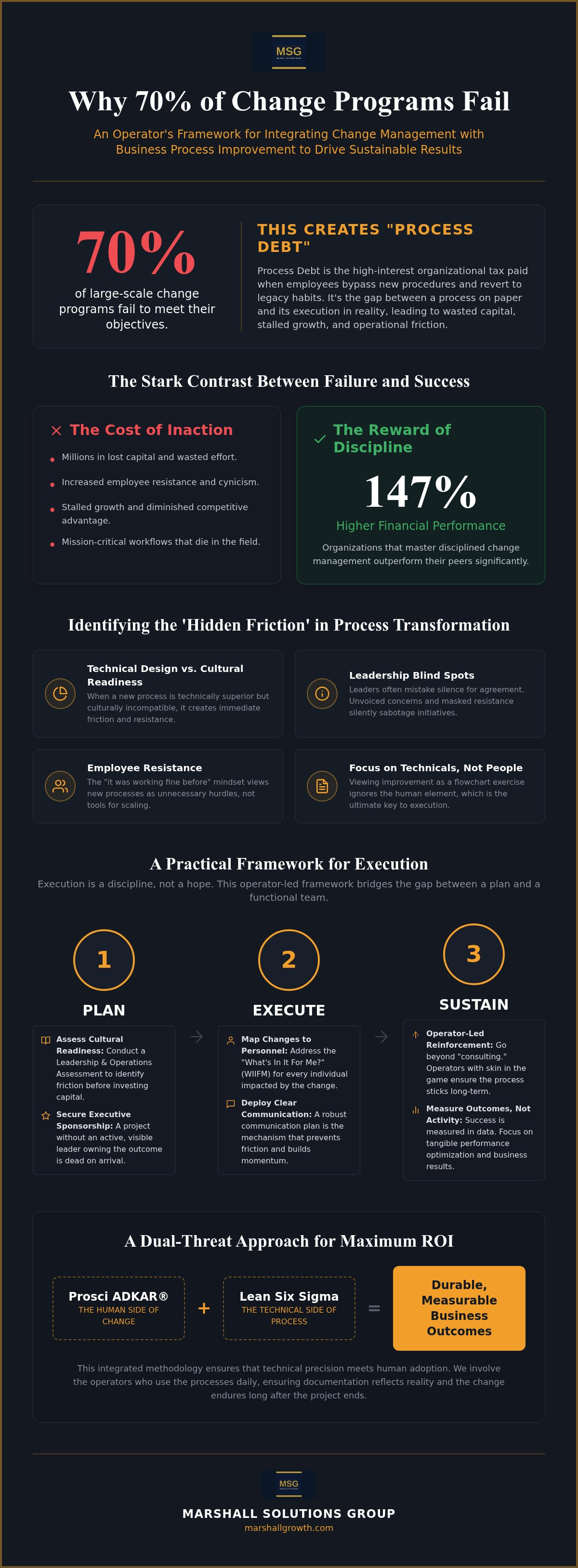
Seventy percent of large-scale change programs fail to meet their objectives. It's a staggering figure that represents millions in lost capital and wasted effort. You've likely felt this friction firsthand. You design a superior workflow on paper, but it dies in the field because the people responsible for execution won't adopt it. Integrating disciplined change management in business process improvement isn't a soft skill; it's the technical requirement for operational durability.
This guide provides an operator-led approach to eliminate process debt. Plan. Execute. Sustain. You'll learn how to align leadership, secure executive sponsorship, and implement a repeatable framework that turns employee resistance into high-stakes accountability. Organizations that master this discipline see financial performance that's 147% higher than their peers. We're moving past theory to focus on the mechanics of sustainable growth and measurable business outcomes.
Key Takeaways
- Eliminate process debt by identifying the friction points where new SOPs typically fail in mission-critical environments.
- Utilize a structured Leadership & Operations Assessment to verify cultural readiness before investing in complex workflow changes.
- Integrate disciplined change management in business process improvement to secure the executive sponsorship needed for sustainable, long-term growth.
- Shift from theoretical planning to an operator-led execution model that ensures zero mission-impacting failures during organizational transformations.
Table of Contents
Why Business Process Improvement Fails Without Strategic Change Management
Most leaders view Business Process Improvement (BPI) as a purely technical exercise. It isn't. It's a leadership challenge. When technical design outpaces cultural readiness, you incur "Process Debt." This is the high-interest tax paid when employees bypass new SOPs to revert to legacy habits. Integrating change management in business process improvement is the only way to ensure your new workflows actually survive the first week of implementation. Design. Implement. Sustain.
Think of your organization as an oil tanker. It carries massive inertia. You don't just "pivot" a mission-critical operation; you apply targeted, sustained leadership force to redirect it. We distinguish between adaptive change, which involves minor tweaks to existing flows, and transformational change. The latter often involves full-scale Business Process Re-engineering. Both require a disciplined operator to manage the transition. Effective change management in business process improvement ensures the tanker stays on its new course rather than drifting back to inefficient habits.
Identifying the 'Hidden Friction' in Process Transformation
Founder-led organizations often suffer from significant leadership blind spots. You might think your team is aligned, but silence isn't agreement. It's often masked resistance. Employees frequently believe that "things were working fine before," viewing new processes as unnecessary hurdles rather than scaling tools. This psychological friction stalls growth and burns capital. Change management is the bridge between technical process design and human execution. Without it, you aren't improving; you're just rearranging the deck chairs. Success requires more than a plan. It requires accountability.
A Practical Framework for Integrating Change Management into Process Lifecycles
Execution is a discipline, not a hope. Plan. Execute. Sustain. To successfully integrate change management in business process improvement, you need a repeatable framework that bridges the gap between a flowchart and a functional team. It starts with a Leadership & Operations Assessment to identify cultural readiness and operational friction. You can't fix a process if the culture is fundamentally broken. Next, secure active, visible executive sponsorship. Without a leader who owns the outcome, the project is dead on arrival.
Once the top is aligned, map technical process changes against the specific personnel they affect. This isn't just about software or steps; it's about the people who pull the levers. If you want to understand What Is Change Management in a practical, mission-critical sense, it's the act of addressing the "What's In It For Me" (WIIFM) for every associate. A clear communication plan isn't a luxury. It's the mechanism that prevents the friction that stalls most initiatives.
Aligning ADKAR with Lean Six Sigma for Maximum ROI
We don't believe in theoretical presentations. Our team utilizes Prosci ADKAR Practitioners and Lean Six Sigma Black Belts to ensure technical precision meets human adoption. This dual-threat approach ensures that change management in business process improvement isn't an afterthought. We develop SOPs by involving the operators who use them daily, ensuring the documentation reflects reality. This ground-up approach ensures the process sticks long after the project ends. Robust PMO support maintains governance during the transition, ensuring the new system doesn't collapse under operational pressure. You need a partner with skin in the game to navigate these high-pressure organizational transformations.
Sustaining Operational Excellence Through Operator-Led Leadership
Traditional consultants deliver a deck and disappear. We don't. We maintain skin in the game until the new process is fully integrated and producing results. This operator-led approach ensures that change management in business process improvement is a lived reality rather than a theoretical goal. Our veteran-led discipline, inherited from high-stakes military command, ensures zero mission-impacting failures during large-scale transformations. We prioritize execution. We prioritize durability.
Success is measured in data, not feelings. While an academic Change Management Process provides a foundational map, the actual terrain requires tactical adjustments. We move organizations toward measurable performance optimization by focusing on outcomes over activities. For federal agencies and prime contractors, MSG serves as a strategic partner for government program management consulting. We align your operational coordination with federal mandates to ensure every project meets its objective.
Building a Culture of Accountability and Continuous Improvement
Growth is volatile. Fractional leadership, including COO-level support, stabilizes your operation when internal systems start to strain under new demands. We leverage military-grade engineering experience to manage risk and compliance in complex sectors like biopharma and defense. We don't just suggest improvements; we embed them into your culture. Implementation is the highest form of strategy. This level of accountability ensures your investment in change management in business process improvement delivers a permanent and scalable competitive advantage.
Move From Strategy to Disciplined Execution
Process improvement is a technical design. Sustainable growth is a leadership discipline. By integrating disciplined change management in business process improvement, you eliminate the friction that turns new workflows into process debt. We've discussed how a structured framework and executive alignment move an organization from chaotic inertia to streamlined execution. Success requires more than a plan. It requires an operator who stays through implementation. Marshall Solutions Group brings 60+ years of military command and Fortune 500 experience to your mission. As an SBA-certified SDVOSB through June 2026, we maintain skin in the game to ensure your transformation produces measurable outcomes. Stop planning for change and start executing for results. Speak with Marshall Solutions Group about your operational transformation challenges. We're ready to help you build a more resilient, accountable organization.
Frequently Asked Questions
What is the difference between organizational change management and business process improvement?
Business process improvement focuses on the technical "how," such as optimizing workflows and reducing waste. Organizational change management focuses on the "who." It ensures your workforce actually adopts and executes those new systems. One designs the engine; the other trains the driver. Without the human side, your technical improvements remain theoretical documents that fail to produce measurable results.
How do I deal with employee resistance during a major process overhaul?
Address the "What's In It For Me" early and often. Resistance usually stems from a fear of incompetence or a perceived loss of control. Involve your operators in the design phase to build ownership. When change management in business process improvement is integrated into the lifecycle, you move from top-down mandates to a culture of high accountability and shared responsibility.
Why is executive sponsorship the #1 factor in successful change management?
Active sponsorship provides the resources and removes the roadblocks that stall middle management. If the executive suite isn't visible, the organization interprets the project as optional. Research indicates projects with excellent change management are six times more likely to meet objectives. Strong leadership signals that the transformation is a mission-critical priority rather than a temporary experiment or a corporate suggestion.
How can small businesses afford professional change management consulting?
Focus on the high cost of failure. With a 70% failure rate for large-scale changes, you can't afford to waste capital on a failed rollout. Investing in change management in business process improvement ensures your small business doesn't fall into that trap. Fractional leadership and targeted assessments provide operator-level expertise and disciplined execution without the overhead of a full-time executive hire.
Disclaimer
The information provided in this article is for general informational and educational purposes only and does not constitute legal, financial, accounting, engineering, or other professional advice. Marshall Solutions Group, Inc. makes no representations or warranties regarding the completeness or applicability of this information to any specific situation. Readers should consult appropriately qualified professionals before making decisions requiring specialized professional advice.