Building a PMO for Federal Projects: Operator-Led Guide
Marshall Solutions Group · reviewed by CJ Marshall
Stop letting compliance slow you down. Our guide to building a PMO for federal projects helps you improve execution, protect margins, and meet rigid standards.

Article by
Chelvis “CJ” Marshall
Chelvis “CJ” Marshall is Founder & Managing Partner of Marshall Solutions Group, a management consulting firm specializing in Strategy & Operations, Organizational Leadership & Change, and Program & Project Management. A retired U.S. Navy Senior Chief who advanced from E-1 to E-8 in 10 years, CJ later transitioned into Fortune 500 enterprise leadership, negotiating more than $20M in contracts within three years. He brings operator-level experience leading teams, complex programs, and mission-critical operations. His work centers on being the bridge between leadership and execution—helping organizations translate strategic direction into disciplined execution, stronger accountability, and measurable results.
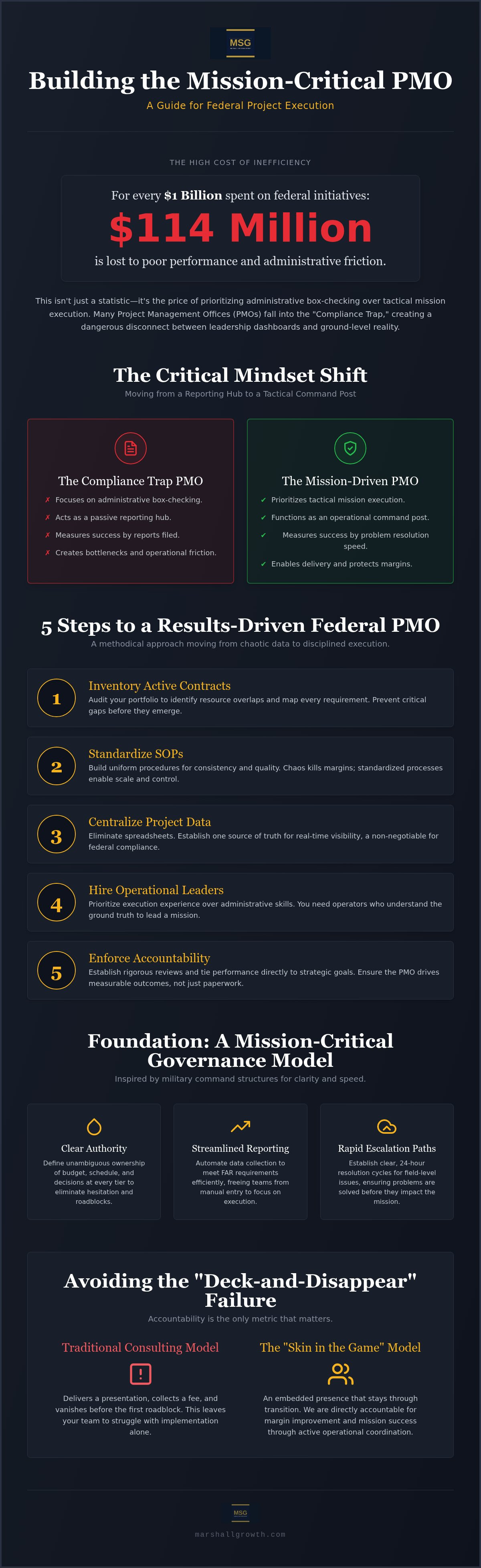
Every billion dollars spent on federal initiatives sees $114 million vanish into the void of poor performance. That isn't just a statistic. It's the literal price of administrative friction. You've likely seen how the weight of FAR requirements and complex reporting turns mission-critical operations into a slow-moving bureaucracy. Building a PMO for federal projects should solve this problem, not exacerbate it.
You need a tactical command post that prioritizes mission execution over simple box-checking. This guide shows you how to establish a Project Management Office that satisfies rigid federal standards while maintaining the operational speed required for success. We'll move beyond theory to build a structured governance model that improves resource allocation and protects your margins through disciplined, operator-led execution. It's time to stop letting compliance slow down your delivery and start using structure as a competitive advantage.
Key Takeaways
- Avoid the "Compliance Trap" by shifting your PMO’s focus from administrative box-checking to tactical mission execution.
- Learn the five essential steps for building a PMO for federal projects, starting with a rigorous inventory of active contracts and resource overlaps.
- Eliminate the "deck-and-disappear" consulting failure by implementing an accountability model where your PMO maintains skin in the game.
- Drive measurable margin improvement through standardized SOPs that satisfy rigid FAR requirements without sacrificing operational speed.
Table of Contents
Why Federal PMOs Fail: Moving Beyond Compliance Paperwork
Most federal PMOs die in the "Compliance Trap." They prioritize filling out FAR paperwork over hitting mission milestones. This creates a dangerous disconnect. Leaders see green dashboards while field operations struggle with resource gaps and tactical friction. Building a PMO for federal projects requires moving beyond the role of a passive observer. You can't manage a high-stakes contract from a spreadsheet alone. It requires presence. It requires a deep understanding of the ground truth.
A standard Project Management Office (PMO) often falls into three categories: supportive, controlling, or directive. Supportive models provide templates but lack teeth. Controlling models demand compliance but lack context. Directive models take the lead. For federal contracts, a directive approach is usually necessary to ensure accountability across complex, multi-year programs. A mission-critical PMO is an operational command post rather than a reporting hub.
Establishing a Mission-Critical Governance Model
Execution fails when authority is vague. Your governance should mirror military command structures; every team member must know exactly who makes the call when a project hits a roadblock. Effective federal program management balances this oversight with operational flexibility. You need a framework that satisfies federal auditors without strangling your site leads in red tape. Focus on these core pillars:
- Clear Authority: Define who owns the budget and the schedule at each tier.
- Streamlined Reporting: Automate data collection to meet FAR requirements without manual double-entry.
- Escalation Paths: Establish 24-hour resolution cycles for field-level issues.
Strategy and field execution disconnect when the PMO acts as a gatekeeper instead of an enabler. Stop measuring success by the number of reports filed. Start measuring it by the speed of problem resolution and the protection of your contract margins.
5 Steps to Building a Results-Driven Federal PMO
Building a PMO for federal projects isn't a software implementation. It's a strategic realignment. Success requires a methodical approach that moves from chaotic data to disciplined execution. Follow these five steps to establish a command post that delivers results rather than just reports.
- Step 1: Inventory active contracts. Audit your portfolio. Identify resource overlaps. Map every requirement to prevent mission-critical gaps.
- Step 2: Standardize SOPs. Build uniform procedures. Chaos kills margins. Consistency allows your team to scale without losing operational control.
- Step 3: Centralize project data. Kill the spreadsheets. You need one source of truth. Real-time visibility is non-negotiable for federal compliance.
- Step 4: Hire operational leaders. Prioritize execution experience. Administrative clerks can't lead a mission. You need operators who understand the ground truth.
- Step 5: Enforce accountability. Establish rigorous reviews. Tie performance to strategy. Ensure the PMO drives measurable business outcomes, not just paperwork.
Aligning FAR Compliance with Operational Speed
Compliance shouldn't be an afterthought. Integrate FAR checks directly into your daily workflows. Treating them as a post-project audit is a recipe for failure. Use Lean Six Sigma principles to strip away administrative waste. This ensures your reporting cycles are lean, fast, and accurate. A Strategic Gov Program Management approach ensures your PMO supports the mission rather than hindering it. If your current structure feels like a bottleneck, consider a Leadership & Operations Assessment to identify exactly where friction is killing your margins.
Executing the Transition: From Static Planning to Operator-Led Delivery
The biggest failure in federal contracting is the deck-and-disappear model. Traditional consultants deliver a presentation, collect their fee, and vanish before the first roadblock appears. This leaves your team to struggle with implementation alone. Building a PMO for federal projects requires a different approach. It demands an embedded presence that stays through the transition to ensure strategy translates into ground-level results.
You need a skin in the game model. Your PMO should be directly accountable for margin improvement and mission success. This isn't just about administrative oversight; it's about active operational coordination that identifies risks before they impact the bottom line. When building a PMO for federal projects, accountability is the only metric that matters. Transitioning your organization requires structured change management. Use frameworks like Prosci ADKAR to move your workforce from awareness to ability. Without this, new systems become expensive shelfware. Effective management consulting services don't just plan; they execute alongside your leadership team until the new standard is the only standard.
Leveraging SDVOSB Partners for Strategic Advantage
Veteran-led expertise brings a level of discipline that's rare in corporate advisory. Teaming with an SBA-certified SDVOSB like MSG provides more than just socioeconomic set-aside points for prime contract bids. It provides a partner who understands the chain of command and the urgency of the mission. Following government contract management best practices means choosing partners who value execution as the highest form of strategy. We don't just advise. We operate.
From Administrative Overhead to Mission Success
Building a PMO for federal projects is more than a compliance exercise. It's an operational necessity for protecting your contract margins. You've learned that moving beyond the Compliance Trap requires a shift in focus from administrative paperwork to tactical mission execution. By standardizing SOPs and centralizing your project data, you eliminate the friction that causes federal programs to stall. Success requires an embedded partner who stays through the implementation phase to ensure accountability.
Marshall Solutions Group brings 60+ years of combined mission-critical leadership. As an SBA-certified SDVOSB, we provide the disciplined, operator-led oversight your organization needs to move from static planning to results-driven delivery. Speak with Marshall Solutions Group about your federal program challenges today. It's time to turn your PMO into a tactical command post that drives real performance. You have the mission; we'll provide the structure to win it.
Frequently Asked Questions
What is the difference between a project manager and a PMO in federal contracting?
A Project Manager owns the tactical execution of a single contract. The PMO serves as the strategic command post managing your entire portfolio. While a PM focuses on daily milestones, the PMO ensures standardized reporting, resource allocation, and risk mitigation across all federal programs. It provides the oversight and governance that individual PMs need to remain consistent with organizational strategy.
How long does it take to stand up a fully functional federal PMO?
Establishing a functional framework typically takes 90 days, but full operational maturity often requires six months. Building a PMO for federal projects isn't a race; it's about establishing durable systems. Initial phases focus on auditing active contracts and resource gaps. Later phases involve implementing a single source of truth for project data and training the workforce on new accountability standards.
Does a PMO help with FAR and DFARS compliance?
Yes. A PMO centralizes compliance by integrating FAR and DFARS requirements directly into the project lifecycle. Instead of treating audits as a post-project panic, the PMO establishes standardized SOPs that ensure every report and milestone meets federal standards. This proactive approach reduces legal risk and protects your contract margins from the high cost of non-compliance and administrative friction.
What are the benefits of partnering with an SDVOSB for PMO support?
Partnering with an SDVOSB like MSG provides both strategic and socioeconomic advantages. You gain access to federal set-asides while benefiting from a leadership team with 60+ combined years of mission-critical experience. Veteran-led teams prioritize disciplined execution over theory. They understand the chain of command and have the resilience to manage complex systems under high-pressure federal environments.
Disclaimer
The information provided in this article is for general informational and educational purposes only and does not constitute legal, financial, accounting, engineering, or other professional advice. Marshall Solutions Group, Inc. makes no representations or warranties regarding the completeness or applicability of this information to any specific situation. Readers should consult appropriately qualified professionals before making decisions requiring specialized professional advice.