Government Contract Management Best Practices: An Operator’s Guide to Federal Execution
Marshall Solutions Group · reviewed by CJ Marshall
Master government contract management best practices. This operator's guide helps you align teams, mitigate risk, and ensure disciplined federal execution.

Article by
Chelvis “CJ” Marshall
Chelvis “CJ” Marshall is Founder & Managing Partner of Marshall Solutions Group, a management consulting firm specializing in Strategy & Operations, Organizational Leadership & Change, and Program & Project Management. A retired U.S. Navy Senior Chief who advanced from E-1 to E-8 in 10 years, CJ later transitioned into Fortune 500 enterprise leadership, negotiating more than $20M in contracts within three years. He brings operator-level experience leading teams, complex programs, and mission-critical operations. His work centers on being the bridge between leadership and execution—helping organizations translate strategic direction into disciplined execution, stronger accountability, and measurable results.
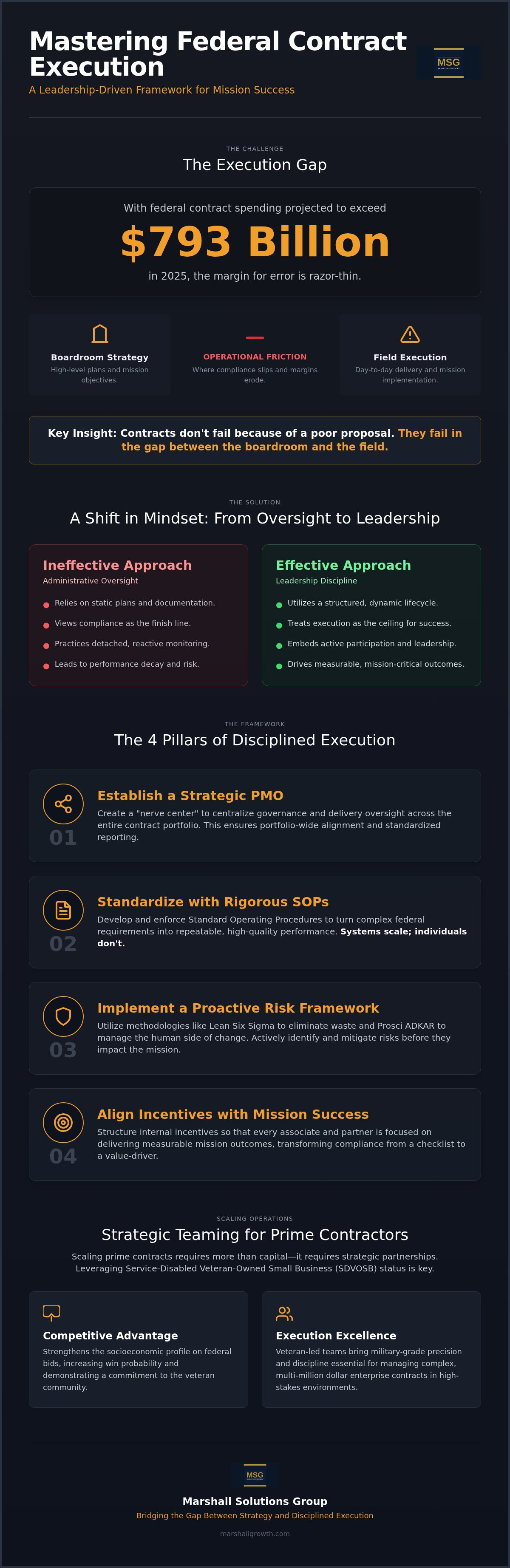
Most federal contracts don't fail because of a poor proposal. They fail because the distance between the boardroom and the field is too wide. You know the feeling of operational friction. It's the gap where compliance standards slip and margins erode while your team struggles to scale. With federal contract spending exceeding $793 billion in 2025, the margin for error is razor thin. Managing these programs isn't about administrative oversight; it's about disciplined execution.
This guide outlines the government contract management best practices used by veteran-led teams to mitigate risk and drive mission-critical performance. We'll show you how to move from a static plan to a structured lifecycle approach that turns regulatory requirements into a strategic advantage. You'll learn to align your people and processes to ensure every deliverable meets the mission while protecting your organization from costly failures.
Key Takeaways
- Move beyond administrative oversight by treating contract management as a leadership discipline that aligns strategy with field execution.
- Discover how a strategic Project Management Office (PMO) serves as the nerve center for implementing government contract management best practices and ensuring portfolio-wide governance.
- Eliminate operational friction and regulatory risk by developing standardized SOPs that turn complex federal requirements into repeatable, high-quality performance.
- Strengthen your competitive position through strategic teaming and SDVOSB certifications to scale operations without sacrificing compliance or mission outcomes.
Table of Contents
The Architecture of Government Contract Management: A Leadership Discipline
Government contract management isn't a back-office administrative function. It's a centralized leadership discipline that aligns strategy, people, and processes toward a single goal: mission success. Effective contract management requires an operator's mindset that prioritizes accountability over simple documentation. While many firms treat Federal Acquisition Regulation (FAR) and DFARS compliance as the finish line, high-performing contractors recognize these as the bare minimum baseline for entry. Compliance is the floor. Execution is the ceiling.
To better understand how these elements integrate into a cohesive strategy, watch this overview:
Real-world execution demands a "skin-in-the-game" model. This isn't about delivering a slide deck and walking away. It's about embedding leadership into the implementation process to navigate high-pressure environments. By integrating government contract management best practices into daily operations, leaders can bridge the gap between high-level strategy and field-level execution. This approach replaces detached oversight with active participation, ensuring performance stays aligned with original mission intent. It's the difference between watching a program and driving it.
Moving Beyond Compliance to Mission Execution
Federal programs frequently stall during the transition from planning to tactical implementation. This failure usually stems from a lack of operational coordination between the boardroom and the field. True federal program management requires more than a good plan; it demands disciplined leadership to manage large-scale, multi-site modernization programs. Without an advisory model that focuses on measurable outcomes, even the best strategy will fail under the weight of operational friction. Success relies on leadership-led oversight that stays through final delivery, ensuring every process change translates into mission-critical reliability. We don't just plan for success; we stay until it's achieved.
5 Essential Best Practices for Federal Contract Execution
Effective execution requires a strategic nerve center. Establish a Project Management Office (PMO) to centralize governance and delivery oversight across your entire portfolio. This isn't just about tracking deadlines; it's about establishing repeatable, high-quality performance. Standardize your business processes by developing rigorous Standard Operating Procedures (SOPs). Without these, performance is tied to individuals rather than the system. Systems scale; people don't.
Implement a proactive risk and compliance framework using methodologies like Lean Six Sigma to strip out waste and Prosci ADKAR to manage the human side of change. Align your internal incentives so every associate stays focused on measurable mission success. If your team isn't incentivized for performance, compliance becomes a box-checking exercise rather than a value driver. These government contract management best practices prevent the operational decay that often kills margins in multi-year programs. Discipline drives durability.
Optimizing Performance and Margin Through Process Improvement
Execution gaps often hide in plain sight. Specialized management consulting services identify these friction points before they erode your bottom line. Watch for red flags like fragmented communication, siloed data, or a lack of clear accountability. High-performing primes track mission impact metrics alongside on-time delivery. This creates a culture of disciplined execution where results are the only currency. If your current systems are failing to scale, it's time to evaluate your operational alignment with an embedded partner who understands high-stakes environments.
Strategic Teaming and Scaling for Prime Contractors
Scaling a prime contract requires more than just capital. It requires strategic teaming. Leveraging Service-Disabled Veteran-Owned Small Business (SDVOSB) status strengthens your socioeconomic profile on federal bids, but the real value lies in the execution discipline. Partnering with veteran-led teams brings a level of military-grade precision essential for managing multi-million dollar enterprise contracts in high-stakes sectors like aerospace and defense. These operators manage complex logistics and engineering program support across multiple countries, ensuring that government contract management best practices are integrated into every layer of the operation.
Sustainable growth depends on proactive workforce development. You must ensure internal teams are capable of sustaining long-term program outcomes after the initial deployment surge. This requires building systems that survive personnel turnover and geographic shifts. By applying structured frameworks to complex operations, you transform a chaotic growth phase into a disciplined, scalable organization that delivers on its promises every time. Systems don't blink under pressure. People do.
Bridging the Execution Gap with a Leadership Assessment
Leaders often hit a ceiling where their current processes can't support their growth. A Leadership & Operations Assessment serves as a critical audit of your operational effectiveness. It identifies exactly where your strategy is losing momentum before it impacts the mission. Veteran-led PMO support stabilizes founder-led organizations during these periods of rapid expansion by providing an outside perspective grounded in real-world command. Don't settle for consultants with only theoretical training. Choose partners with direct operational command experience who have navigated real-world friction. Applying these government contract management best practices ensures your organization remains mission-ready, regardless of the program's scale.
Move from Planning to Disciplined Execution
Federal execution isn't a paperwork exercise; it's a test of operational discipline. Success requires moving beyond simple compliance to a structured system that aligns your people, processes, and strategy around measurable outcomes. Implementing government contract management best practices eliminates the friction that causes mission failure and margin erosion. You've seen how a strategic PMO and veteran-led teaming stabilize complex aerospace and defense programs.
We bring 60+ years of combined leadership experience and a proven track record overseeing $500M federal transformation programs. As an SBA-certified SDVOSB and VOSB, Marshall Solutions Group doesn't just deliver advice. We embed with your team to drive performance and accountability. Speak with Marshall Solutions Group about your program management challenges to secure your next mission. Your organization has the plan; we provide the discipline to see it through.
Frequently Asked Questions
What are the core differences between commercial and government contract management?
Government contract management is governed by the Federal Acquisition Regulation (FAR) and strict audit requirements that don't exist in the commercial sector. While commercial deals focus on mutual agreement, federal contracts are sovereign acts with unilateral change rights. You must manage performance under intense public scrutiny and rigid compliance standards. Failure to adapt to these regulatory frameworks leads to mission failure and severe penalties.
How can a PMO help a federal contractor manage risk and compliance?
A Project Management Office (PMO) serves as the strategic nerve center for delivery oversight. It standardizes government contract management best practices by creating a single source of truth for portfolio performance. By centralizing governance, the PMO identifies execution gaps before they become regulatory failures. This structured approach ensures every deliverable meets mission standards while protecting the prime contractor from operational risk.
Why is SDVOSB certification important for government contract management best practices?
SDVOSB certification is a powerful tool for strategic teaming and meeting agency socioeconomic goals. It provides a competitive advantage during the bidding process, especially for set-aside contracts. Beyond the label, veteran-led teams bring military-grade discipline to the implementation phase. This alignment of status and execution capability ensures prime contractors can scale operations without sacrificing the precision required for federal compliance.
What role does Lean Six Sigma play in federal program execution?
Lean Six Sigma provides a methodical framework for stripping waste out of complex federal programs. In high-stakes environments, every unnecessary step is a point of potential failure. By applying these principles, contractors improve their margins through process optimization and measurable performance gains. It turns government contract management best practices into a repeatable system that drives mission-critical reliability across multi-million dollar enterprise contracts.
Disclaimer
The information provided in this article is for general informational and educational purposes only and does not constitute legal, financial, accounting, engineering, or other professional advice. Marshall Solutions Group, Inc. makes no representations or warranties regarding the completeness or applicability of this information to any specific situation. Readers should consult appropriately qualified professionals before making decisions requiring specialized professional advice.