Strategy to Action: Operator's Execution Guide (2026)
Marshall Solutions Group · reviewed by CJ Marshall
Learn how to translate strategy into action with our guide. Bridge the execution gap and drive results with a disciplined framework for operational alignment.

Article by
Chelvis “CJ” Marshall
Chelvis “CJ” Marshall is Founder & Managing Partner of Marshall Solutions Group, a management consulting firm specializing in Strategy & Operations, Organizational Leadership & Change, and Program & Project Management. A retired U.S. Navy Senior Chief who advanced from E-1 to E-8 in 10 years, CJ later transitioned into Fortune 500 enterprise leadership, negotiating more than $20M in contracts within three years. He brings operator-level experience leading teams, complex programs, and mission-critical operations. His work centers on being the bridge between leadership and execution—helping organizations translate strategic direction into disciplined execution, stronger accountability, and measurable results.
Strategy is cheap. Execution is everything. Research indicates that up to 90% of strategic initiatives stall before they ever reach the frontline. The real challenge isn't the vision; it's knowing how to translate strategy into action without losing momentum or clarity. You've likely felt the friction when a high-level kickoff meets the cold reality of daily operations. It's frustrating to watch a solid plan dissolve because of a lack of accountability or a disconnect in leadership teams. You need a system that actually delivers.
This guide provides the disciplined framework veteran leaders use to bridge the gap and drive measurable results. We'll examine the mechanics of operational alignment and the specific systems required to build a culture of relentless execution. Stop planning and start operating. It's time to turn your executive vision into a clear roadmap for performance.
Key Takeaways
- Identify the "Execution Gap" where intent fails to become tactical tasks and learn to eliminate the three primary killers of strategic momentum.
- Master a disciplined five-step framework for how to translate strategy into action by creating measurable, operator-level objectives that drive daily performance.
- Break departmental silos by aligning your organizational structure and resource allocation directly with your most critical strategic goals.
- Build a sustainable engine for delivery through a PMO governance model and leadership incentives that prioritize shared responsibility and measurable outcomes.
Table of Contents
Decoding the Execution Gap: Why Strategic Plans Stumble
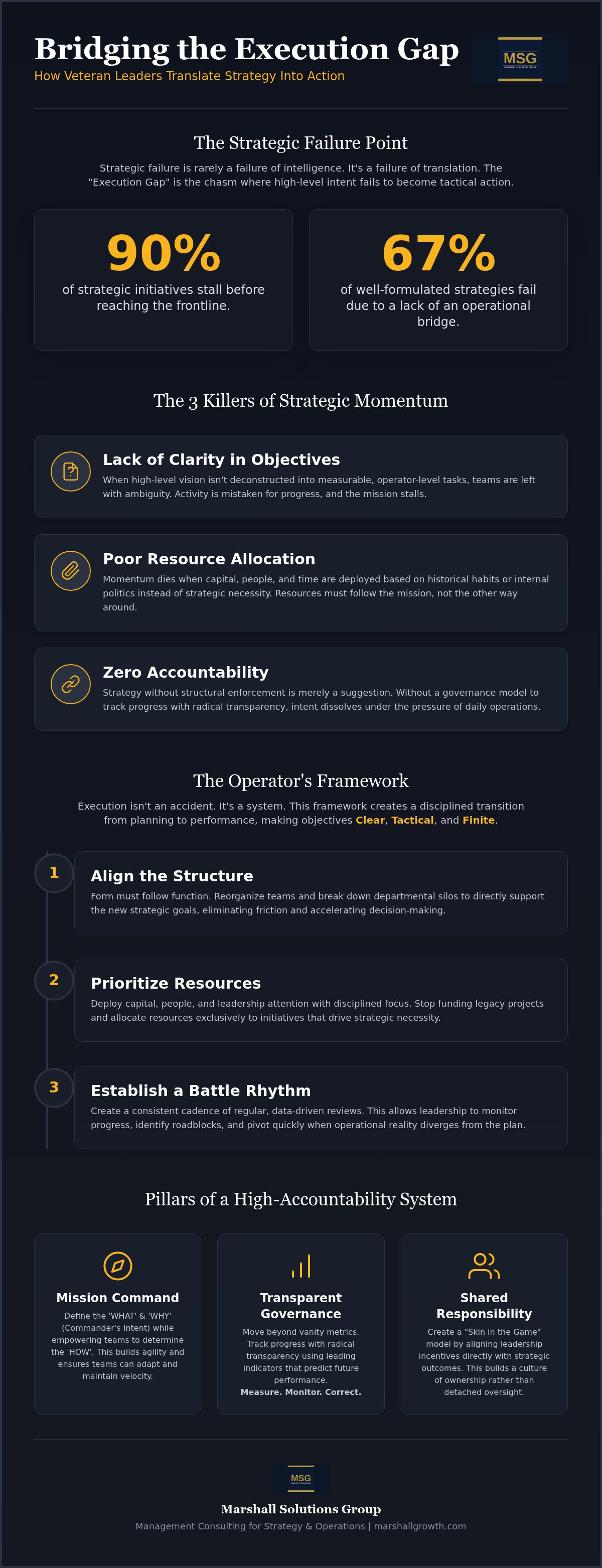
Strategic failure is rarely a failure of intelligence. It's a failure of translation. While Strategic planning produces the vision, the execution gap represents the chasm where high-level intent fails to become tactical tasks. Research from 2026 shows that 67% of well-formulated strategies fail because they lack an operational bridge. To understand how to translate strategy into action, you must first identify the specific friction points slowing your progress.
Three common killers stifle momentum: a lack of clarity in objectives, poor resource allocation, and zero accountability. Traditional top-down management often relies on rigid directives that crumble under pressure. Clarity. Alignment. Results. A results-oriented execution model focuses on measurable outcomes rather than activity for its own sake. Performing a Leadership & Operations Assessment is the essential first step to diagnosing these structural weaknesses before they derail your mission.
Adopting Mission Command: Leadership for High-Stakes Environments
In mission-critical sectors, we utilize Mission Command. This framework provides the "what" and "why" while empowering the team to determine the "how." It relies on "commander’s intent" to ensure teams remain agile when reality deviates from the plan. Veteran leaders prioritize discipline and reliability over theoretical models. By focusing on the intent rather than a rigid checklist, you ensure your organization can adapt and maintain velocity in high-pressure environments. This isn't just management; it's operational coordination that demands high accountability at every level.
The Operator’s Framework: 5 Steps to Tactical Alignment
Execution isn't an accident. It's a system. Understanding how to translate strategy into action requires moving beyond the boardroom and into the mechanics of daily work. High-level intent must be deconstructed into operator-level objectives that are measurable and time-bound. Clear. Tactical. Finite. Without this translation, your strategy is just a collection of hope. This framework demands a disciplined transition from planning to performance.
- Align the Structure: Form must follow function. Reorganize teams to support new strategic goals and eliminate departmental silos that stifle speed.
- Prioritize Resources: Deploy capital, people, and time based on strategic necessity. Stop funding projects based on historical habit or political influence.
- Establish a Battle Rhythm: Create a cadence of regular reviews. This allows leadership to monitor progress and pivot quickly when the original plan meets operational reality.
This methodical approach ensures every team member knows their specific role in the mission. It replaces ambiguity with a disciplined path toward measurable results. It builds the foundation for long-term scalability and operational excellence.
Bridging the Gap with Standard Operating Procedures (SOPs)
Strategy without SOPs is merely a suggestion. Under stress, teams don't rise to the level of their goals; they fall to the level of their systems. Integrating change management in business process improvement ensures that new tactical actions become permanent habits. We map high-level strategic goals to specific, repeatable workflows for the frontline. This creates a durable environment where execution is the default. If your current processes are failing to deliver, a tailored Strategy & Operations Consulting engagement can provide the structural integrity your organization needs.
Establishing Governance and High-Accountability Systems
Strategic intent dies without structural enforcement. Accountability isn't a cultural aspiration; it's a mechanical requirement. To master how to translate strategy into action, you must establish a governance model that tracks progress with radical transparency. This means moving beyond vanity metrics that look good in board meetings and focusing on leading indicators that predict future performance. Measure. Monitor. Correct. Establishing this governance is the final step in learning how to translate strategy into action.
Identifying where these systems are failing is the purpose of an Operational Performance Assessment. It pinpoints exactly where accountability breaks down between leadership and the frontline. Effective execution also requires a "Skin in the Game" model. Leaders must have incentives directly aligned with strategic outcomes, ensuring they're as invested in the result as the organization itself. This creates a culture of shared responsibility rather than detached oversight.
The Role of the PMO in Strategy Delivery
The Program Management Office (PMO) serves as the engine room of strategic delivery. We contrast a passive, administrative PMO with an active, execution-focused unit that drives results. By adapting federal program management best practices for mid-market industrial firms, you gain the rigor of high-stakes oversight. A veteran-led PMO provides senior-level delivery oversight, managing cross-functional risks and ensuring the original intent remains the priority. It's the steady hand that keeps complex initiatives on track when operational friction increases.
Mastering the Mission: From Intent to Impact
Success isn't found in a polished deck; it's earned through disciplined implementation. You now understand the mechanics of the execution gap and the necessity of operator-level objectives. By integrating standard operating procedures and high-accountability governance, you ensure your vision becomes a measurable reality. Learning how to translate strategy into action is the difference between a stagnant organization and a scalable operation. Don't let your strategic plan sit on a shelf while your competitors execute.
Marshall Solutions Group brings 60+ years of combined military and Fortune 500 leadership experience to your organization. As a Service-Disabled Veteran-Owned Small Business (SDVOSB), we don't just advise; we embed as your execution partner. Stop planning and start executing. Contact Marshall Solutions Group today for an operator-led assessment of your strategic alignment. It's time to build a culture of relentless accountability and drive the results your leadership demands.
Frequently Asked Questions
Why do most strategic plans fail during implementation?
Strategic plans fail when there's a disconnect between executive vision and frontline reality. Many initiatives stall because they lack a structured framework for tactical implementation. Leaders often prioritize the "what" but neglect the "how," leaving teams without clear ownership or the necessary resources. Without disciplined systems to manage daily tasks, the original intent dissolves under the pressure of operational friction.
How do you measure the success of strategic execution?
Success is measured by the velocity of tactical task completion and the alignment of leading indicators with long-term goals. You must move beyond vanity metrics and track the specific outcomes of operator-level objectives. Regular reviews and radical transparency in reporting allow you to identify performance gaps. These measurable results prove that your operational systems are successfully driving the organization toward its strategic vision.
What is the difference between strategic planning and strategic execution?
Strategic planning defines the destination and the theoretical path to get there. Strategic execution is the mechanical process of driving the organization forward through daily action. While planning focuses on the roadmap, execution is about how to translate strategy into action by aligning people, processes, and leadership around measurable tasks. Planning is the intent; execution is the disciplined reality of achieving the mission.
How can a Fractional COO help translate strategy into action?
A Fractional COO serves as an embedded operator who stabilizes and scales your internal systems. They provide the senior-level oversight needed to manage daily operations, develop robust SOPs, and drive process improvement. This partnership bridges the gap between high-level planning and frontline delivery. By instilling a culture of accountability, a Fractional COO ensures your strategic goals are converted into repeatable, high-performance workflows.
Disclaimer
The information provided in this article is for general informational and educational purposes only and does not constitute legal, financial, accounting, engineering, or other professional advice. Marshall Solutions Group, Inc. makes no representations or warranties regarding the completeness or applicability of this information to any specific situation. Readers should consult appropriately qualified professionals before making decisions requiring specialized professional advice.