Strategic Planning for Execution: Operator’s Guide 2026
Marshall Solutions Group · reviewed by CJ Marshall
Turn your strategic planning into reality. Our 2026 operator's guide provides a framework to align your team, drive execution, and achieve measurable results.

Article by
Chelvis “CJ” Marshall
Chelvis “CJ” Marshall is Founder & Managing Partner of Marshall Solutions Group, a management consulting firm specializing in Strategy & Operations, Organizational Leadership & Change, and Program & Project Management. A retired U.S. Navy Senior Chief who advanced from E-1 to E-8 in 10 years, CJ later transitioned into Fortune 500 enterprise leadership, negotiating more than $20M in contracts within three years. He brings operator-level experience leading teams, complex programs, and mission-critical operations. His work centers on being the bridge between leadership and execution—helping organizations translate strategic direction into disciplined execution, stronger accountability, and measurable results.
Roughly 84.5% of strategic projects fail to reach completion. It's a staggering waste of capital and momentum that leaves most leaders wondering where their vision went wrong. You've likely felt the frustration of a strategic planning session that produces a thick binder but zero operational change. When the executive suite and the front lines aren't aligned, resources vanish into low-impact initiatives while "phantom owners" make no real progress. It's the difference between having a map and actually driving the vehicle.
We're moving beyond academic theory to provide a battle-tested framework for 2026. This guide delivers a clear roadmap to turn high-level strategy into disciplined operational execution. You'll learn how to unify your leadership, fix misaligned processes, and drive measurable performance gains that actually stick. We'll explore the mechanics of accountability and the specific steps required to bridge the gap between a visionary goal and a successful result.
Key Takeaways
- Identify the primary killers of organizational momentum and learn why vision without a disciplined execution framework remains a costly hallucination.
- Discover how to establish an operational baseline using a Leadership & Operations Assessment to ensure your 2026 roadmap is grounded in reality.
- Master a five-step strategic planning process that prioritizes mission-critical outcomes over vague growth targets and unassigned goals.
- Learn to embed high accountability into daily operations by translating high-level strategy into tactical Standard Operating Procedures for your front-line teams.
Table of Contents
Beyond the Document: Why Strategic Planning Often Stalls
Many leaders treat what strategic planning is as a static annual event, but vision without execution is just an expensive hallucination. This is the "Deck-and-Disappear" trap. Traditional consultants deliver a polished presentation and then exit the building, leaving your team to navigate the complex implementation alone. You don't need another binder; you need a system that survives contact with the real world. Strategy typically stalls because it meets three primary killers: a lack of cross-functional alignment, insufficient resource allocation, and zero accountability for measurable outcomes. When these pillars are missing, your plan is destined to collect dust on a shelf.
The Execution Gap is the persistent disconnect between executive intent and operational reality.
To better understand why plans often fail to become reality, watch this breakdown of strategy versus planning:
The Execution Gap: Theory vs. Operational Reality
Mid-sized firms and federal contractors often struggle to move from high-level strategy to cross-functional execution. Silos develop, and departments begin working at cross-purposes, which creates massive operational drag. When executives aren't on the same page, the front lines receive mixed signals, leading to wasted resources on low-impact tasks. Identifying these tactical friction points requires a leadership blind spots assessment to reveal where communication breaks down and where accountability is absent. Fragmented leadership teams are the silent killers of strategic momentum. Success in strategic planning requires moving beyond intent to build a unified front that can withstand the pressures of daily operations.
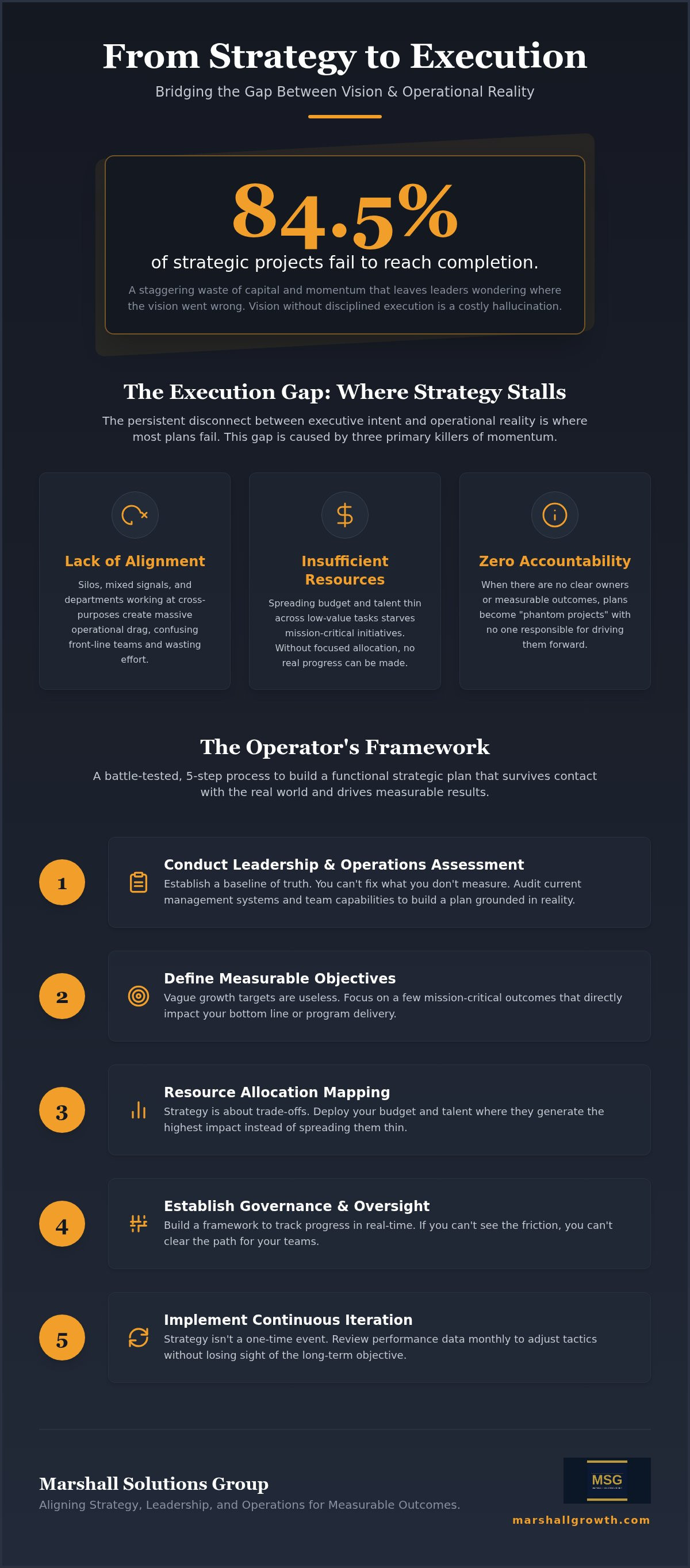
The Operator’s Framework: 5 Steps to a Functional Strategic Plan
Building a resilient organization requires more than vision. It requires a structured path. The Operator’s Framework connects high-level intent to the mechanics of daily delivery. This isn't academic; it's tactical. Every component must drive toward a measurable outcome, ensuring that your plan survives the friction of real-world implementation.
- Step 1: Conduct a Leadership & Operations Assessment. You can't fix what you don't measure. Establish a baseline of truth by auditing your current management systems and team capabilities.
- Step 2: Define measurable objectives. Vague growth targets are useless. Focus on mission-critical outcomes that directly impact your bottom line or program delivery.
- Step 3: Resource allocation mapping. Strategy is about trade-offs. Deploy your budget and talent where they generate the highest impact. Don't spread resources thin across low-value tasks.
- Step 4: Establishing a Governance and Delivery Oversight model. Build a framework to track progress in real-time. If you can't see the friction, you can't clear the path.
- Step 5: Continuous Iteration. Strategy isn't a one-time event. Review performance data monthly to adjust tactics without losing sight of the long-term objective.
Phase 1: Operational Assessment and Environmental Analysis
A basic SWOT analysis isn't enough for high-stakes environments. You need a deep-dive into organizational management and workforce development. This phase identifies Risk and Compliance factors that could derail long-term program execution, especially for federal contractors navigating shifting regulatory mandates. Your Mission Statement must be more than a plaque on the wall. It should serve as a tactical North Star for the entire organization. If your current strategic planning feels disconnected from the front lines, it's time to evaluate your operational alignment with an embedded partner who understands the stakes.
Embedding Accountability: Transforming Strategy into Daily Operations
Accountability is the engine of execution. Without it, even the most rigorous strategic planning remains a theoretical exercise. High-performing teams don't emerge by accident; they're built through intentional organizational leadership consulting that prioritizes ownership over activity. You must translate vision into Standard Operating Procedures (SOPs) that define daily tactical actions. When the "how" is documented, the "what" becomes achievable. This clarity eliminates the guesswork that usually leads to operational friction.
Success requires a "skin-in-the-game" approach. Align your organizational incentives so every team member has a stake in the outcome. When everyone pulls in the same direction, you eliminate the silos that traditionally kill momentum. Program & Project Management acts as the bridge between strategy and performance optimization, ensuring that high-level intent results in measurable field-level gains. It's about moving from a culture of permission to a culture of performance.
The Role of the Embedded Operator in Strategy Execution
Internal teams are often too buried in daily fires to oversee structural changes. This is where fractional leadership, specifically a Fractional COO, becomes the missing piece in building leadership capacity. An embedded operator provides the objective oversight needed to maintain a disciplined rhythm of tactical review. Stop treating strategy as a one-time annual event. Shift to a monthly performance management cycle that identifies and clears bottlenecks before they become systemic failures. Your strategy is only as good as the discipline of the team executing it. Precision matters. Results follow.
Take Command of Your 2026 Execution
Success in 2026 depends on your ability to bridge the gap between executive intent and operational reality. We've discussed how strategic planning fails when it lacks accountability, clear resource mapping, and a baseline of truth. Precision in execution isn't a coincidence; it's the result of disciplined systems and leadership alignment. You've seen the framework for turning high-level goals into tactical wins. Now, it's time to move from theory to action.
Marshall Solutions Group provides an operator-led advisory model backed by veteran-owned expertise and 60+ years of combined operational command. We don't just deliver a plan; we stay embedded to ensure your organization scales with precision. Speak with Marshall Solutions Group about aligning your strategy and operations to secure your competitive advantage and drive measurable performance. Your vision deserves a team that understands how to win. Let's get to work.
Frequently Asked Questions
What is the difference between strategic planning and tactical execution?
Strategic planning defines your long-term destination and the logic behind your mission. Tactical execution is the disciplined, daily application of resources to reach those goals. Strategy provides the roadmap, but execution is the engine that moves the vehicle. Without a tactical framework, your plan is just an expensive document that lacks operational impact.
How often should a mission-critical organization update its strategic plan?
You should review tactical progress monthly and conduct a full strategic assessment annually. High-stakes environments require a continuous planning model rather than a static document. This rhythm allows leaders to pivot based on real-time data or regulatory shifts. Frequent reviews ensure your resources remain aligned with the mission as operational conditions change on the ground.
Why do 48% of organizations fail to meet their strategic targets?
Most failures occur because of a breakdown in leadership alignment and a lack of clear ownership. When executive intent isn't translated into tactical Standard Operating Procedures, the front lines become disconnected. Without skin-in-the-game accountability and proper resource mapping, initiatives stall. Success requires moving beyond theory to embed discipline into the mechanics of your daily operations.
Can a strategic plan be used for federal program management and PMO support?
Effective strategic planning is the foundation of successful federal program management and PMO support. It establishes the governance models and performance metrics required to navigate complex multi-agency environments. A structured plan ensures that large-scale initiatives remain compliant with federal mandates while delivering measurable outcomes. It provides the oversight needed to coordinate people and processes with precision.
Disclaimer
The information provided in this article is for general informational and educational purposes only and does not constitute legal, financial, accounting, engineering, or other professional advice. Marshall Solutions Group, Inc. makes no representations or warranties regarding the completeness or applicability of this information to any specific situation. Readers should consult appropriately qualified professionals before making decisions requiring specialized professional advice.