Building Leadership Capacity: An Operator’s Guide to Scaling Mission-Critical Teams
Marshall Solutions Group · reviewed by CJ Marshall
Move from founder-led chaos to a scalable system. Our operator's guide to building leadership capacity ensures mission-critical teams execute flawlessly.
Article by
Chelvis “CJ” Marshall
Chelvis “CJ” Marshall is Founder & Managing Partner of Marshall Solutions Group, a management consulting firm specializing in Strategy & Operations, Organizational Leadership & Change, and Program & Project Management. A retired U.S. Navy Senior Chief who advanced from E-1 to E-8 in 10 years, CJ later transitioned into Fortune 500 enterprise leadership, negotiating more than $20M in contracts within three years. He brings operator-level experience leading teams, complex programs, and mission-critical operations. His work centers on being the bridge between leadership and execution—helping organizations translate strategic direction into disciplined execution, stronger accountability, and measurable results.
Your leadership isn't a personality trait; it's an operational bottleneck. Most founders believe their presence is the glue holding the mission together. In reality, that dependency is exactly what caps your growth. If every critical decision requires your signature, you haven't built a company; you've built a cage. Building leadership capacity is about shifting from individual heroics to a disciplined, systemic framework.
We understand the pressure of high-stakes environments where execution must be flawless. This guide will show you how to transform leadership into a scalable operational system that drives mission endurance. You'll learn to implement accountability frameworks that remove you from the tactical weeds while ensuring quality never slips. We're moving from founder-led chaos to a self-sustaining structure built for measurable impact.
Key Takeaways
- Define leadership as a systemic asset rather than a personal trait to ensure your organization can scale without losing execution quality.
- Identify and eliminate decision-making bottlenecks by auditing where founder-led dependency halts progress and building leadership capacity through structured delegation.
- Establish clear accountability frameworks and SOPs that give your middle management the authority to execute mission-critical tasks independently.
- Move beyond theoretical training by embedding continuous development into your daily operations through a "skin-in-the-game" implementation model.
Table of Contents
Defining Leadership Capacity as a Strategic Operational Asset
Stop treating leadership as a soft skill. It's a hard asset. Leadership capacity is the organizational bandwidth to execute strategic objectives without central failure points. If your team can't move without your input, you have a capacity deficit, not a talent problem. Scaling requires a system that functions independently of any single individual's heroics.
Traditional theories of leadership often emphasize individual charisma or innate qualities. These views are insufficient for scaling mission-critical operations. Building leadership capacity requires a shift from individual heroics to systemic durability. It's about building a structure where decision-making is distributed and execution remains consistent across every department, regardless of who is in the room.
To better understand the behaviors that hinder this transition, watch this helpful video:
The Shift from Founder-Led Control to Systemic Execution
The "founder's ceiling" is a real operational barrier. It's the moment your personal oversight turns from a catalyst into a bottleneck. Growth stalls. Friction increases. This happens because you've prioritized control over scalability. Building leadership capacity is the only way to move past this plateau. It's the structural ability to absorb and manage increased operational complexity without breaking the system.
To break through, you must objectively evaluate your current state. A comprehensive Leadership & Operations Assessment identifies exactly where your presence is hindering progress. Alignment starts with cold, hard data. Stop guessing why your team isn't executing. Start building the frameworks that allow them to win without you.
A Framework for Building Resilient Leadership Systems
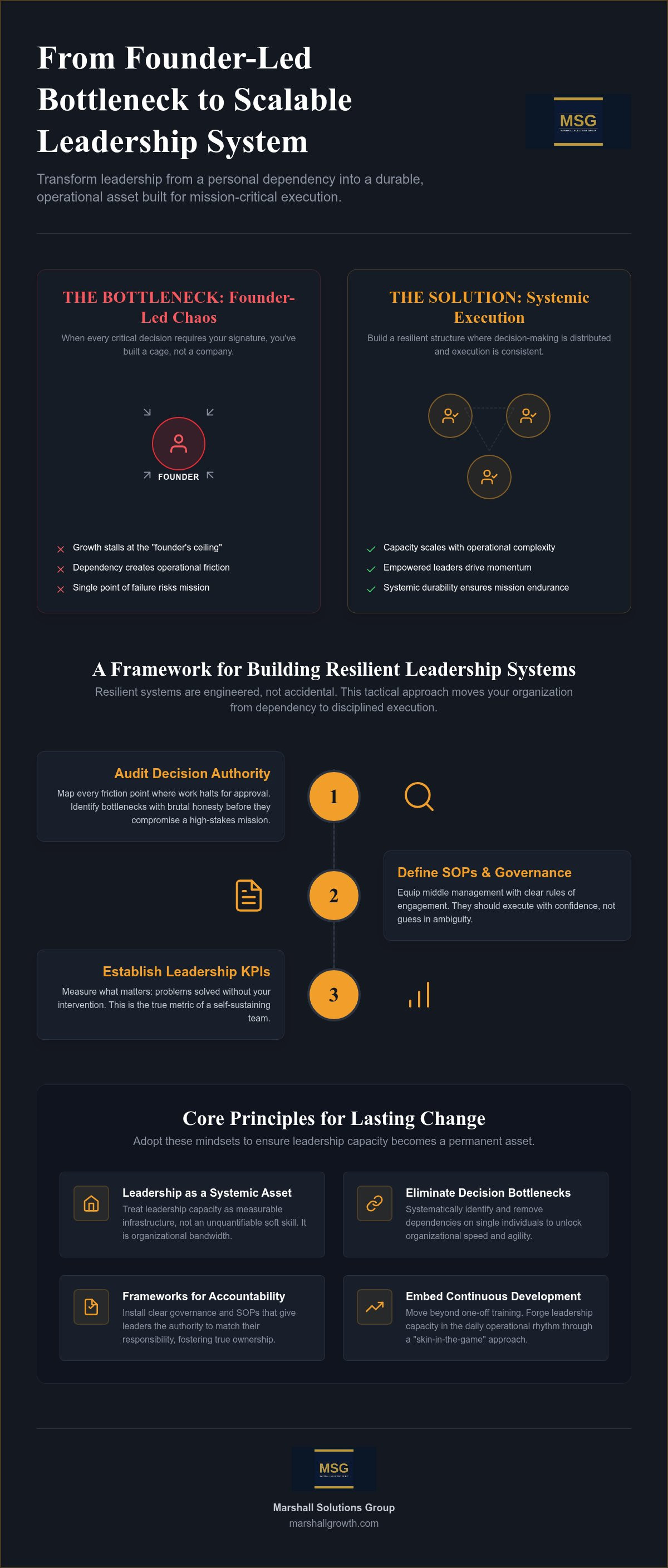
Resilient systems don't happen by accident. They're engineered. Building leadership capacity requires a three-step tactical approach. First, audit your decision-making authority. Map every friction point where work stops for approval. If your signature is required for routine tactical tasks, you've identified a failure point. Identify these bottlenecks with brutal honesty. If you don't find them, they'll find you when the stakes are highest.
Second, define clear Standard Operating Procedures (SOPs) and governance models. Middle management shouldn't guess; they should execute. Third, establish measurable KPIs for leadership performance. Don't just track revenue or technical output. Measure how many problems were solved without your intervention. High technical skill is useless if a leader can't build a self-sustaining team that functions in their absence.
Implementing Accountable Governance and Decision Frameworks
Authority must align with responsibility. When leaders have the weight of the mission but lack the power to make calls, burnout is inevitable. This misalignment is why most scaling efforts fail. Effective organizational leadership consulting focuses on creating frameworks that push decision-making to the lowest competent level. This ensures mission endurance during high-pressure cycles by removing the founder as the single point of failure.
Moving from strategy to disciplined execution requires structured accountability sessions. These aren't passive status updates. They're rigorous reviews of performance against specific outcomes. By sustaining capacity through coaching, you empower your team to own the results rather than just following orders. If you're ready to stop firefighting and start leading, a structured approach from Marshall Solutions Group can stabilize your growth and secure your mission's future.
Sustaining Capacity through Mission-Critical Execution
Capacity isn't built in a weekend workshop. It's forged in the daily operational rhythm. Many firms treat development as a one-off event, but true durability requires integration into every meeting, decision, and project. Building leadership capacity means making growth a standard operating requirement. It demands a "skin-in-the-game" advisory model where frameworks aren't just planned; they're embedded through active implementation and shared accountability.
Success in high-pressure transformation programs depends on reliability and veteran-like discipline. When the stakes are high, theory fails. You need systems that withstand friction without compromising quality. This isn't about generic coaching; it's about shifting the organizational culture toward high-level performance management and measurable outcomes.
Leveraging Federal PMO Standards for Organizational Growth
Federal-grade project management standards (PMO) offer a blueprint for private-sector scaling. These rigorous frameworks manage risk and compliance with surgical precision. By adapting these standards, organizations build teams capable of handling complex execution challenges without mission-impacting failures. At Marshall Solutions Group, we use our operator-level experience to bridge the gap between strategic planning and tactical reality.
Veteran-rooted discipline ensures that your leadership structure remains stable under fire, which is the ultimate goal when building leadership capacity. We don't just deliver a presentation and disappear. We stay in the trenches to ensure your new systems hold. This level of operational coordination transforms leadership from a liability into your most reliable strategic asset. If your current structure is buckling under growth, it's time to install a system designed for mission endurance.
Securing Mission Endurance Through Scalable Leadership
Scaling a mission-critical firm requires more than a visionary founder. It demands an operational system that survives your absence. Building leadership capacity isn't a luxury for future growth; it's the foundation for current stability. We've seen firms fail because they confused individual talent with organizational bandwidth. By auditing decision bottlenecks and implementing federal-grade project management standards, you move from founder-led friction to disciplined execution.
Marshall Solutions Group is a veteran-owned and operator-led advisory. We don't just hand over slide decks. We've managed $500M+ federal programs and stayed in the trenches to deliver measurable results. If you're ready to stabilize your operations and empower your team, it's time to act. Speak with Marshall Solutions Group about your leadership and operational challenges. Your organization's future depends on the systems you build today.
Frequently Asked Questions
What is the difference between leadership development and leadership capacity?
Leadership development focuses on enhancing the skills and traits of an individual. Building leadership capacity, however, is about creating an organizational system that can execute strategic objectives without central failure points. While development improves a person, capacity improves the structure. It ensures the mission continues even if a key leader is absent. Capacity is a measurable operational asset, not just a personal growth goal.
How do you measure an organization's leadership capacity?
Measure capacity by auditing decision-making flow and operational friction. Track how many critical decisions require founder intervention versus those handled by middle management. High-capacity organizations maintain consistent execution quality during high-pressure cycles. You should also evaluate the "bus factor," which is the risk to the mission if a primary leader is suddenly unavailable. If operations stall without one person, your capacity is low.
Why do founder-led companies often struggle to build leadership capacity?
Founders often struggle because they prioritize personal control over systemic durability. Their direct oversight, which was once a catalyst, eventually becomes a growth-capping bottleneck. Building leadership capacity requires the "tough love" of stepping back from tactical decisions. Many lack the structured governance needed to empower others effectively. Without this shift, the organization remains trapped in a state of founder-led dependency that limits scalability.
How can a Fractional COO help in building leadership capacity?
A Fractional COO acts as an embedded operator to install the frameworks your team needs to function independently. They move beyond theory to build accountability models and clear SOPs that distribute authority. By focusing on process improvement and performance management, they bridge the gap between strategy and execution. This "skin-in-the-game" approach ensures that organizational bandwidth is actually embedded into the daily operational rhythm.
Disclaimer
The information provided in this article is for general informational and educational purposes only and does not constitute legal, financial, accounting, engineering, or other professional advice. Marshall Solutions Group, Inc. makes no representations or warranties regarding the completeness or applicability of this information to any specific situation. Readers should consult appropriately qualified professionals before making decisions requiring specialized professional advice.