Organizational Effectiveness: A Template for Disciplined Execution (2026)
Marshall Solutions Group · reviewed by CJ Marshall
Bridge the gap between strategy and results. Our guide offers a framework for organizational effectiveness through disciplined execution and leadership align...

Article by
Chelvis “CJ” Marshall
Chelvis “CJ” Marshall is Founder & Managing Partner of Marshall Solutions Group, a management consulting firm specializing in Strategy & Operations, Organizational Leadership & Change, and Program & Project Management. A retired U.S. Navy Senior Chief who advanced from E-1 to E-8 in 10 years, CJ later transitioned into Fortune 500 enterprise leadership, negotiating more than $20M in contracts within three years. He brings operator-level experience leading teams, complex programs, and mission-critical operations. His work centers on being the bridge between leadership and execution—helping organizations translate strategic direction into disciplined execution, stronger accountability, and measurable results.
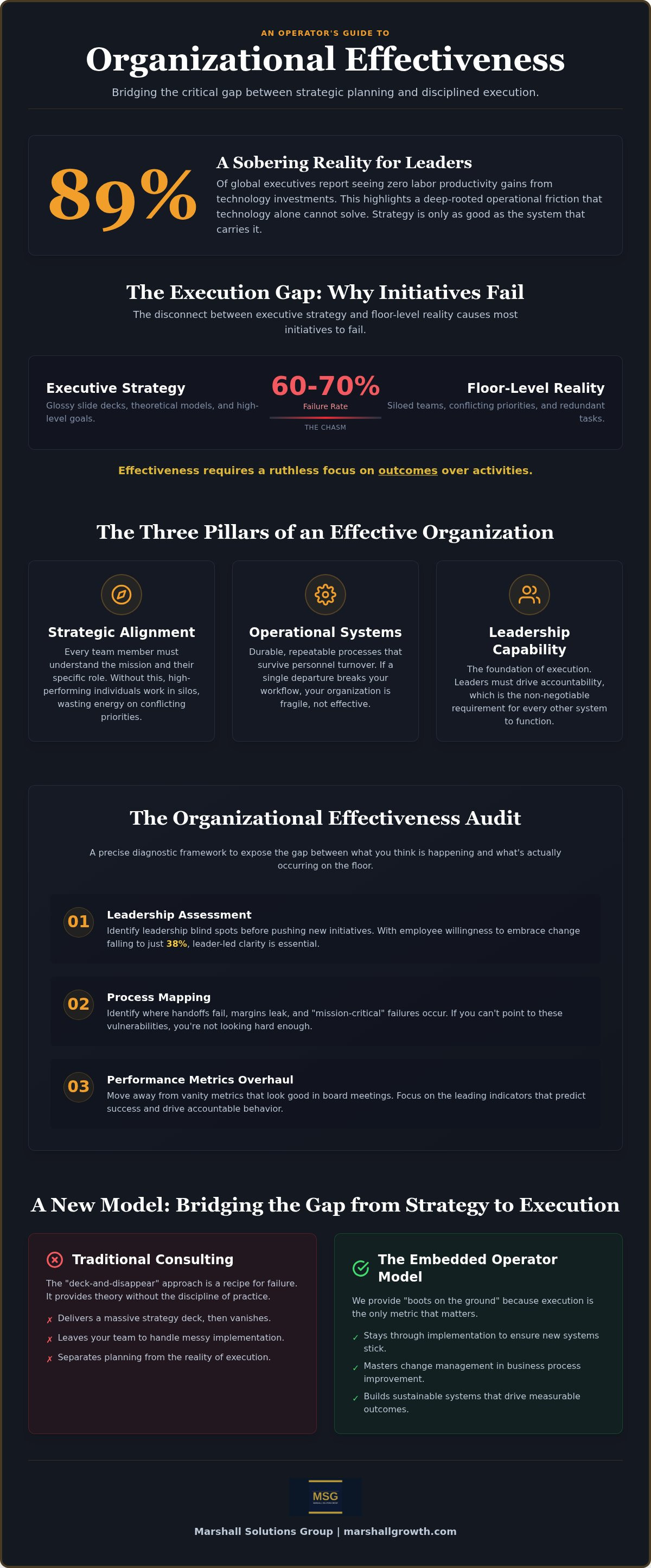
89% of global executives report seeing zero labor productivity gains from AI investments in 2026. It's a sobering reality for leaders who expected technology to solve deep-rooted operational friction. You've likely felt this stagnation firsthand. You've built the strategy and hired the talent, yet priorities remain blurred and high-performing teams continue to operate in silos. Strategy is only as good as the system that carries it. If your leadership isn't aligned, your execution will always falter.
We're here to help you bridge the gap between planning and results. This guide provides a clear diagnostic framework to identify where your systems are failing and how to rebuild organizational effectiveness through disciplined execution. You'll learn to align your leadership, people, and processes around measurable outcomes. We'll move past the theory of management and focus on the mechanics of building a high-performance culture that actually sticks. It's time to stop managing friction and start driving performance.
Key Takeaways
- Define organizational effectiveness as the measurable ability to execute strategy by aligning leadership, people, and processes.
- Diagnose operational friction using a diagnostic framework that identifies leadership blind spots and execution gaps.
- Learn why transformation initiatives fail and how to move from strategy decks that don't work to disciplined implementation.
- Adopt an operator-led approach that focuses on accountability and sustainable systems rather than detached advisory presentations.
Table of Contents
Defining Organizational Effectiveness Beyond Management Theory
True organizational effectiveness isn't found in a glossy slide deck or a theoretical model. It's the measurable ability of an entity to execute its strategy by synchronizing leadership, people, and processes. While an organizational effectiveness definition often focuses on abstract health, we define it by output. Can your team hit the target when the pressure is on? If the answer is "sometimes," you have a system failure, not a talent problem.
Most initiatives fail because of the "Execution Gap." This is the disconnect between executive strategy and floor-level reality. Research suggests that 60% to 70% of change initiatives fail to reach their goals. This happens when leaders prioritize "busy-ness"—endless meetings and activity—over actual progress. In mission-critical environments, movement doesn't always mean advancement. Effectiveness requires a ruthless focus on outcomes over activities. It's about building a structure that forces alignment rather than hoping for it.
The Three Pillars of an Effective Organization
Execution is a discipline. To master it, you must address three specific areas where friction usually hides:
- Strategic Alignment: Every associate must understand the mission and their specific role in it. Without this, you have high-performing individuals working in silos, wasting energy on conflicting priorities and redundant tasks.
- Operational Systems: You need durable, repeatable processes. These systems should survive personnel turnover. If a single departure breaks your workflow, your organization isn't effective; it's fragile.
- Leadership Capability: This is the foundation. We help leaders move from tactical management to strategic command. Accountability isn't a corporate buzzword. It's the non-negotiable requirement for every other system to function. Without it, even the best plans dissolve into excuses.
The Organizational Effectiveness Audit Template
You don't need a massive advisory team to fix your operations. You need a diagnostic framework that targets friction points with precision. High organizational effectiveness is built on three specific audits that expose the gap between what you think is happening and what's actually occurring on the floor. We don't trade in theory; we trade in results.
Start with a Leadership Assessment. With employee willingness to embrace change falling to 38% in 2026, leaders must identify their own blind spots before pushing new initiatives. Next, move to Process Mapping. Identify where handoffs fail and margins leak. Finally, overhaul your Performance Metrics. Move away from vanity metrics that look good in board meetings. Focus on leading indicators that predict success. Integrating the Principles of effective organizations ensures your audit covers both structural and cultural health.
How to Use This Diagnostic Framework
Begin by conducting a Leadership & Operations Assessment to baseline your current performance. This isn't a theoretical exercise. It's a tactical deep dive into your workforce development. Does your team have the tools and training to execute? If they don't, your strategy is just a wish list. You must evaluate if your people are equipped for the mission you've assigned them.
Focus on "Mission-Critical" failures. Identify the specific points where a breakdown causes an immediate delivery impact. If you can't point to these vulnerabilities, you're not looking hard enough. Real growth requires a ruthless look at your internal systems. If you need a partner to help identify these leaks, speak with an embedded operator who understands high-stakes execution.
Bridging the Gap from Strategy to Disciplined Execution
Traditional consulting is fundamentally broken. Most firms deliver a massive strategy deck and then vanish. For founder-led companies, this "deck-and-disappear" approach is a total recipe for failure. You don't need more slides. You need boots on the ground to ensure your organizational effectiveness survives the messy transition from planning to practice. This is the core of the "Embedded Operator" model. We stay through the implementation because execution is the only metric that matters.
Real success requires mastering change management in business process improvement. If new systems don't stick, your investment is wasted. For federal contractors, these effectiveness frameworks do more than just stabilize internal operations. They strengthen your socioeconomic profile and make you a much more attractive partner for prime teaming opportunities. In high-stakes government work, organizational effectiveness is your most valuable currency.
Execution in High-Stakes Environments
We apply the hard-won lessons of military command to the corporate world. Discipline isn't about restriction; it's about reliability. Durable Standard Operating Procedures (SOPs) are the lifeblood of any scalable organization. They allow you to scale rapidly without losing the core culture that fueled your initial success. Many firms utilize Fractional COO support to provide this level of oversight, stabilizing growth when internal resources are stretched thin.
The final step is establishing a rigid cadence of accountability. This prevents the operational drift that kills momentum. Without a structured rhythm of reviews and clear ownership, even the most robust systems will eventually degrade. You must move with purpose. Every meeting and every metric must serve the mission directly. It's not enough to be good once. You must be effective every single day.
Mastering the Mechanics of Execution
Operational friction doesn't fix itself. You've seen how to move beyond static strategy decks and implement a diagnostic framework that identifies real friction points. Lasting organizational effectiveness depends on your ability to bridge the gap between high-level planning and floor-level execution. It requires a relentless focus on leadership accountability and durable systems that survive personnel changes.
We bring over 60 years of combined military and Fortune 500 leadership experience to every partnership. As a veteran-owned, operator-led firm, we don't just hand over a presentation; we stay through the implementation to ensure your systems perform in mission-critical environments. If you're ready to stop managing chaos and start driving measurable results, speak with Marshall Solutions Group about your organizational challenges. Your organization is capable of disciplined growth. It's time to build the systems that carry it there.
Frequently Asked Questions
What is the difference between organizational efficiency and organizational effectiveness?
Efficiency is doing things right, while effectiveness is doing the right things to achieve mission-critical results. In high-stakes operations, efficiency focuses on resource optimization. However, organizational effectiveness ensures those resources align perfectly with the strategic mission. You can be efficiently moving in the wrong direction. True effectiveness requires leadership to prioritize measurable outcomes over mere activity, ensuring every process serves a specific goal.
How do you measure organizational effectiveness in a federal contracting environment?
Measurement in federal contracting centers on program delivery, risk mitigation, and strict compliance. You evaluate performance through contract milestones, Quality Control Plan adherence, and CPARS ratings. Effectiveness isn't just about meeting minimum requirements. It's about building a PMO structure that anticipates friction before it impacts the mission. Metrics must track execution accuracy and the reliability of Standard Operating Procedures in high-pressure scenarios.
How often should a mid-sized business conduct an effectiveness assessment?
Mid-sized businesses should conduct a formal organizational effectiveness assessment at least once a year. High-growth firms often benefit from quarterly reviews to prevent operational drift. These assessments shouldn't be passive check-ins. They must be tactical deep dives that audit leadership alignment and process durability. Regular baselining allows you to identify margin leaks and leadership blind spots before they stall your revenue targets.
What are the common signs of organizational ineffectiveness in founder-led companies?
The primary indicators include decision-making bottlenecks at the executive level and high-performing individuals working in silos. If your team is constantly reacting to crises instead of executing the plan, your systems are failing. You'll often see stalled growth despite increased hiring or a breakdown in handoffs between departments. These red flags suggest that your current structure cannot scale, requiring a shift toward disciplined execution.
Disclaimer
The information provided in this article is for general informational and educational purposes only and does not constitute legal, financial, accounting, engineering, or other professional advice. Marshall Solutions Group, Inc. makes no representations or warranties regarding the completeness or applicability of this information to any specific situation. Readers should consult appropriately qualified professionals before making decisions requiring specialized professional advice.