Embedding Change in Company Culture: A Checklist for Disciplined Execution
Marshall Solutions Group · reviewed by CJ Marshall
Stop culture initiatives from failing. Our checklist for embedding change in company culture helps leaders drive real, measurable shifts in workforce behavior.

Article by
Chelvis “CJ” Marshall
Chelvis “CJ” Marshall is Founder & Managing Partner of Marshall Solutions Group, a management consulting firm specializing in Strategy & Operations, Organizational Leadership & Change, and Program & Project Management. A retired U.S. Navy Senior Chief who advanced from E-1 to E-8 in 10 years, CJ later transitioned into Fortune 500 enterprise leadership, negotiating more than $20M in contracts within three years. He brings operator-level experience leading teams, complex programs, and mission-critical operations. His work centers on being the bridge between leadership and execution—helping organizations translate strategic direction into disciplined execution, stronger accountability, and measurable results.
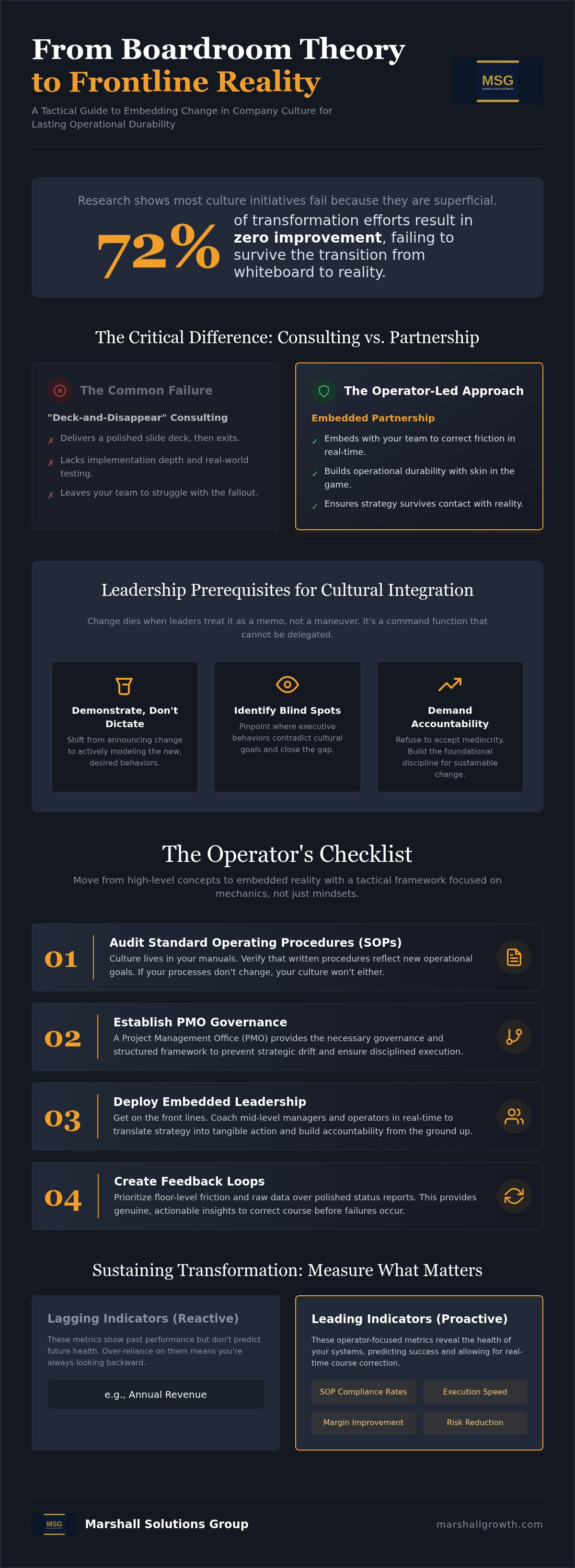
Research shows that 72% of culture initiatives result in zero improvement because employees view them as superficial. You've likely seen this play out. A strategy looks perfect on a whiteboard but fails to take root on the floor. This misalignment between executive vision and daily execution isn't just a hurdle; it's a mission-critical failure. You need a system that survives the transition from the boardroom to the front lines.
True progress requires embedding change in company culture through disciplined, operator-led leadership. We don't deal in vague theories or corporate perks. Instead, we focus on the mechanics of operational durability. This article outlines a tactical checklist to move your transformation from a high-level concept to a permanent reality. Learn how to align your people and processes to achieve measurable shifts in behavior and long-term stability.
Key Takeaways
- Identify the leadership prerequisites necessary to prevent cultural change from stalling at the executive level.
- Implement a tactical framework for embedding change in company culture by auditing SOPs and establishing PMO governance.
- Replace "deck-and-disappear" consulting with tactical accountability to ensure long-term operational durability.
- Transition from boardroom theory to a permanent cultural reality that drives measurable shifts in workforce behavior.
Table of Contents
The Prerequisites: Aligning Leadership for Cultural Integration
Cultural change dies in the executive suite when leaders treat it as a memo rather than a maneuver. Most organizational change management efforts fail because there's a tactical disconnect between the boardroom and the floor. When leadership isn't aligned on the specific mechanics of embedding change in company culture, the initiative becomes noise. You can't delegate culture. It's a command function. It requires physical presence, active participation, and a refusal to accept mediocrity.
Successful embedding change in company culture requires a shift from announcing change to modeling it. Stop issuing directives. Start demonstrating the new behaviors you expect from your operators. This builds the foundational accountability necessary for sustainable workforce development. Without this alignment, your strategy is just a deck with no destination. It lacks the durability to survive real-world operational friction.
Identifying Leadership Blind Spots in Transformation
Leadership blind spots are the gap between strategic intent and operational reality. These gaps often hide in plain sight, masked by comfortable habits and legacy systems. We recommend conducting a Leadership & Operations Assessment to pinpoint exactly where executive behaviors contradict your new cultural goals.
Our operator-led approach closes these gaps through direct executive coaching and tactical support. We don't just deliver a presentation. We embed with your team to correct friction points in real time. Precision matters. Discipline wins. We ensure your leadership team operates with the same rigor required of the mission-critical systems they manage. This is the only path to a permanent cultural reality.
The Operator’s Checklist for Embedding Change
Moving from leadership alignment to execution requires a tactical shift. There is an intextricable link between change and culture that many consultants ignore. They focus on mindsets. We focus on mechanics. Embedding change in company culture isn't about posters in the breakroom. It's about how your team operates at 0300 when no one's watching. Disciplined execution demands a structured framework that survives the transition from strategy to the front lines.
- Audit SOPs: Verify that your written procedures actually reflect the new operational goals.
- Establish a PMO: A Project Management Office provides the necessary governance to prevent drift.
- Deploy Embedded Leadership: Get on the front lines. Coach mid-level managers in real-time.
- Create Feedback Loops: Prioritize floor-level friction over polished status reports.
Translating Strategy into Standard Operating Procedures (SOPs)
Culture lives in your manuals, not your mission statement. If your processes don't change, your culture won't either. By creating standard operating procedures that reflect your new values, you turn abstract goals into repeatable tasks. Map your current workflows. Identify exactly where legacy habits are buried in the steps. Often, resistance isn't an attitude problem; it's a process problem. We help organizations strip away these inefficiencies to ensure that embedding change in company culture is a structural reality. This level of precision ensures that new behaviors become the default setting. If you're struggling to move past theoretical progress, consider an operator-led assessment to bridge the gap.
Sustaining Transformation Through Tactical Accountability
Tactical accountability is the bedrock of operational durability. It is the constant, uncompromising alignment of individual performance with organizational effectiveness. In mission-critical environments, you can't afford "deck-and-disappear" consulting. This common industry failure occurs when a firm delivers a polished slide deck and exits before the real friction begins. That model lacks implementation depth and leaves your team to struggle with the fallout. True transformation requires an embedded partner with skin in the game. We view margin improvement and risk management as the primary KPIs for cultural success. If embedding change in company culture doesn't protect your bottom line or reduce operational exposure, it hasn't truly taken root.
Measuring Organizational Effectiveness Post-Change
To ensure you're actually embedding change in company culture, you must track the right data. Use an organizational effectiveness template to monitor whether new behaviors drive results. Stop obsessing over lagging indicators like annual revenue alone. Instead, focus on leading indicators of cultural health, such as SOP compliance rates and cross-functional execution speed. These metrics reveal the health of your systems before failures occur.
When leading a team through organizational change, celebrate small, tactical wins that reinforce the new standard. These aren't just morale boosters. They are proof points that the new system is superior to the old one. This methodical approach ensures that your transformation becomes a permanent, measurable reality rather than a temporary shift. Discipline is not a one-time event; it's the daily practice of maintaining the new operational baseline.
Move Toward Operational Durability
Success isn't found in a slide deck. It's built through disciplined execution on the floor. You've seen why transformation fails without leadership alignment and why SOPs are the true home of your organization's values. Sustaining these gains requires tactical accountability and a focus on measurable effectiveness. Embedding change in company culture is a high-stakes mission that demands a steady hand and a proven framework. It's time to stop theorizing and start operating.
Marshall Solutions Group brings 60+ years of collective military and Fortune 500 command experience to your organization. As a veteran-owned firm, we don't just advise; we embed with your team to provide direct implementation support with real skin in the game. Speak with an MSG Operator about embedding change in your organization today. Let's turn your strategic vision into a permanent cultural reality. You have the plan. We have the discipline to help you execute it.
Frequently Asked Questions
How long does it take to truly embed a new culture in a mid-sized organization?
True integration typically requires 18 to 36 months of disciplined execution. While tactical wins occur within the first 90 days, embedding change in company culture is a marathon, not a sprint. It takes time for new behaviors to survive the friction of the old way. Durability is only achieved when the new processes become the subconscious default for your entire workforce.
What is the difference between organizational change and cultural transformation?
Organizational change refers to shifting the mechanics of a business, like new software or a merger. Cultural transformation is the shift in the people side that powers those systems. Change is a directive; culture is a habit. You can change a process in a day, but you transform a culture only when those changes are reinforced by leadership modeling and tactical accountability.
Can a company embed change without a dedicated PMO or external support?
Most internal teams fail because they lack the governance to resist legacy habits. A PMO provides the structure required for embedding change in company culture by tracking leading indicators and managing risk. Without an embedded operator or external oversight, daily fires usually consume the transformation effort. Professional support ensures that execution remains the priority even when operational pressure increases.
How do you handle high-performing employees who resist cultural shifts?
High performance is never an excuse for cultural sabotage. If an employee delivers results but refuses to adopt the new operational standards, they become a mission-critical risk. You handle this through direct, tough love coaching and strict accountability. If they won't align, you must remove them. One talented outlier can derail an entire organization's progress by signaling that the new rules are optional.
Disclaimer
The information provided in this article is for general informational and educational purposes only and does not constitute legal, financial, accounting, engineering, or other professional advice. Marshall Solutions Group, Inc. makes no representations or warranties regarding the completeness or applicability of this information to any specific situation. Readers should consult appropriately qualified professionals before making decisions requiring specialized professional advice.