Leading a Team Through Organizational Change: An Operator-Led Execution Guide
Marshall Solutions Group · reviewed by CJ Marshall
Stop change fatigue. Our guide to leading a team through organizational change offers a tactical, operator-led framework for real results and accountability.

Article by
Chelvis “CJ” Marshall
Chelvis “CJ” Marshall is Founder & Managing Partner of Marshall Solutions Group, a management consulting firm specializing in Strategy & Operations, Organizational Leadership & Change, and Program & Project Management. A retired U.S. Navy Senior Chief who advanced from E-1 to E-8 in 10 years, CJ later transitioned into Fortune 500 enterprise leadership, negotiating more than $20M in contracts within three years. He brings operator-level experience leading teams, complex programs, and mission-critical operations. His work centers on being the bridge between leadership and execution—helping organizations translate strategic direction into disciplined execution, stronger accountability, and measurable results.
Most organizational changes fail because they're treated as academic exercises rather than tactical operations. You've likely felt the friction when a consultant leaves you with a beautiful strategy but zero instructions for the morning after. It's exhausting to watch your best people succumb to change fatigue while leadership alignment remains a suggestion rather than a requirement. You need stability. You need results. Leading a team through organizational change requires more than empathy; it demands a disciplined, operator-led approach that protects your core business while you transform it.
We're moving beyond the fluff of generic business coaching. This guide provides a clear execution roadmap designed to maintain team accountability and deliver measurable operational improvements. You'll learn how to bridge the gap between high-level vision and ground-level reality. Strategy meets execution. Alignment drives impact. Let's get to work.
Key Takeaways
- Establish tactical alignment by defining the mission-critical why so every team member understands their specific role in the transition.
- Implement a disciplined 5-step framework that moves your organization from intelligence gathering to measurable transformation programs.
- Master the mechanics of leading a team through organizational change by prioritizing tactical execution over theoretical management models.
- Sustain long-term results by integrating change into your standard operating procedures through rigorous process improvement and high accountability.
Table of Contents
Establishing Tactical Alignment and Mission Clarity
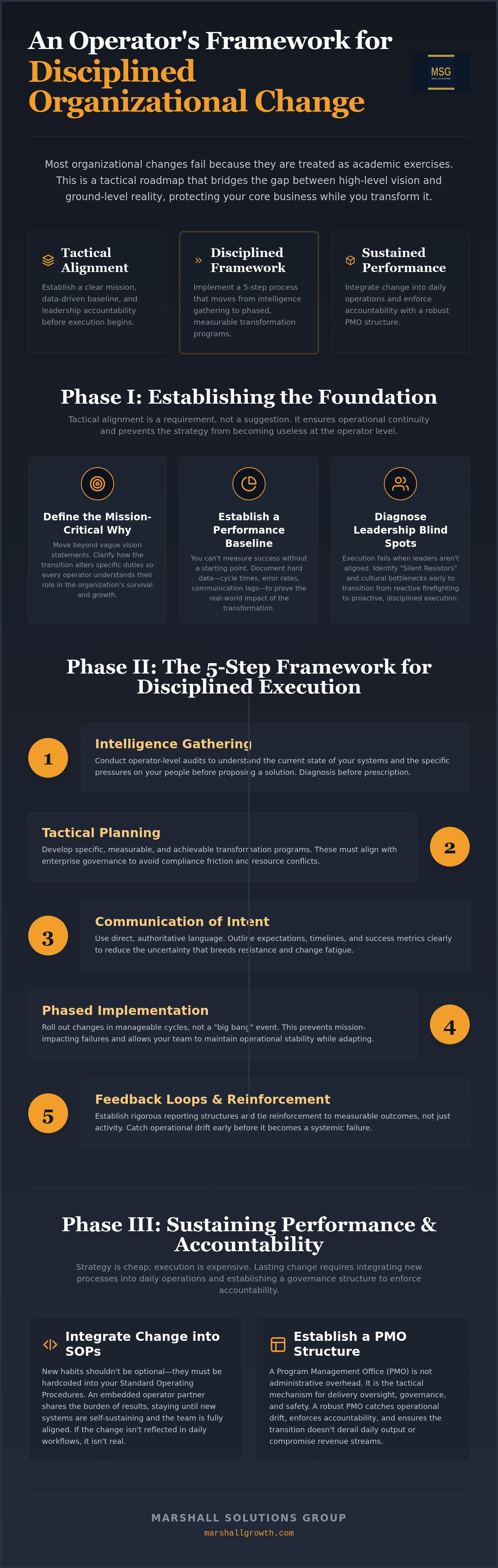
Tactical alignment isn't a suggestion. It's a requirement for operational continuity. When leading a team through organizational change, you must ensure every individual understands how the transition alters their specific duties. If the mission isn't clear at the operator level, the strategy is useless. Move beyond vague vision statements. Identify the "Mission-Critical Why." This isn't about corporate values; it's about operational survival and the mechanics of growth. People don't follow posters on a wall. They follow a plan that keeps the organization viable.
Before moving a single piece on the board, establish a baseline for performance. You need hard data on current output to measure the real-world impact of your transformation. This involves documenting current cycle times, error rates, and communication lags. Without a starting point, you're just guessing. A disciplined leader knows that change without measurement is merely chaos with a different name. Baseline first. Execute second.
Diagnosing Leadership Blind Spots and Operational Inefficiencies
Execution fails when leaders aren't aligned. Perform a Leadership & Operations Assessment to pinpoint where friction will stall progress. You must map specific cultural bottlenecks that resist new governance models or streamlined SOPs. This isn't just about technical gaps. It's about finding the "Silent Resistors." These are the leaders who nod in the boardroom but fail to implement changes in the field. Their inaction is a poison to momentum. By identifying these blind spots early, you can transition from a state of reactive firefighting to one of proactive, disciplined execution. Accountability starts at the top and flows to the front lines.
A 5-Step Framework for Disciplined Change Execution
Successful execution isn't accidental. It's the result of a methodical process that prioritizes operational stability over theoretical ideals. When leading a team through organizational change, you must follow a chronological roadmap that accounts for both systems and people.
- Step 1: Intelligence Gathering. Conduct operator-level audits. You must understand the current state of your systems and the specific pressures on your people before proposing a solution.
- Step 2: Tactical Planning. Develop specific, measurable transformation programs. These must align with federal or enterprise governance to avoid compliance friction later.
- Step 3: Communication of Intent. Use direct, authoritative language. Outline expectations clearly to reduce the uncertainty that breeds resistance.
- Step 4: Phased Implementation. Roll out changes in manageable cycles. This prevents mission-impacting failures and allows your team to maintain stability while adapting.
- Step 5: Feedback Loops. Establish rigorous reporting structures. Catch operational drift early before it becomes a systemic failure.
This disciplined approach ensures that your Organizational Leadership & Change initiatives result in durable performance rather than temporary shifts.
Applying Prosci ADKAR in High-Stakes Environments
We leverage the ADKAR model to bridge the gap between individual performance and organizational goals. Awareness and Desire are the foundation, but Knowledge must translate into Ability through hands-on SOP training and curriculum development. It's not enough for a team to know what to do; they must be physically and technically capable of doing it under pressure. Reinforcement must be tied to measurable outcomes. Attendance at a meeting is not a metric. Operational output is.
Sustaining Performance and Accountability through Transformation
Strategy is cheap; execution is expensive. Most consultants hand over a deck and vanish before the friction starts. We don't. Leading a team through organizational change requires skin in the game implementation where the partner shares the burden of results. You need an embedded operator who stays until the new systems are self-sustaining and the team is fully aligned. This means integrating change management directly into business process improvement. New habits shouldn't be optional. They must be hardcoded into your standard operating procedure. If the change isn't reflected in your daily workflows, it isn't real.
To maintain this momentum, establish a PMO structure. A Program Management Office isn't just administrative overhead. It's the tactical mechanism for delivery oversight and governance. It ensures that the transition doesn't derail daily output or compromise safety standards. A robust PMO is the safest way to keep leading a team through organizational change without compromising your current revenue streams. It catches operational drift before it causes a failure and enforces accountability at every level of the hierarchy.
The Role of Fractional Leadership in Stabilizing Change
Internal teams are often maxed out during a transition. A Fractional COO provides embedded leadership to manage high-stakes daily operations while the founder focuses on strategic pivots. This stability is critical. For mission-critical sectors like aerospace, defense, and federal infrastructure, veteran-led advisory is vital. We bring the discipline of military engineering and high-level corporate experience to your front lines. This isn't generic coaching. It's active operational management. You can see examples of this operator-led leadership in action on our LinkedIn page. We don't just advise. We execute alongside you to ensure the mission succeeds.
Operationalizing Your Transformation
Leading a team through organizational change isn't about managing feelings; it's about managing mechanics. You've seen how tactical alignment and a disciplined 5-step framework replace chaos with order. By establishing a clear mission-critical why and leveraging a robust PMO, you protect current operations while building for the future. Strategy only matters if you can execute it on the ground. Plan. Align. Execute.
As a veteran-owned and operator-led firm, Marshall Solutions Group brings 60+ years of combined military and Fortune 500 experience to your front lines. Our SBA-certified SDVOSB status makes us a reliable partner for high-stakes federal teaming. Schedule an Operational Performance Audit with Marshall Solutions Group to secure your execution roadmap. Your organization deserves the stability that comes from disciplined leadership. Let's get to work.
Frequently Asked Questions
How do you lead a team through change when you do not agree with the decision?
You prioritize the mission over personal preference. Leading a team through organizational change when you disagree requires separating your individual opinion from your professional duty. Focus on the tactical objectives and the "Mission-Critical Why" established by the organization. Your job is to provide stability and clear direction, ensuring your team remains productive while navigating the new operational reality.
What are the most common reasons change management initiatives fail in mid-sized companies?
Most initiatives fail due to a lack of leadership alignment at the top and the "deck-and-disappear" consulting model. Mid-sized companies often struggle when change isn't integrated into daily standard operating procedures. Without rigorous accountability and a clear execution roadmap, staff succumb to change fatigue. Transformation requires more than a presentation; it needs embedded operators who stay until the work's done.
How can I measure the success of organizational change beyond employee surveys?
Measure success through hard operational data rather than subjective sentiment. Track specific metrics such as cycle times, error rates, and project delivery speed. If leading a team through organizational change is successful, you'll see measurable improvements in output and reduced operational friction. High-stakes environments require concrete proof points like cost-of-quality reductions and the durability of new processes over time.
What is the role of a PMO in leading a team through organizational change?
A Program Management Office (PMO) provides the governance and delivery oversight necessary to maintain stability. It acts as the tactical engine that synchronizes different workstreams and enforces accountability. By monitoring operational drift, the PMO ensures that the transformation doesn't derail core business functions. It serves as the steady hand that keeps execution aligned with the strategic mission.
Disclaimer
The information provided in this article is for general informational and educational purposes only and does not constitute legal, financial, accounting, engineering, or other professional advice. Marshall Solutions Group, Inc. makes no representations or warranties regarding the completeness or applicability of this information to any specific situation. Readers should consult appropriately qualified professionals before making decisions requiring specialized professional advice.