Culture of Ownership: An Operator's Guide to Execution
By CJ Marshall, President & Founder
Learn how to build a culture of ownership to eliminate leadership bottlenecks, clarify decision rights, and protect operating margins across your business.

Article by
Chelvis “CJ” Marshall
Chelvis “CJ” Marshall is President & Founder of Marshall Solutions Group, a management consulting firm specializing in Strategy & Operations, Organizational Leadership & Change, and Program & Project Management. A retired U.S. Navy Senior Chief who advanced from E-1 to E-8 in 10 years, CJ transitioned into Fortune 500 enterprise leadership, where his commercial experience has included more than $20 million in contract value. He brings operator-level experience leading teams, complex programs, and mission-critical operations. His work focuses on bridging leadership and execution—helping organizations translate strategic direction into disciplined execution, stronger accountability, and measurable business results.
Telling your team to "think like an owner" won't fix an operational bottleneck. When frontline managers identify problems but wait for executive permission to solve them, margins bleed through delay and rework. You're likely exhausted from acting as the default clearinghouse for daily fires, wondering why capable leaders hesitate to step up. Real accountability isn't an attitude; it's an operational system. Learning how to build a culture of ownership starts by dismantling the structural ambiguity that forces your people into passive compliance.
This guide bypasses corporate slogans to deliver a practical framework for execution. You'll discover how to establish clear decision rights, empower managers to resolve issues without executive escalation, and protect project profitability through frontline accountability. We'll examine why common culture initiatives fail, detail three operational steps to build single-threaded ownership, and outline the operating cadence needed to keep execution on track.
Key Takeaways
- Accountability collapses when leaders demand responsibility for outcomes without transferring the decision authority required to achieve them.
- Discover how to build a culture of ownership by replacing motivational rhetoric with explicit commander intent and standardized operational baselines.
- Mapping precise decision rights and single-threaded ownership eliminates operational bottlenecks while protecting project margins against passive compliance.
- Maintaining disciplined frontline execution requires a consistent weekly operating cadence and blame-free reviews focused on process breakdown rather than personal fault.
Table of Contents
Why Most Initiatives to Build a Culture of Ownership Fail
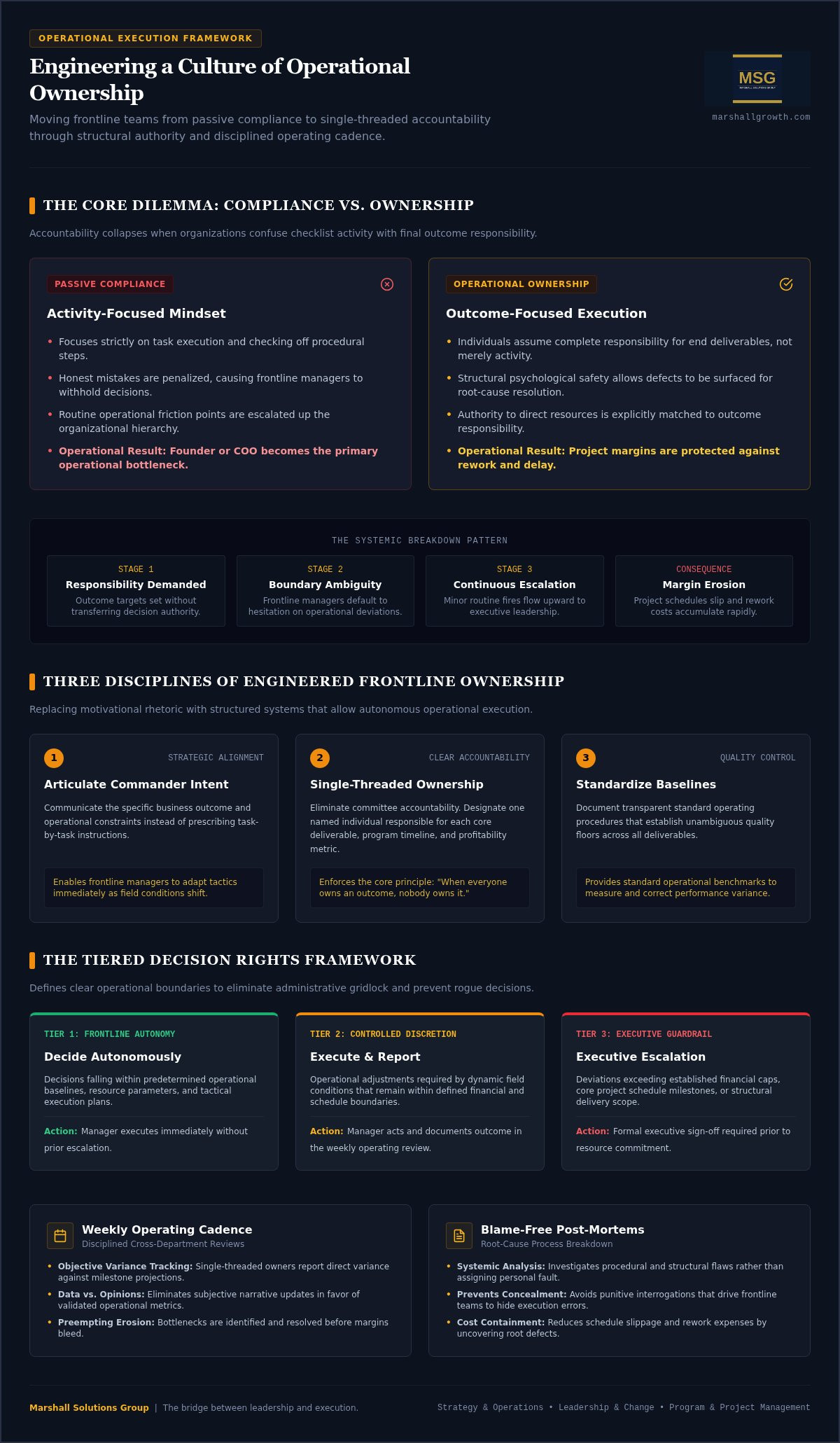
Most executives mistake compliance for accountability. They assume that if an employee checks off tasks on an SOP, operational success follows. Genuine operational ownership means an individual takes complete responsibility for the end outcome, not just the activity. Distributing equity shares or hanging inspirational posters will not change this dynamic. When leaders ask how to build a culture of ownership, they often look for cultural mindset shifts while ignoring broken operating mechanics.
To see how disciplined accountability transforms field execution, watch this operational perspective on leadership:
Passive compliance thrives whenever organizations punish honest mistakes. When surfacing an operational defect results in blame rather than root-cause analysis, frontline employees protect themselves. They stop making decisions. They escalate every routine friction point up the chain, turning the founder or COO into an operational bottleneck. Passive teams do not lack ambition; they lack structural safety.
The Structural Flaw: Demanding Responsibility While Withholding Authority
You cannot hold managers accountable for results if they lack the authority to direct resources. Demanding ownership while requiring executive sign-off on minor operational deviations paralyzes your leadership pipeline. Without an explicit operational excellence framework, boundary lines blur. Capable managers default to hesitation, project margins deteriorate through rework, and true operational autonomy collapses under bureaucratic drag.
How to Build a Culture of Ownership in Three Operational Steps
Operational execution improves when leaders structure autonomy rather than hoping for it. Real organizational accountability demands engineered systems, not motivational speeches. If you want to know how to build a culture of ownership that protects your operating margins, implement these three core disciplines:
- Articulate commander intent: Communicate the specific business outcome and operational constraints instead of prescribing task-by-task instructions. Frontline managers need the freedom to adjust tactics when field conditions shift.
- Assign single-threaded ownership: Eliminate committee accountability. Designate one named individual responsible for each core deliverable, program timeline, and profitability metric. When everyone owns an outcome, nobody owns it.
- Standardize operational baselines: Document clear operating procedures that establish quality floors. Transparent standards provide the baseline against which operational variance can be measured and corrected.
Defining Decision Rights and Operational Guardrails
Teams hesitate when authority lines remain vague. A practical tiered decision model resolves this by defining what managers decide autonomously, what they execute and report, and what requires executive escalation. Setting firm financial and schedule boundaries prevents both administrative gridlock and rogue decision-making. Before delegating complete operational control, reviewing an operational readiness checklist confirms your team has the tools and staffing required for success. When execution friction persists, engaging an embedded operational partner can help establish the decision rights your leaders need to perform.
Sustaining Ownership Through Accountability and Operating Cadence
Ownership collapses without an operating rhythm to reinforce it. When managers make commitments in isolation, passive drift sets in. Sustaining this behavior requires a predictable operating cadence: weekly cross-department reviews where single-threaded owners report direct variance against milestone projections. These sessions replace subjective status updates with objective operational data, ensuring teams solve delivery bottlenecks before margins erode.
Accountability fails when reviews turn into interrogations. Punitive investigations force teams to conceal mistakes, inflating rework costs and driving schedule slips. Sustained execution depends on blame-free post-mortems focused on systemic flaws rather than personal fault. If you want to master how to build a culture of ownership across expanding operations, you must treat variance as operational feedback, not a disciplinary event.
Implementing Structured Operating Reviews and Root Cause Discipline
Effective reviews isolate why planned performance diverged from reality. By institutionalizing proven root cause analysis techniques, leaders evaluate whether failures stem from bad data, resource bottlenecks, or unclear handoffs. This approach creates psychological safety while demanding uncompromising operational rigor.
Decentralized decision-making directly protects business profitability. When frontline leaders possess the authority and standard protocols to correct delivery issues instantly, project margins remain intact:
- Margin preservation: Early variance detection eliminates late-stage project rework and costly rush freight.
- Labor efficiency: Autonomous field resolutions keep executive leadership focused on strategic growth rather than tactical firefights.
- Predictable capacity: Consistent weekly reporting cycles produce reliable utilization data for operational forecasting.
Bridge the Gap Between Strategic Intent and Daily Execution
True accountability doesn't happen by accident. Learning how to build a culture of ownership requires replacing vague corporate appeals with single-threaded responsibility, unambiguous decision boundaries, and disciplined operating cadences. When you eliminate executive bottlenecks and focus operational reviews on systemic variance, frontline leaders take genuine control over business outcomes and protect your operating margins.
Transitioning from passive compliance to decentralized execution requires seasoned operational leadership. Backed by over 60 years of combined operational command experience, Marshall Solutions Group acts as an embedded partner staying through implementation rather than delivering passive slide decks. Partner with Marshall Solutions Group to embed disciplined leadership systems and build operational accountability across your organization. Your teams are ready to lead; give them the operational framework to execute.
Frequently Asked Questions
What is the fastest way to build a culture of ownership in a team?
The fastest route is establishing explicit decision rights and stopping executive intervention on routine operational calls. Clarify exactly what frontline managers can decide without prior approval, such as spending thresholds or schedule adjustments. When leaders consistently refuse to solve escalated problems that fall within these defined boundaries, teams stop defaulting to passive compliance and begin taking direct responsibility for outcomes.
Can you establish a culture of ownership without offering equity or stock options?
Yes, because operational ownership is driven by autonomy and authority, not capital structure. Financial equity rarely changes daily behavior if employees must still seek permission for minor workflow changes. Learning how to build a culture of ownership without equity requires providing clear commander intent, predictable operating reviews, and the structural authority needed to deliver outcomes without fear of punitive blame.
Why do employees resist taking ownership even when leaders ask them to?
Employees resist ownership when organizations demand accountability for outcomes while withholding the authority to make critical decisions. If stepping up risks punishment for unexpected variance, passive execution becomes a rational self-defense mechanism. People don't resist responsibility because they lack initiative; they hesitate because past experiences taught them that unapproved decisions trigger micromanagement or executive reprimands.
What is the difference between accountability and an ownership culture?
Accountability focuses on tracking whether an assigned task was executed, while ownership centers on responsibility for the final business outcome. An accountable employee completes assigned checklist steps on time. An owner recognizes when those steps fail to produce the required metric, proactively adjusts tactics, and solves operational friction without waiting for leadership direction.
Disclaimer
The information provided in this article is for general informational and educational purposes only and does not constitute legal, financial, accounting, engineering, or other professional advice. Marshall Solutions Group, Inc. makes no representations or warranties regarding the completeness or applicability of this information to any specific situation. Readers should consult appropriately qualified professionals before making decisions requiring specialized professional advice.