Operational Excellence Framework: The Operator’s Guide to Disciplined Execution
By CJ Marshall, President & Founder
Build a practical operational excellence framework that eliminates leadership bottlenecks, protects margins, and bridges strategy with disciplined execution.

Article by
Chelvis “CJ” Marshall
Chelvis “CJ” Marshall is President & Founder of Marshall Solutions Group, a management consulting firm specializing in Strategy & Operations, Organizational Leadership & Change, and Program & Project Management. A retired U.S. Navy Senior Chief who advanced from E-1 to E-8 in 10 years, CJ transitioned into Fortune 500 enterprise leadership, where his commercial experience has included more than $20 million in contract value. He brings operator-level experience leading teams, complex programs, and mission-critical operations. His work focuses on bridging leadership and execution—helping organizations translate strategic direction into disciplined execution, stronger accountability, and measurable business results.
Most leadership teams believe a stack of SOPs and a shiny dashboard equal operational excellence. They're wrong. A process map is just a wish list if your team lacks the discipline to follow it. You've likely seen revenue climb while your EBITDA margins erode, or felt the weight of every decision landing back on your desk because your managers won't lead. It's the natural result of growth exceeding your operational capacity.
This guide introduces a disciplined operational excellence framework designed to bridge the gap between your strategic intent and measurable results. We'll move beyond the theory of consultant-speak to build a self-managing operating system. You will learn how to establish clear management rhythms, instill high-stakes accountability, and create the predictable business outcomes your organization requires to scale without breaking. It is time to stop managing by fire drill and start leading by design.
Key Takeaways
- Stop confusing static process maps with actual performance by identifying the specific execution gaps where most strategic initiatives fail.
- Learn how to deploy a leadership-driven operational excellence framework that replaces manual workarounds with a disciplined management operating system.
- Discover the mechanics of translating high-level goals into tactical "Operator Intent" to ensure your team executes consistently without constant intervention.
- Identify how to eliminate leadership bottlenecks and margin erosion by establishing single points of accountability for every core business process.
Table of Contents
Defining Operational Excellence: More Than Just Process Mapping
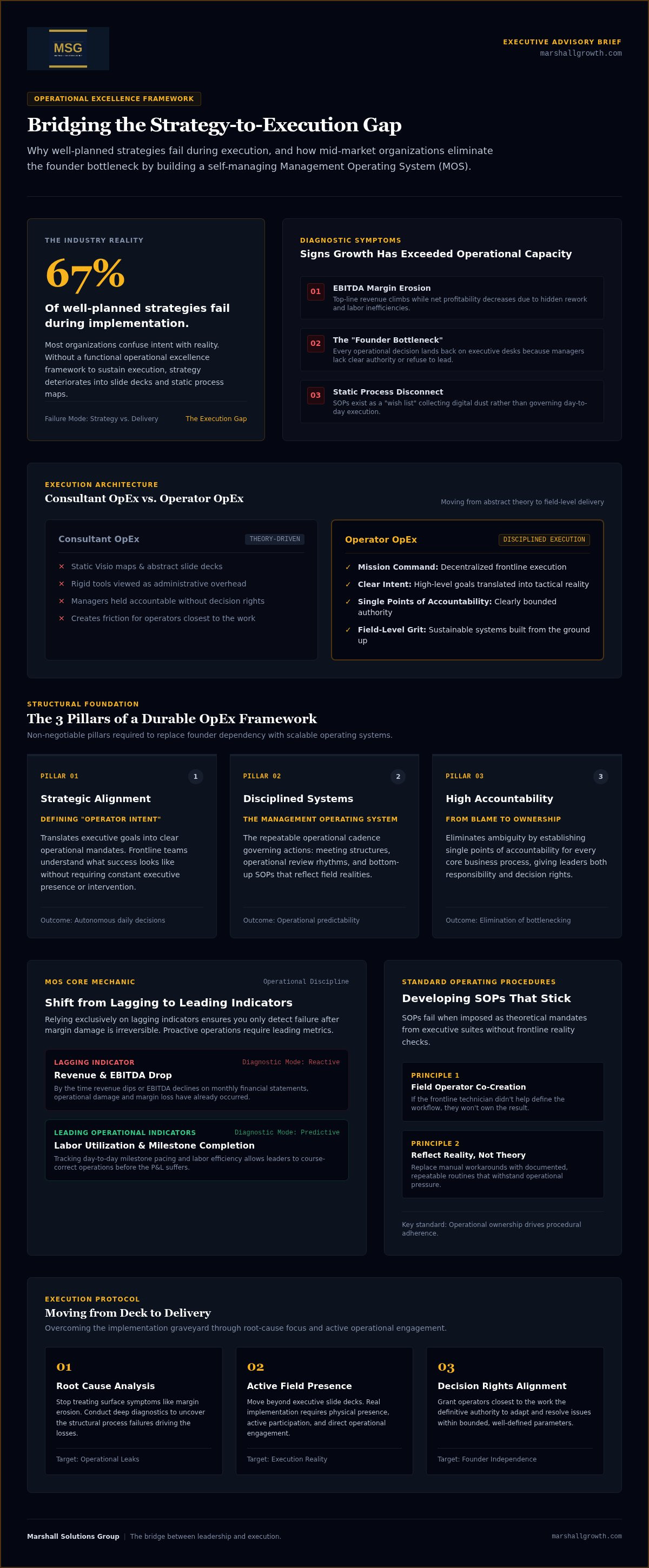
Operational excellence isn't a static document or a set of Visio charts. It's the consistent execution of strategy through disciplined leadership and systems. Most organizations confuse intent with reality. Industry data suggests that 67% of well-planned strategies fail during implementation because they lack a functional operational excellence framework to sustain them. This "Execution Gap" is where margins disappear and labor inefficiency takes root.
To better understand this concept, watch this helpful video:
There's a sharp divide between "Consultant OpEx" and "Operator OpEx." Consultants deliver slide decks filled with theory. Operators deliver field-level results through grit and systems. True excellence relies on a leadership-driven operational excellence framework that utilizes "Mission Command" for decentralized execution. Leaders provide clear intent, but they give the frontline the authority to adapt. This moves the organization beyond academic operational excellence methodologies and toward a culture of high accountability.
Why Traditional Frameworks Fail Founder-Led Businesses
Rapid growth eventually triggers the "Founder Bottleneck." This occurs when the business outpaces the owner's capacity to oversee every decision personally. In agile mid-market firms, rigid Lean or Six Sigma tools often feel like administrative overhead. These initiatives fail because they don't address the root cause: a lack of clear decision rights. Managers are often held accountable for results without having the authority to make the decisions required to produce them. Without single points of accountability, processes don't scale. They just create more friction for the operators closest to the work.
The 3 Pillars of a Durable Operational Excellence Framework
A durable operational excellence framework stands on three non-negotiable pillars. Without them, your strategy is just a slide deck collecting digital dust. We recommend starting with a Leadership & Operations Assessment. This diagnostic identifies where your execution is currently bleeding margin and which bottlenecks are stalling your growth. This leadership-driven operational excellence framework replaces founder dependency with scalable systems that produce predictable outcomes.
Pillar 1 is Strategic Alignment. This requires translating executive goals into "Operator Intent." Your team must understand exactly what success looks like without you standing over them. Pillar 2 involves Disciplined Systems. This is your Management Operating System (MOS), the repeatable cadence that drives daily action. Pillar 3 is a High-Accountability Culture. It moves the needle from a culture of blame to one of ownership. This disciplined alignment mirrors the standards found in the Baldrige Excellence Framework, where process rigor translates directly into measurable delivery.
Building a Management Operating System (MOS) That Scales
The MOS is the heartbeat of your business. It consists of the meeting cadences, KPIs, and SOPs that govern daily performance. To develop SOPs that people actually follow, you must involve the operators closest to the work. If a field technician didn't help define the process, they won't own the result. This bottom-up approach ensures your documentation reflects reality, not theory.
Effective leaders also transition from lagging indicators to leading indicators. Revenue is a lagging indicator; by the time it drops, the damage is already done. Instead, focus on operational metrics like project milestone completion or labor utilization. These leading indicators allow you to course-correct before the P&L suffers. If you want to see how these systems integrate, you can follow our operational insights for real-world implementation strategies.
Implementing the Framework: Moving from Deck to Delivery
Implementation is the graveyard of strategy. Too many firms deliver a slide deck and vanish before the hard work begins. To successfully deploy an operational excellence framework, you must first conduct a root cause analysis of your operational failures. Stop treating symptoms like margin erosion and start fixing the broken processes that cause them. This is about physical presence and active participation, not just observation.
Once the leaks are identified, align your leadership team on Single Points of Accountability (SPA). If everyone is responsible for a core process, no one is. Assigning clear ownership ensures that when execution stalls, you know exactly who is responsible for the recovery. Embedding these habits often requires fractional leadership or an Operating Partner to serve as the bridge between your plan and your daily reality. You can measure the financial consequences of these execution gaps through our Operational Performance Assessment.
The Financial Impact: Connecting Process to EBITDA
Every hour spent on rework or labor inefficiency is a direct hit to your bottom line. By tightening execution, you improve project economics and scale without proportional overhead growth. This focus on efficiency is the hallmark of the operational excellence value discipline, which treats process as a competitive advantage rather than a chore.
We utilize a "Skin in the Game" advisory model because staying through implementation is non-negotiable. Systems don't fail; people do. Proper change management in business process improvement prevents your organization from rejecting new standards as administrative overhead. This disciplined approach ensures that your operational excellence framework becomes the permanent management operating system of your business.
From Strategic Intent to Disciplined Execution
Execution is the only strategy your customers ever see. A durable operational excellence framework replaces founder bottlenecks with a predictable management operating system. By aligning leadership intent with frontline action, you protect your margins and reclaim the capacity to scale. It's the difference between managing by fire drill and leading by design.
Marshall Solutions Group provides the veteran-rooted discipline required to stabilize high-pressure environments. Our operator-led advisory team brings over 60 years of combined leadership experience, including a record of zero mission-impacting failures within naval engineering commands. We don't just deliver plans; we stay through implementation to ensure they work. Ready to bridge the gap between strategy and execution? Schedule an Operations Assessment with Marshall Solutions Group today. Your organization deserves a system that manages itself.
Frequently Asked Questions
What is an operational excellence framework?
An operational excellence framework is a leadership-driven system that aligns strategy, people, and processes to produce predictable business outcomes. It serves as the bridge between strategic intent and execution. Unlike a static process map, this framework establishes the management rhythms and decision rights required for an organization to scale without breaking. It ensures every operator understands their intent and is held accountable for results.
How does operational excellence improve EBITDA?
Operational excellence directly impacts EBITDA by removing the friction that erodes margins. When you eliminate labor inefficiency and stop mission-impacting failures, project profitability increases. A disciplined operational excellence framework reduces rework and operational waste, allowing your business to grow revenue without a proportional increase in overhead. This creates operating leverage, ensuring more of your top-line growth reaches the bottom line.
Why do most operational excellence initiatives fail?
Most initiatives fail because they're treated as deck-and-disappear events rather than daily management rhythms. Success requires leadership-led accountability and skin in the game implementation. Failure also occurs when growth exceeds operational capacity, leading to the founder bottleneck. Without clear single points of accountability, teams revert to manual workarounds, causing the organization to reject the new process as administrative overhead.
What is the difference between operational excellence and continuous improvement?
Continuous improvement focuses on incremental process tweaks, while operational excellence is the holistic leadership system that sustains those gains. While continuous improvement fixes specific bottlenecks, excellence creates a self-managing culture where execution is the highest form of strategy. It moves the organization from fixing problems to preventing them entirely by establishing durable systems and clear decision rights that govern daily performance.
Disclaimer
The information provided in this article is for general informational and educational purposes only and does not constitute legal, financial, accounting, engineering, or other professional advice. Marshall Solutions Group, Inc. makes no representations or warranties regarding the completeness or applicability of this information to any specific situation. Readers should consult appropriately qualified professionals before making decisions requiring specialized professional advice.