Operational Performance Consulting: From Diagnosis to Execution
By CJ Marshall, President & Founder
Practical operational performance consulting addresses root causes behind execution gaps. Learn how to connect diagnostic findings to sustained daily results.

Article by
Chelvis “CJ” Marshall
Chelvis “CJ” Marshall is President & Founder of Marshall Solutions Group, a management consulting firm specializing in Strategy & Operations, Organizational Leadership & Change, and Program & Project Management. A retired U.S. Navy Senior Chief who advanced from E-1 to E-8 in 10 years, CJ transitioned into Fortune 500 enterprise leadership, where his commercial experience has included more than $20 million in contract value. He brings operator-level experience leading teams, complex programs, and mission-critical operations. His work focuses on bridging leadership and execution—helping organizations translate strategic direction into disciplined execution, stronger accountability, and measurable business results.
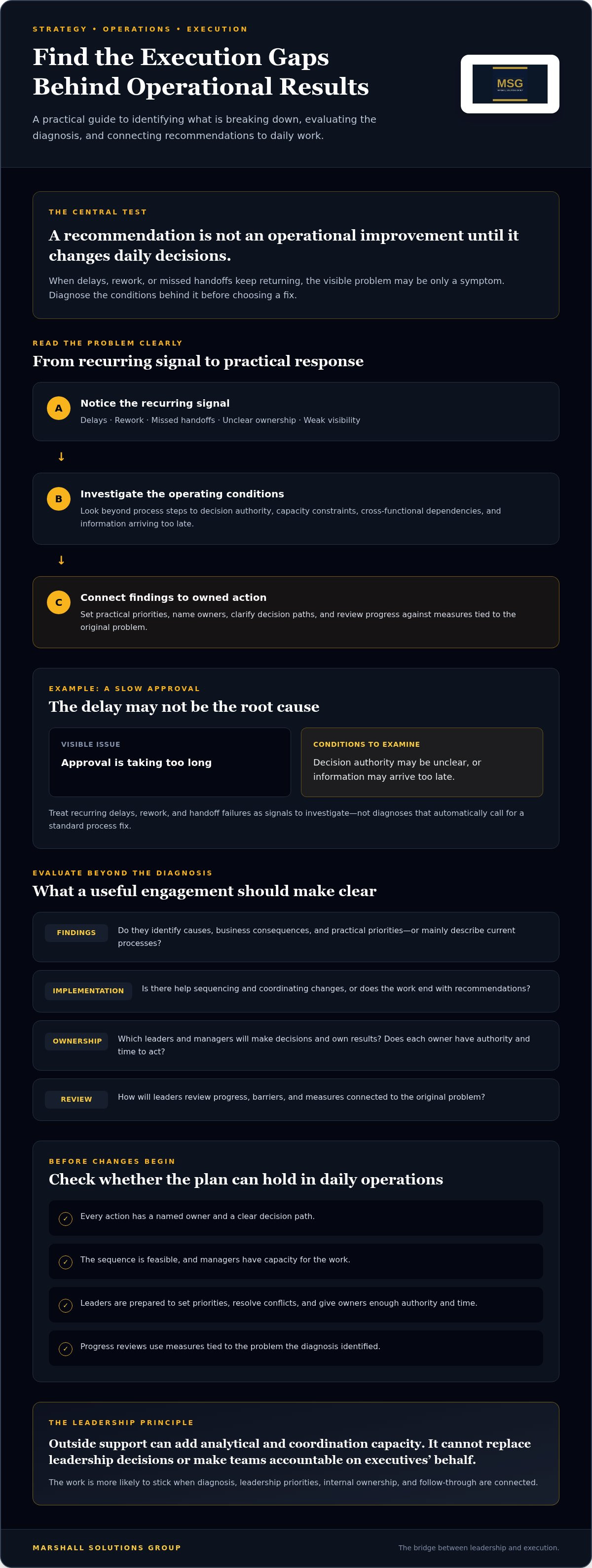
A recommendation that doesn’t change daily decisions isn’t an operational improvement. When delays, rework, or missed handoffs keep returning, the visible problem may be only a symptom. A slow approval, for example, may point to unclear decision authority or information arriving too late. Operational performance consulting should distinguish symptoms from underlying causes before recommending a fix, then connect the recommendations to the work of putting changes in place.
Leaders should expect clear findings, practical priorities, and a way to review progress. This article explains how to define the operational problem before engaging support, assess whether a consultant is addressing root causes, and connect leadership, processes, and accountability to execution. It also covers what to establish after diagnosis, including who owns each change and which measures can show whether improvements are holding in daily operations.
Key Takeaways
- Use operational performance consulting to investigate why results are slipping before committing to a fix.
- Assess whether a consultant examines decision authority, constraints, and cross-functional dependencies, not just process steps.
- Clarify the deliverables, implementation support, and internal ownership for each change.
- Choose a partner whose management capabilities, leadership access, and progress reviews fit the work required to sustain improvement.
Table of Contents
Operational Performance Consulting: Find the Execution Gaps Behind Results
Operational performance consulting helps leaders understand and improve how work gets delivered. The goal isn’t simply to label a process inefficient and prescribe a standard fix. It’s to find where performance breaks down, identify the conditions behind the breakdown, and determine what needs to change in how people make decisions and coordinate work.
Recurring delays, rework, unclear ownership, and weak visibility are signals, not diagnoses. A late approval could reflect unclear decision rights. Rework might result from incomplete handoffs or measures that reward speed over quality. The Operational Excellence overview describes approaches such as Lean Management and Six Sigma, but choosing a method before understanding the operating cause can miss the problem.
For a closer look at the topic, watch this video:
A useful diagnosis should lead to action. Before work begins, clarify how recommendations will be tested, who will own the changes, and how leaders will review progress. Without those agreements, a polished report can leave daily work untouched.
When does an operational performance problem call for outside support?
Consider outside support when bottlenecks keep returning, execution varies across teams, or leaders spend time resolving coordination issues that managers can’t settle. Start by asking where the problem crosses functions: Are decision rights unclear? Do handoffs break down between departments? Do performance measures help teams make decisions, or only report results? If the issue spans teams, authority, and accountability, a focused Leadership & Operations Assessment can help clarify what’s driving it before you choose a response.
How to Evaluate Operational Performance Consulting Beyond the Diagnosis
Evaluate an engagement by what happens after the findings are presented. A useful scope makes the path from diagnosis to action explicit while keeping leaders responsible for decisions and internal ownership.
| Area | What to clarify |
|---|---|
| Diagnostic deliverable | Will findings identify causes, business consequences, and practical priorities, or mainly describe current processes? |
| Implementation role | Will the consultant help sequence and coordinate changes, or conclude after delivering recommendations? |
| Internal ownership | Which leaders and managers will make decisions and own results? |
| Progress review | How often will progress, barriers, and measures tied to the original problem be reviewed? |
Good operational performance consulting also examines the conditions surrounding the work. Ask whether the consultant will assess capacity constraints, decision authority, cross-functional dependencies, and the impact of leaving the issue unresolved. If managers are already carrying full workloads, a plan that adds tasks without making room for them is unlikely to hold.
Outside support can add analytical and coordination capacity, but it can’t replace leadership decisions or make teams accountable on executives’ behalf. Leaders need to set priorities, resolve conflicts, and give owners enough authority and time to act.
What separates useful findings from recommendations that get implemented?
Recommendations need named owners, feasible sequencing, and measures tied to the problem identified. A plan can stall if the accountable manager lacks authority, time, or alignment with teams whose work must change. Before implementation, check that each action has an owner, a decision path, and a way to review progress. For support connecting strategy to follow-through, review Marshall Solutions Group’s execution-focused work.
Choose an Operational Performance Consulting Partner That Stays Through Execution
The right partner brings more than a diagnostic method. Look for relevant management capabilities, a clearly bounded scope, access to decision-makers, a defined implementation role, and a review cadence that keeps work visible. A consultant who can identify a problem but can’t work with leadership on priorities and follow-through may leave your organization with a plan and no capacity to carry it out.
Marshall Solutions Group works across Strategy & Operations, Organizational Leadership & Change, and Program & Project Management. The leadership team brings 60+ combined years of experience. That experience informs the work, but it doesn’t guarantee a particular result. Progress depends on the operating problem, leadership decisions, and the organization’s ability to carry changes into daily work.
What should leaders agree before an engagement begins?
Put four things in writing: the problem statement, the executive decision owner, the boundaries of the work, and the evidence that will show whether progress is occurring. For example, if handoffs are the concern, identify the workflow in scope and agree which existing measure or observable evidence will indicate improvement. Set a review cadence and name who can resolve barriers.
Clarify the implementation role, too. MSG can support leaders as they coordinate priorities, decisions, ownership, and progress. Agree which actions the consulting partner will help move forward and which decisions and adoption responsibilities remain with internal leaders. This makes the division of work clear from the start.
If you’re weighing support, connect with Marshall Solutions Group to discuss the organizational challenge and review whether its Strategy & Operations, Organizational Leadership & Change, or Program & Project Management capabilities fit the work ahead.
Turn Operational Findings Into Lasting Change
Operational performance consulting is most useful when it moves beyond identifying friction and helps leaders act on its causes. A sound next step connects diagnosis to clear ownership, practical priorities, and evidence that shows whether daily work is improving. Recommendations alone won’t change how decisions get made or how teams coordinate.
At Marshall Solutions Group, the leadership team brings 60+ combined years of experience. The firm’s embedded delivery approach stays involved through implementation, with aligned incentives, while organizational leaders retain responsibility for decisions and results.
If recurring operational issues are pulling leaders into constant coordination or keeping strategy from reaching the front line, discuss your operational performance challenge with Marshall Solutions Group. The team can review the challenge and relevant capabilities. With a clear diagnosis, ownership, and follow-through, your organization can build a stronger path from plans to results.
Frequently Asked Questions
What does operational performance consulting include?
Operational performance consulting can assess how leadership, processes, accountability, and execution affect organizational performance. The scope depends on the problem leaders define and the work agreed with the consultant. It may include examining decision rights, handoffs, performance measures, or coordination across teams. It doesn’t automatically include technical implementation, and there’s no universal package that fits every organization.
When should a company hire an operational performance consultant?
Consider outside support when execution problems keep returning, cross team boundaries, or persist after internal fixes. Examples include unclear ownership between departments or bottlenecks that remain despite process changes. First, define the specific problem and name the leader who can make decisions about it. Outside support may not be appropriate if leaders can’t allocate the time or authority needed to act on findings.
How can leaders tell whether operational performance consulting is working?
Agree on a baseline, accountable owners, and measures tied to the identified problem before changes begin. Review those measures regularly to see whether performance is moving in the intended direction, and investigate unintended effects rather than treating one indicator as proof of success. What counts as improvement depends on the organization’s starting point and goals; no specific financial result should be assumed.
Disclaimer
The information provided in this article is for general informational and educational purposes only and does not constitute legal, financial, accounting, engineering, or other professional advice. Marshall Solutions Group, Inc. makes no representations or warranties regarding the completeness or applicability of this information to any specific situation. Readers should consult appropriately qualified professionals before making decisions requiring specialized professional advice.