Operational Challenges for Government Contractors: From Friction to Execution
By CJ Marshall, President & Founder
Address operational challenges for government contractors by diagnosing root causes in governance, capacity, and accountability to protect contract delivery.

Article by
Chelvis “CJ” Marshall
Chelvis “CJ” Marshall is President & Founder of Marshall Solutions Group, a management consulting firm specializing in Strategy & Operations, Organizational Leadership & Change, and Program & Project Management. A retired U.S. Navy Senior Chief who advanced from E-1 to E-8 in 10 years, CJ transitioned into Fortune 500 enterprise leadership, where his commercial experience has included more than $20 million in contract value. He brings operator-level experience leading teams, complex programs, and mission-critical operations. His work focuses on bridging leadership and execution—helping organizations translate strategic direction into disciplined execution, stronger accountability, and measurable business results.
Contract delivery rarely slips because one person simply failed to work hard enough. More often, the operating system around the work is unclear. Operational challenges for government contractors can show up as missed handoffs, slow decisions, shifting priorities, or teams stretched across commitments. Leaders know federal work demands disciplined coordination. The harder task is pinpointing whether a delay stems from unclear ownership, misaligned plans, limited workforce capacity, or inconsistent performance controls.
This article explains how to distinguish symptoms from root causes, what to check before choosing a response, and how to improve governance, coordination, and accountability. It also clarifies when management and program execution support may help, and when a concern needs legal or technical expertise.
Key Takeaways
- Operational challenges for government contractors often point to gaps in ownership, capacity, or coordination, not just individual performance.
- Trace work from decision to handoff to identify where accountability or information breaks down.
- Check whether the constraint is governance, workforce capacity, process consistency, or performance visibility before choosing a fix.
- Match the response to the problem. A targeted correction may be enough, while broader execution gaps may call for stronger governance or program management support.
Table of Contents
Operational Challenges for Government Contractors: Where Execution Breaks Down
Operational challenges for government contractors emerge when delivery demands outpace clear ownership, available capacity, or coordination. A decision waits because no one knows who can approve it. A handoff leaves critical information behind. Managers may see activity across a program but lack a timely picture of what is on track, blocked, or at risk.
These are operating signals, not proof of a single cause. A government contractor may need to coordinate leaders, program teams, and supporting functions around contract work. When those connections are weak, teams can duplicate effort, compete for the same people, or struggle to determine whether planned work fits available capacity. The result may be rework or delivery risk, though the consequences depend on the contract and the specific breakdown.
This video offers another perspective on execution challenges in government contracting:
How to distinguish a delivery symptom from an operating problem
An isolated delay may have a specific cause. Repeated delays at the same approval point, across teams or workstreams, suggest a process or decision-rights problem. Look for patterns before assigning blame.
Start with three questions: Who owns the decision? What information do they need to make it? How quickly does an unresolved issue reach someone with authority to act? If the answers vary depending on whom you ask, escalation routes or accountability may be unclear.
Keep the diagnosis precise. Some concerns require legal or technical expertise, but not every missed handoff or performance gap does. First determine whether the breakdown involves management coordination, ownership, or visibility. That distinction helps leaders choose a response proportionate to the problem.
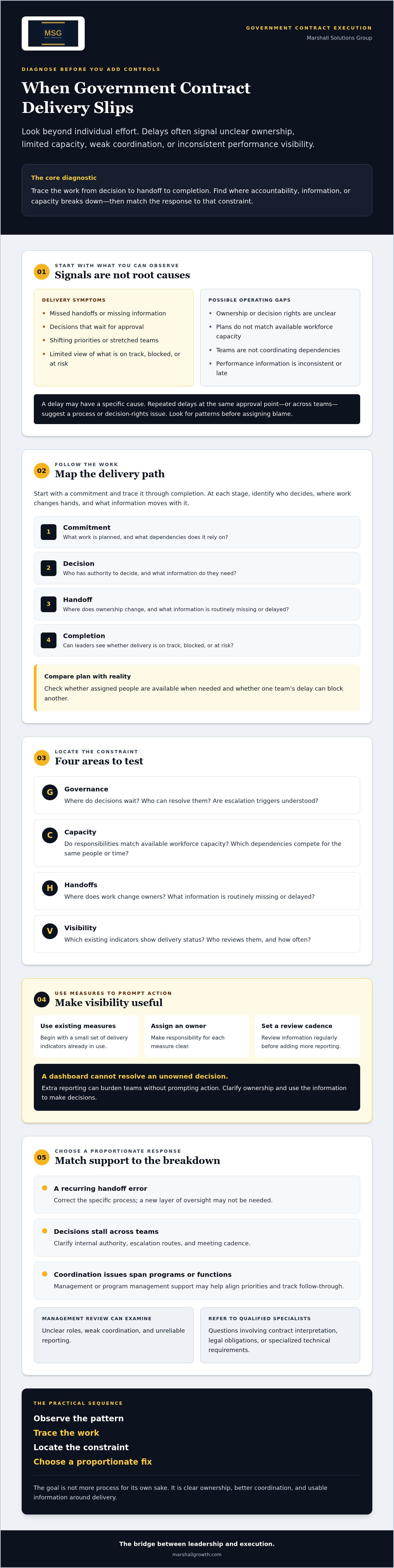
How to Diagnose Government Contractor Operational Challenges
Diagnose the work before adding controls or assigning blame. Map a delivery path from commitment through completion. At each step, note who makes the decision, where work changes hands, and what information moves with it. Then compare the planned path with actual staffing and dependencies: are assigned people available when needed, and can one team’s delay block another?
The Federal contracting practices overview from the U.S. Government Accountability Office offers useful context on the environment. For an internal diagnosis, stay close to the work and test whether the constraint is governance, staffing coordination, process consistency, or performance information.
Questions leaders can use to locate the execution constraint
- Governance: Where do decisions wait, and who has authority to resolve them? Are escalation triggers understood?
- Capacity: Do assigned responsibilities match available workforce capacity? Which dependencies compete for the same people or time?
- Handoffs: Where does work change owners, and what information is routinely missing or delayed?
- Visibility: Which existing indicators show whether delivery is on track or blocked? Who reviews them, and how often?
Start with a small set of delivery measures already in use. Give each measure an owner and a regular review cadence before adding more. A dashboard will not resolve a decision nobody owns, and extra reporting can burden teams without prompting action.
Keep the diagnosis within its lane. A management review can identify unclear roles, weak coordination, or unreliable reporting. Questions about contract interpretation, legal obligations, or specialized technical requirements belong with qualified legal or technical specialists. If the management-side constraint is difficult to isolate, MSG’s management and program execution perspective may help leaders frame the issue.
Respond to Contractor Execution Problems with the Right Management Support
Match the response to the scale and location of the breakdown. A recurring handoff error may call for one process correction, not a new layer of oversight. If decisions stall across teams, clarify internal authority, escalation routes, and meeting cadence. If coordination problems span programs or functions, management or PMO support may help align priorities and track follow-through.
More process is not automatically better. A new checklist or reporting requirement can make responsibilities visible, but it will not solve weak ownership. If nobody acts on the information or maintains the process, the added work can slow delivery without improving control. Before introducing new steps, assign an accountable owner and decide how the change will be reviewed.
When outside program and operations support may fit
Outside support may be useful when leaders lack the capacity to coordinate across functions, reinforce accountability, or keep an execution plan moving while managing other priorities. Marshall Solutions Group provides Program & Project Management, Organizational Leadership & Change, and Process Improvement & Performance support focused on management-level execution. These services do not replace qualified legal counsel or specialists responsible for technical delivery.
Before engaging an advisor, define the work and its boundaries. Which decisions remain with company leadership? Who owns implementation? Which delivery measures will show whether coordination is improving? Clear answers protect internal accountability and keep outside support focused on a defined management need. Look for support that clarifies responsibility and helps carry agreed changes through implementation, rather than stopping at recommendations.
Operational challenges for government contractors do not all require outside help. Use a targeted internal fix when the cause is contained and ownership is clear. Consider broader support when the constraint crosses teams or leaders need added execution capacity to make agreed changes stick.
Turn Execution Friction Into Clear Action
Operational challenges for government contractors are easier to address when leaders separate visible symptoms from the management issue underneath. Trace where decisions stall, work changes hands, or capacity falls short. Then choose a proportionate response, from correcting one process to strengthening governance or adding program management support. More controls will not help if ownership and follow-through remain unclear.
Marshall Solutions Group takes an operator-led approach and stays through implementation, helping organizations connect leadership priorities with program execution. The leadership team has 60+ combined years of experience, and MSG is SBA-certified as an SDVOSB and VOSB, certified June 2026.
If a delivery problem crosses teams or keeps returning despite internal fixes, discuss an execution challenge with Marshall Solutions Group. A clear diagnosis is a practical first step toward more coordinated delivery.
Frequently Asked Questions
What are the most common operational challenges for government contractors?
Operational challenges for government contractors often involve unclear ownership, weak coordination, capacity constraints, or limited performance visibility. For example, a decision may sit between managers, a handoff may omit key information, or planned work may exceed the team’s available capacity. These issues can make delivery harder to coordinate and risks harder to identify early. The specific impact depends on the contract and operating environment.
How can a government contractor identify the root cause of an operational problem?
Trace a recurring problem through the work rather than treating each incident separately. Identify where decisions wait, which teams exchange the work, what information is missing, and whether assigned staff have capacity to meet the plan. Then check who is accountable for resolving the issue and whether escalation reaches someone with authority. Repeated breakdowns at the same point may indicate an operating-process problem.
Can better program governance help address contractor delivery problems?
Yes. Clear governance can define decision ownership, escalation paths, review cadence, and how leaders track delivery commitments. It can help teams surface dependencies and act on delays before they spread across workstreams. Governance will not solve every performance issue, and added reporting can burden teams if no one follows through. It also does not replace qualified legal counsel or technical specialists.
When should a government contractor consider outside operations or program management support?
Consider outside support when execution problems cross teams, leaders lack time to coordinate work, or internal managers need help establishing accountability and keeping plans moving. Define the scope, decision rights, implementation owner, and measures of progress before engaging support. Management and program support addresses coordination and execution. It is not a substitute for specialized legal, engineering, IT, or other technical services.
Disclaimer
The information provided in this article is for general informational and educational purposes only and does not constitute legal, financial, accounting, engineering, or other professional advice. Marshall Solutions Group, Inc. makes no representations or warranties regarding the completeness or applicability of this information to any specific situation. Readers should consult appropriately qualified professionals before making decisions requiring specialized professional advice.