How to Document Business Processes: A Practical Guide
By CJ Marshall, President & Founder
Learn how to document business processes that teams actually follow. Clarify roles, handoffs, and decision points to drive consistent operational execution.

Article by
Chelvis “CJ” Marshall
Chelvis “CJ” Marshall is President & Founder of Marshall Solutions Group, a management consulting firm specializing in Strategy & Operations, Organizational Leadership & Change, and Program & Project Management. A retired U.S. Navy Senior Chief who advanced from E-1 to E-8 in 10 years, CJ transitioned into Fortune 500 enterprise leadership, where his commercial experience has included more than $20 million in contract value. He brings operator-level experience leading teams, complex programs, and mission-critical operations. His work focuses on bridging leadership and execution—helping organizations translate strategic direction into disciplined execution, stronger accountability, and measurable business results.
A process can be documented and still be impossible to follow. If key decisions live in employees’ heads or handoffs depend on who’s working that day, a checklist alone won’t create consistent execution. Learning how to document business processes means making responsibilities and judgment visible, not just listing tasks.
This guide explains how to capture work as it actually happens, clarify roles and decision points, and record handoffs without burying people in unnecessary detail. You’ll also learn how to keep procedures current and connect documentation to process improvement, so the finished document supports better performance instead of gathering dust.
Key Takeaways
- Start with how work actually moves from trigger to outcome, not how a procedure is supposed to work on paper.
- To learn how to document business processes, capture each step’s owner, input, decision, handoff, and output.
- Keep documentation usable by recording the details people need to do the work, not every incidental variation.
- Assign an owner and approval authority so process documents stay current as responsibilities and operating conditions change.
Table of Contents
How to Document a Business Process Without Capturing Unusable Detail
Process documentation is a practical record of how work moves from a trigger to an intended outcome. It should show how the work gets done, where decisions happen, and who is responsible for moving it forward. It doesn’t need to describe every action an employee might take.
That distinction matters when deciding how to document business processes. A procedure copied from a policy or built around an ideal workflow may miss the exceptions and handoffs employees face in practice. Business process modeling offers a way to represent how work flows, but a map or SOP is useful only if people can act on it.
For a step-by-step overview, watch this video from SweetProcess:
Choose the right process and define its boundaries
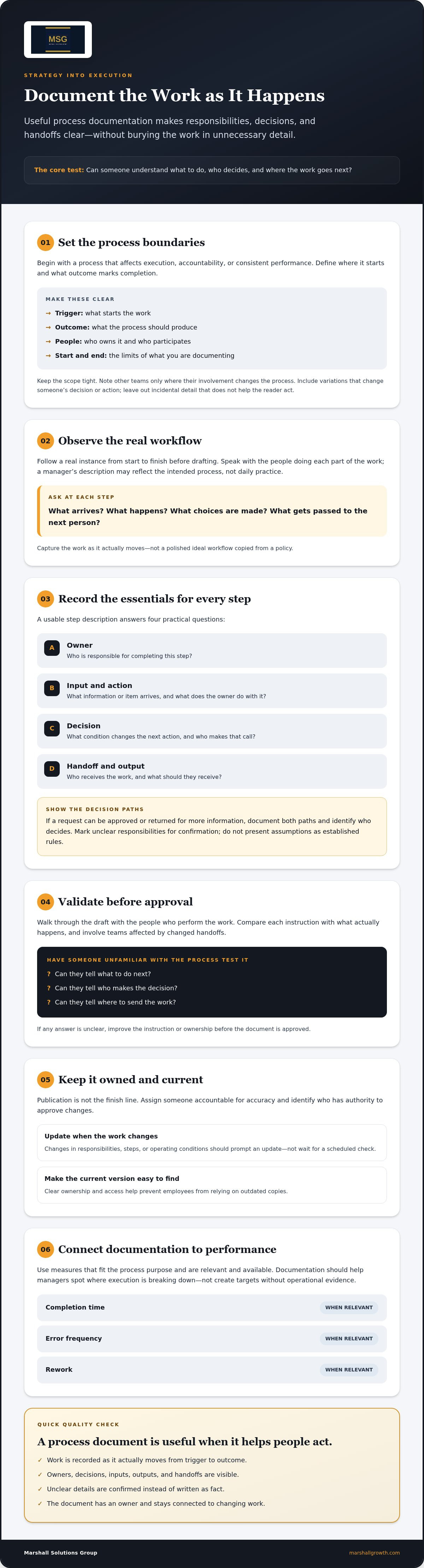
Start with work that affects execution, accountability, or consistent performance. Define what triggers the process, what outcome it should produce, who owns it, and who participates. Set clear start and end points. For example, a process might begin when a customer request is approved and end when the responsible team receives the completed handoff.
Keep the scope tight. Note connections to other teams where they affect the process, but don’t document their entire workflows. A usable SOP explains the steps, owners, decisions, and handoffs people need to complete the work. Include a variation when it changes what someone must decide or do. Leave out detail that doesn’t help the reader act, since a long account of every variation can bury the essentials.
How to Document Business Processes Step by Step
To document business processes accurately, observe the work before writing the procedure. Follow a real instance from start to finish, then speak with the people who perform each part. Ask what they receive, what they do, what choices they make, and what they pass to the next person. Don’t rely on a manager’s description alone. It may reflect the intended process rather than daily practice.
For each step, record the essentials:
- Owner: who is responsible for completing the step.
- Input and action: what information or item arrives, and what the owner does with it.
- Decision: what conditions change the next action.
- Handoff and output: who receives the work and what they should receive.
For example, if a request can be approved or returned for more information, show both paths and identify who makes that decision. Mark exceptions or unclear responsibilities for confirmation. Don’t write an assumption as an established rule. Unresolved details can become errors once people begin relying on the SOP. The complete guide to process documentation offers additional context on creating process documents.
Validate the draft with the people who perform the work
Walk through the draft with participants and compare each step with how the process is actually performed. Then ask someone unfamiliar with the work to follow it. Can they tell what to do next, who decides, and where to send the work? If not, clarify the instruction or ownership before approving the document.
Validation can also reveal who will be affected by a change. A revised handoff may alter another team’s responsibilities, so involve the people who will use the process before rollout. For practical guidance, see this change management guide for process improvement.
Keep Process Documentation Current, Owned, and Connected to Performance
A process document needs an owner after publication. Assign someone accountable for its accuracy and identify who can approve changes. The owner doesn’t have to perform every step, but they should know who does and have a clear way to resolve disagreements about the procedure.
Review the document when responsibilities, process steps, or operating conditions change. A scheduled check can help catch drift, but changes to the work should prompt an update rather than wait for the next review. Make the current version easy to find so employees don’t rely on outdated copies.
Connect the procedure to measures that reflect its purpose, such as completion time, error frequency, or rework, when those measures are relevant and available. The document should help managers see where execution is breaking down, not impose targets unsupported by operational evidence. The process documentation resource also describes documentation as a support for consistency and continuous improvement.
Use documentation to support improvement, not compliance theater
Test the document against actual work. Can employees use it to complete the process? Can a manager identify who owns a stalled step or where a handoff fails? If not, revise the instructions or investigate the operating gap. Repeated questions, workarounds, and unclear decisions are useful signals. They are not reasons to simply add more pages.
Keep the procedure connected to how the organization manages and improves work. For a broader approach, read MSG’s operational excellence framework, or explore MSG’s process improvement and SOP development capabilities.
Put Process Documentation to Work
Knowing how to document business processes is only the first step. The documentation must reflect how work is actually done, make decisions and handoffs clear, and stay current as responsibilities or operating conditions change. When employees can use the procedure and managers can see where work stalls, it becomes a practical tool for consistent execution and improvement.
Keep ownership clear, update the document when work changes, and connect it to relevant performance measures without assuming the document alone will improve results. At Marshall Solutions Group, Process Improvement & Performance includes business process improvement and SOP development. MSG’s stated approach is to stay through implementation with aligned incentives, keeping the focus on putting useful processes into practice.
Explore MSG’s process improvement and SOP development capabilities and start with one process your team needs to run better.
Frequently Asked Questions
What should a business process document include?
A business process document should show how work moves from its trigger to its intended outcome. Include the process owner, participants, start and end points, each step’s input and action, decision points, handoffs, and resulting outputs. Note meaningful exceptions and who approves changes. Keep details focused on what someone needs to perform the work correctly and understand where responsibility sits.
How do you document a process that employees perform differently?
Observe the work and ask employees to explain why their approaches differ. Some variations may reflect legitimate conditions, while others may reveal unclear instructions or inconsistent expectations. Document the decision rules that determine which path to follow. If participants disagree or a rule is uncertain, flag it for the accountable manager to resolve rather than presenting one person’s method as the agreed process.
How often should business process documentation be reviewed?
Review documentation whenever responsibilities, process steps, or operating conditions change. A recurring review can also catch outdated instructions, but the appropriate cadence depends on how often the process changes and the consequences of an error. Assign an owner to monitor changes and set a review schedule. Don’t wait for a scheduled review if employees are already using workarounds or reporting unclear steps.
How can leaders make sure employees use documented processes?
Make the approved procedure easy to find, involve the people who perform the work in validating it, and walk through it with employees before relying on it. Managers should reinforce the process during day-to-day oversight and make it safe to report unclear steps. If people avoid the document, investigate whether it is hard to access, out of date, or disconnected from actual work.
Disclaimer
The information provided in this article is for general informational and educational purposes only and does not constitute legal, financial, accounting, engineering, or other professional advice. Marshall Solutions Group, Inc. makes no representations or warranties regarding the completeness or applicability of this information to any specific situation. Readers should consult appropriately qualified professionals before making decisions requiring specialized professional advice.