Leadership Team Development Consulting: The Operator Framework for 2026
By CJ Marshall, President & Founder
Practical leadership team development consulting eliminates bottlenecks, clarifies decision rights, and drives disciplined execution to protect margins.

Article by
Chelvis “CJ” Marshall
Chelvis “CJ” Marshall is President & Founder of Marshall Solutions Group, a management consulting firm specializing in Strategy & Operations, Organizational Leadership & Change, and Program & Project Management. A retired U.S. Navy Senior Chief who advanced from E-1 to E-8 in 10 years, CJ transitioned into Fortune 500 enterprise leadership, where his commercial experience has included more than $20 million in contract value. He brings operator-level experience leading teams, complex programs, and mission-critical operations. His work focuses on bridging leadership and execution—helping organizations translate strategic direction into disciplined execution, stronger accountability, and measurable business results.
Offsite retreats and personality tests will not fix an executive team that cannot execute. You already recognize the friction: strategic priorities stall, departmental silos block cross-functional accountability, and the CEO remains the single operational bottleneck for every major decision. The issue is rarely a lack of vision or motivation; it is an absence of operational structure. Practical leadership team development consulting addresses this reality head-on, treating team alignment as an operational engineering challenge rather than a motivational exercise.
Discover how executive leadership team development consulting turns misaligned management into a disciplined, high-performing operational engine. Below, we break down the 2026 Operator Framework to establish unified decision rights, build independent second-tier management capacity, and introduce operating cadences that eliminate margin erosion across your organization.
Key Takeaways
- Pinpoint the structural causes of executive friction, from departmental silos to founder bottlenecks that stall strategic momentum.
- Learn how practical leadership team development consulting replaces theoretical facilitators with embedded operational discipline to drive business performance.
- Define explicit decision rights across your executive bench to eliminate managerial overlaps and build independent execution capacity.
- Install structured operating cadences that protect profit margins and translate high-level strategy into measurable daily execution.
Table of Contents
Diagnosing Executive Misalignment: When Strategy Stalls in the C-Suite
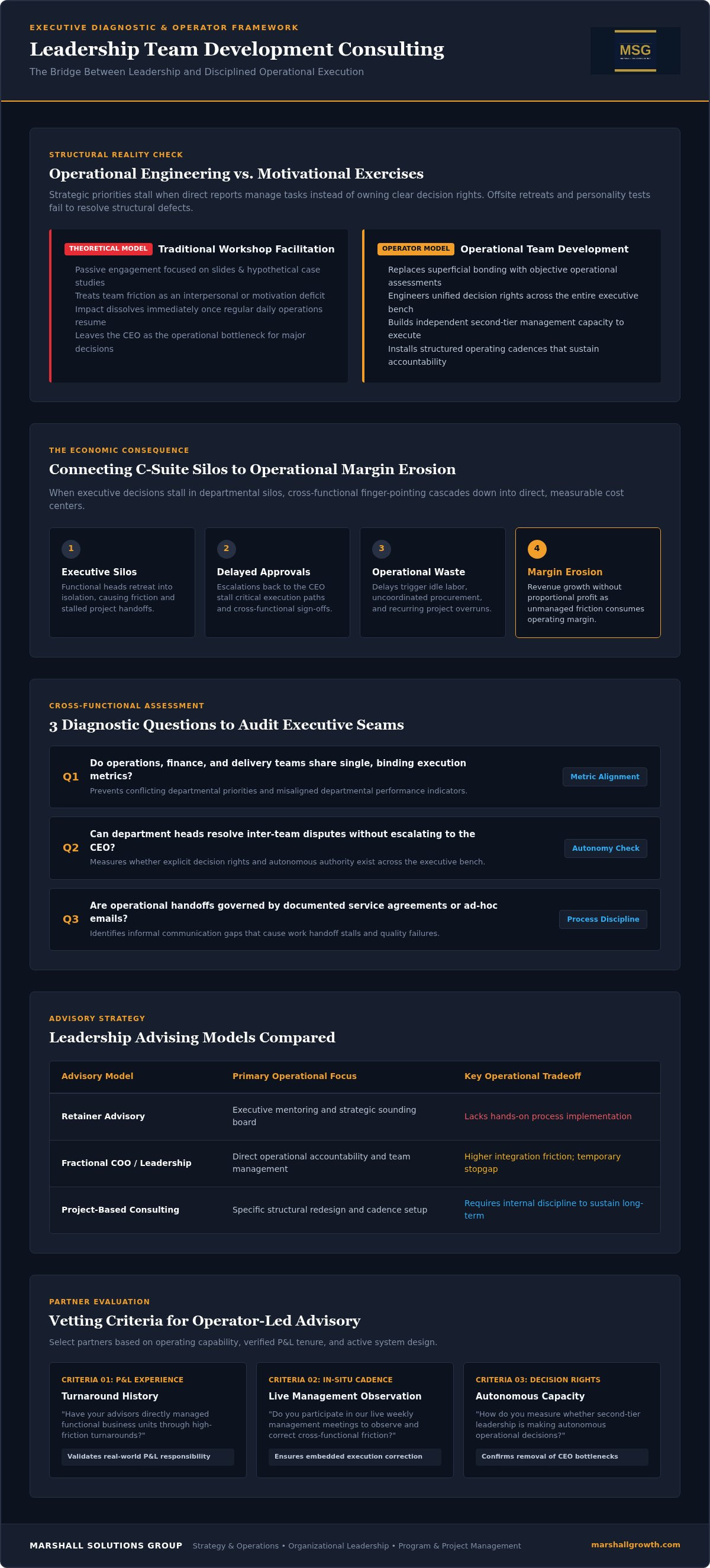
Strategy rarely fails because the market rejected it. It fails because functional heads retreat into departmental silos, creating cross-functional finger-pointing, stalled handoffs, and compounding project delays. Founder dependency persists when direct reports manage tasks rather than owning clear decision rights. Offsite retreats and personality profiles will not solve this structural defect. Effective leadership team development consulting replaces superficial bonding exercises with objective operational assessments, identifying systemic execution bottlenecks where strategy loses momentum.
To see how structured team alignment transforms executive execution, watch this operational overview:
Understanding the broader leadership development process requires recognizing that collective leadership capacity matters more than individual intent.
Connecting C-Suite Silos to Operational Margin Erosion
When executive decisions stall, margin erosion quickly follows. Delayed approvals cascade downward into idle labor, uncoordinated procurement, and recurring project overruns. Evaluate cross-functional friction by asking three diagnostic questions:
- Do operations, finance, and delivery teams share single, binding execution metrics?
- Can department heads resolve inter-team disputes without escalating to the CEO?
- Are operational handoffs governed by documented service agreements or ad-hoc emails?
Rigorous leadership team development consulting targets these seams. Review our guide on results-driven organizational leadership consulting to systematically evaluate and repair your operational structure.
Evaluating Leadership Team Development Consulting: Advising Models Compared
Most organizations select advisory partners based on credentials rather than operating capability. Traditional workshop facilitators focus on passive engagement, delivering slide decks and hypothetical case studies that dissolve once normal operations resume. In contrast, embedded operating partners work alongside executive teams within their real business cadences. While institutional offerings like the Center for Creative Leadership's Leadership Development Program provide research-grounded benchmarks for personal development, operational leadership team development consulting demands active system design. Choosing between advisory retainers, fractional executive roles, and project-based consulting depends on your primary execution bottleneck.
| Advisory Model | Primary Focus | Key Tradeoff |
|---|---|---|
| Retainer Advisory | Executive mentoring and strategic sounding board | Lacks hands-on process implementation |
| Fractional COO / Leadership | Direct accountability and team management | Higher integration friction; temporary stopgap |
| Project-Based Consulting | Specific structural redesign and cadence setup | Requires internal discipline to sustain long-term |
Criteria for Selecting an Operator-Led Advisory Partner
Select your partner using four distinct criteria: verified P&L operational tenure, direct implementation support, cadence establishment, and shared accountability for outcomes. Before committing, ask these vetting questions:
- Have your advisors directly managed functional business units through high-friction turnarounds?
- Do you participate in our live weekly management meetings to observe and correct cross-functional friction?
- How do you measure whether second-tier leadership is making autonomous operational decisions?
Evaluate your internal baseline first with our leadership & operations assessment checklists. If your team struggles to translate strategic objectives into disciplined performance, explore how our team at Marshall Solutions Group bridges the gap between leadership and day-to-day execution.
Implementing an Execution Operating System to Sustain Team Accountability
Accountability without clear authority produces paralysis. When executive roles carry vague mandates, leaders hesitate, defer decisions upward, or step on peer toes. An execution operating system replaces ambiguous oversight with explicit decision rights. Functional leaders must know what expenditures, resource shifts, and delivery trade-offs they own without committee sign-off. High-impact leadership team development consulting instills this discipline by mapping decision matrices directly to project profitability and enterprise scorecards.
Embedding Mission Command and Disciplined Operational Cadences
Mission command solves founder dependency. Define the operational objective, establish clear boundaries, and delegate tactical execution. If a leadership bench can't decide autonomously within those guardrails, the founder remains a bottleneck. Sustaining accountability requires structured management rhythms rather than reactive status meetings:
- Weekly Executive Standups: Sixty minutes focused on KPI variances, cross-functional blockers, and urgent resource reallocation.
- Monthly Operating Reviews: Retrospectives analyzing department budget pacing, operational handoffs, and project margin performance.
- Quarterly Strategy Alignment: Recalibrating strategic priorities against proven operational capacity.
Connecting these structured rhythms to an operational excellence framework turns executive alignment into a sustained business habit. Pragmatic leadership team development consulting ensures your executive team executes with precision, protecting profit margins without executive intervention.
Turn Executive Alignment into Measurable Operating Results
Strategic plans mean nothing without operational discipline. Shifting an executive team from siloed hesitation to decisive ownership requires structured decision rights, objective business cadences, and uncompromising accountability. That is the core value of pragmatic leadership team development consulting.
Marshall Solutions Group operates as the bridge between leadership and execution. As a veteran-owned firm led by former military operators with 60+ years of combined command experience, we reject passive slide decks to embed durable management systems directly into your business. With an active nationwide track record supporting commercial enterprises and federal contractor teams, we help you eliminate operational bottlenecks and protect project margins. Take command of your execution capacity. Schedule a strategic leadership consultation with Marshall Solutions Group today.
Frequently Asked Questions
What is the difference between leadership team development consulting and executive coaching?
Executive coaching focuses on an individual leader's personal skills and mindset, while leadership team development consulting optimizes how the executive unit operates together. Coaching develops the person. Consulting repairs the operational machine, establishing explicit decision rights, handoff agreements, and cross-functional operating cadences so the entire bench executes strategy without friction.
How do you measure the return on investment from leadership team consulting?
You measure return on investment through concrete operational metrics rather than subjective team satisfaction scores. Track reductions in CEO escalation volume, shortened strategic cycle times, improved variance closure in monthly reviews, and protected project profit margins. When executive alignment takes hold, operational delays drop and labor efficiency immediately improves.
How long does a leadership team development engagement typically take to show operational results?
Visible changes in decision velocity and meeting efficiency typically emerge within the first 30 to 60 days. Clarifying operational boundaries delivers immediate relief. Sustaining those behaviors across second-tier managers and translating alignment into bottom-line profitability generally requires three to six months of disciplined operating cadences.
Can leadership team consulting resolve deep-seated conflict between functional department heads?
Yes, because most executive disputes stem from structural defects rather than personal animosity. Operational leadership team development consulting removes ambiguity around territory, competing incentives, and overlapping authorities. When you establish shared enterprise metrics and binding decision matrices, friction disappears and functional leaders focus on joint execution.
Disclaimer
The information provided in this article is for general informational and educational purposes only and does not constitute legal, financial, accounting, engineering, or other professional advice. Marshall Solutions Group, Inc. makes no representations or warranties regarding the completeness or applicability of this information to any specific situation. Readers should consult appropriately qualified professionals before making decisions requiring specialized professional advice.