Crisis Management for Small Business: A Practical Guide
By CJ Marshall, President & Founder
Use strategy and operations consulting to build a practical small business crisis plan that sets clear decision authority and protects essential operations.

Article by
Chelvis “CJ” Marshall
Chelvis “CJ” Marshall is President & Founder of Marshall Solutions Group, a management consulting firm specializing in Strategy & Operations, Organizational Leadership & Change, and Program & Project Management. A retired U.S. Navy Senior Chief who advanced from E-1 to E-8 in 10 years, CJ transitioned into Fortune 500 enterprise leadership, where his commercial experience has included more than $20 million in contract value. He brings operator-level experience leading teams, complex programs, and mission-critical operations. His work focuses on bridging leadership and execution—helping organizations translate strategic direction into disciplined execution, stronger accountability, and measurable business results.
A crisis plan is tested less by what it predicts than by who can act when normal authority breaks down. For a small business, strategy and operations consulting can help turn preparation into clear decisions and workable steps, rather than another document no one reaches for under pressure.
You already know disruptions can strain a small team’s time, capacity, and cash flow. The harder question is who decides what happens first when the owner or a key manager isn’t available. This guide will help you identify threats to essential operations and build a crisis plan that clarifies roles, decisions, communication, and recovery priorities. You’ll also see how to test and update the plan so it reflects how your business actually works, not just how it looks on paper.
Key Takeaways
- Separate crisis response from business continuity and recovery, while connecting all three to protecting essential work.
- Use strategy and operations consulting principles to set decision authority and prioritize actions without building an overcomplicated manual.
- Document who communicates, through which channels, and what information the team needs to act.
- Test the plan with a realistic disruption scenario, then update it based on unclear ownership, delays, and overlooked dependencies.
Table of Contents
Crisis Management Planning for Small Business: What the Plan Must Protect
A small-business crisis plan is a practical guide for making decisions, communicating with the people affected, and keeping essential work moving during a disruption. Crisis management covers the actions leaders take to address an unexpected event and limit its effects. The plan should make those actions clear before pressure sets in.
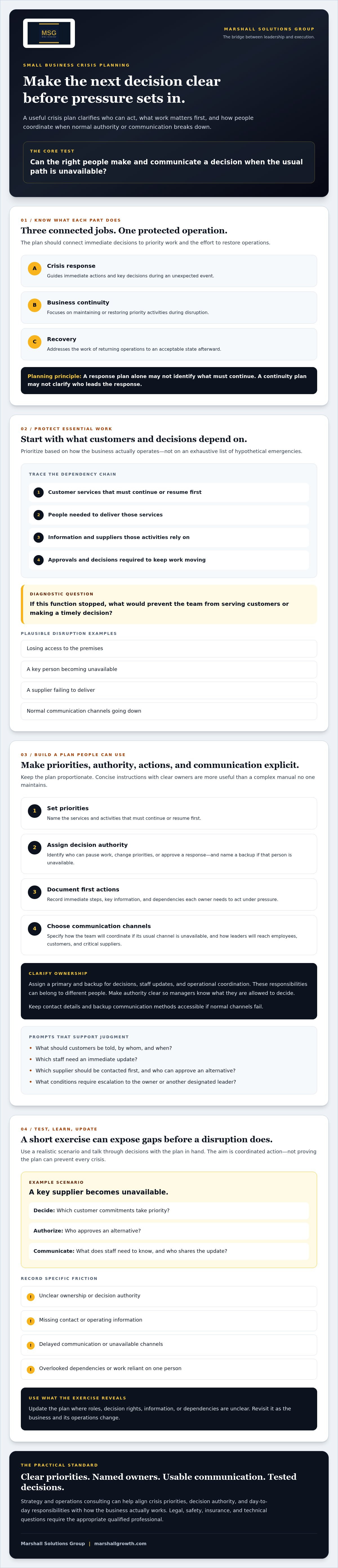
Related disciplines have different jobs. Crisis management guides the immediate response and key decisions. Business continuity focuses on maintaining or restoring priority activities during disruption. Recovery addresses the work of returning operations to an acceptable state afterward. They overlap, but a response plan alone won’t identify what must continue, and a continuity plan may not clarify who leads the response.
Choose scenarios that reflect how the business actually operates. Plausible disruptions might include losing access to the premises, a key person becoming unavailable, a supplier failing to deliver, or normal communication channels going down. A generic checklist can miss the dependency that would stop your team from serving customers or making decisions.
Which business functions need to keep working first?
Start with the services customers rely on, the people needed to deliver them, and the information and suppliers those activities depend on. Ask: If this function stopped, what would prevent us from serving customers or making a timely decision? Then trace the dependencies behind it. A service may rely on one manager’s approval, a single supplier, or records only one person can access.
Set priorities based on those answers, not on a long list of hypothetical emergencies. For a small team, the first useful plan is one leaders can understand and act on. This is where strategy and operations consulting can help align priorities, roles, and day-to-day responsibilities without confusing planning with specialized emergency or technical services.
How to Build a Small-Business Crisis Plan Without Overengineering It
A useful plan doesn’t need to cover every imaginable emergency. It needs to help people act. Start with the essential operations identified earlier, then build a short sequence around them:
- Set priorities: Name the services and activities that must continue or resume first.
- Assign decision authority: Identify who can pause work, change priorities, or approve a response, including a backup if that person is unavailable.
- Document first actions: Record the immediate steps, key information, and dependencies each owner needs. Keep instructions specific enough to use under pressure.
- Choose communication channels: Document how the team will coordinate if its usual channel is unavailable, and how leaders will reach employees, customers, and critical suppliers.
Then add prompts that guide judgment rather than trying to script every conversation. What should customers be told, by whom, and when? Which staff need an immediate update? Which supplier should be contacted first, and who can approve an alternative? What conditions require escalation to the business owner or another designated leader?
Who decides, communicates, and coordinates during a disruption?
Assign a primary and backup owner for decisions, staff updates, and operational coordination. These can be different people. Make authority explicit so a manager isn’t expected to act without knowing what they’re allowed to decide. Store contact details and backup communication methods where responsible people can access them if normal channels fail.
Keep the document proportionate to the business. A complex manual that no one maintains is less useful than a concise plan with clear owners and current contact information. Strategy and operations consulting can help leaders align roles and priorities with actual operations. For legal, safety, insurance, or technical questions, identify the qualified professional to consult; don’t use an internal plan as a substitute for specialist advice.
How to Test and Update Your Crisis Management Plan
A plan that hasn’t been tested may leave basic questions unanswered: Who can authorize a change in priorities? Can the team reach one another if the usual channel is unavailable? A short, discussion-based exercise can expose those gaps without disrupting normal operations.
Choose a plausible disruption tied to your business, such as a key supplier becoming unavailable. Set a few decision points: Which customer commitments take priority? Who approves an alternative? What does staff need to know, and who shares the update? Ask participants to talk through their actions using the plan. The aim isn’t to prove the plan can prevent every crisis. It’s to see whether people, processes, and authority support a coordinated response.
Record specific friction, not just general impressions. Note unclear ownership, missing contact or operating information, delayed communication, and dependencies the plan overlooks. These often point to execution issues: leaders may agree on priorities but lack clear decision rights, or a process may depend on one person who isn’t available.
What should leaders review after an exercise or real disruption?
Update contacts, role assignments, essential-operation priorities, and communication steps whenever they change. For each gap, name an owner and a follow-up date. Then verify the change was made and that the revised guidance is usable. A list of lessons without assigned follow-through is not improvement.
If the exercise exposes broader weaknesses in accountability or operating processes, a Leadership & Operations Assessment can help leaders examine those issues beyond the crisis plan itself. Strategy and operations consulting can also support the alignment of priorities, decision authority, and execution; the work is organizational, not a substitute for specialized emergency or technical services.
Make Your Crisis Plan Ready for Action
A useful crisis plan protects the work your business depends on, clarifies who can make decisions, and gives the team a practical way to coordinate. Keep it grounded in your actual operations, then test it against a realistic disruption. Update it when responsibilities, contacts, or critical dependencies change. A plan can’t prevent every crisis, but clear roles and follow-through can help your people respond with less confusion.
That discipline depends on leadership and execution, not documentation alone. Marshall Solutions Group’s leadership team brings 60+ combined years of experience, and its embedded delivery approach stays through implementation with aligned incentives. Strategy and operations consulting can help connect organizational priorities with the decisions and processes needed to carry them out.
Explore Marshall Solutions Group’s strategy and operations capabilities, and take the next step toward a plan your team can put to work. Start with clarity. Build from there.
Frequently Asked Questions
What should a crisis management plan for a small business include?
Include the decisions, roles, and communication steps people need to protect essential operations during a disruption. Identify priority services and dependencies, assign primary and backup decision-makers, document immediate actions, and record how to reach employees, customers, and critical suppliers if normal channels fail. Keep the plan specific to your business, and identify specialist questions that require qualified professional advice.
How often should a small business review its crisis management plan?
Review the plan on a regular schedule and whenever a meaningful change affects operations. Changes in key roles, suppliers, customer commitments, contact details, or communication tools can make instructions unreliable. Also review the plan after a discussion exercise or real disruption. Assign someone to update it, then check that changes were made and the revised steps still reflect how the business works.
Can a small business create a crisis plan without hiring a consultant?
Yes. Leaders can build a practical first version by identifying priority operations, assigning decision authority, documenting initial actions, and choosing backup communication channels. Test it with a realistic scenario and correct gaps as they appear. If roles, processes, or priorities are difficult to align, strategy and operations consulting can help structure the planning and execution without replacing legal, safety, insurance, or technical specialists.
What is the difference between crisis management and business continuity planning?
Crisis management focuses on how leaders respond to an unexpected event, make decisions, and communicate. Business continuity planning focuses on maintaining or restoring essential activities during disruption. Recovery addresses the work of returning operations to an acceptable state afterward. These efforts connect, but they aren’t interchangeable: a response plan may not explain what work must continue, while continuity planning may not define who leads the response.
Disclaimer
The information provided in this article is for general informational and educational purposes only and does not constitute legal, financial, accounting, engineering, or other professional advice. Marshall Solutions Group, Inc. makes no representations or warranties regarding the completeness or applicability of this information to any specific situation. Readers should consult appropriately qualified professionals before making decisions requiring specialized professional advice.