Root Cause Analysis Techniques: An Operator’s Guide to Solving Persistent Failures (2026)
By CJ Marshall, President & Founder
Stop blaming people for broken processes. Apply proven root cause analysis techniques to eliminate recurring failures and protect your operating margins.

Article by
Chelvis “CJ” Marshall
Chelvis “CJ” Marshall is President & Founder of Marshall Solutions Group, a management consulting firm specializing in Strategy & Operations, Organizational Leadership & Change, and Program & Project Management. A retired U.S. Navy Senior Chief who advanced from E-1 to E-8 in 10 years, CJ transitioned into Fortune 500 enterprise leadership, where his commercial experience has included more than $20 million in contract value. He brings operator-level experience leading teams, complex programs, and mission-critical operations. His work focuses on bridging leadership and execution—helping organizations translate strategic direction into disciplined execution, stronger accountability, and measurable business results.
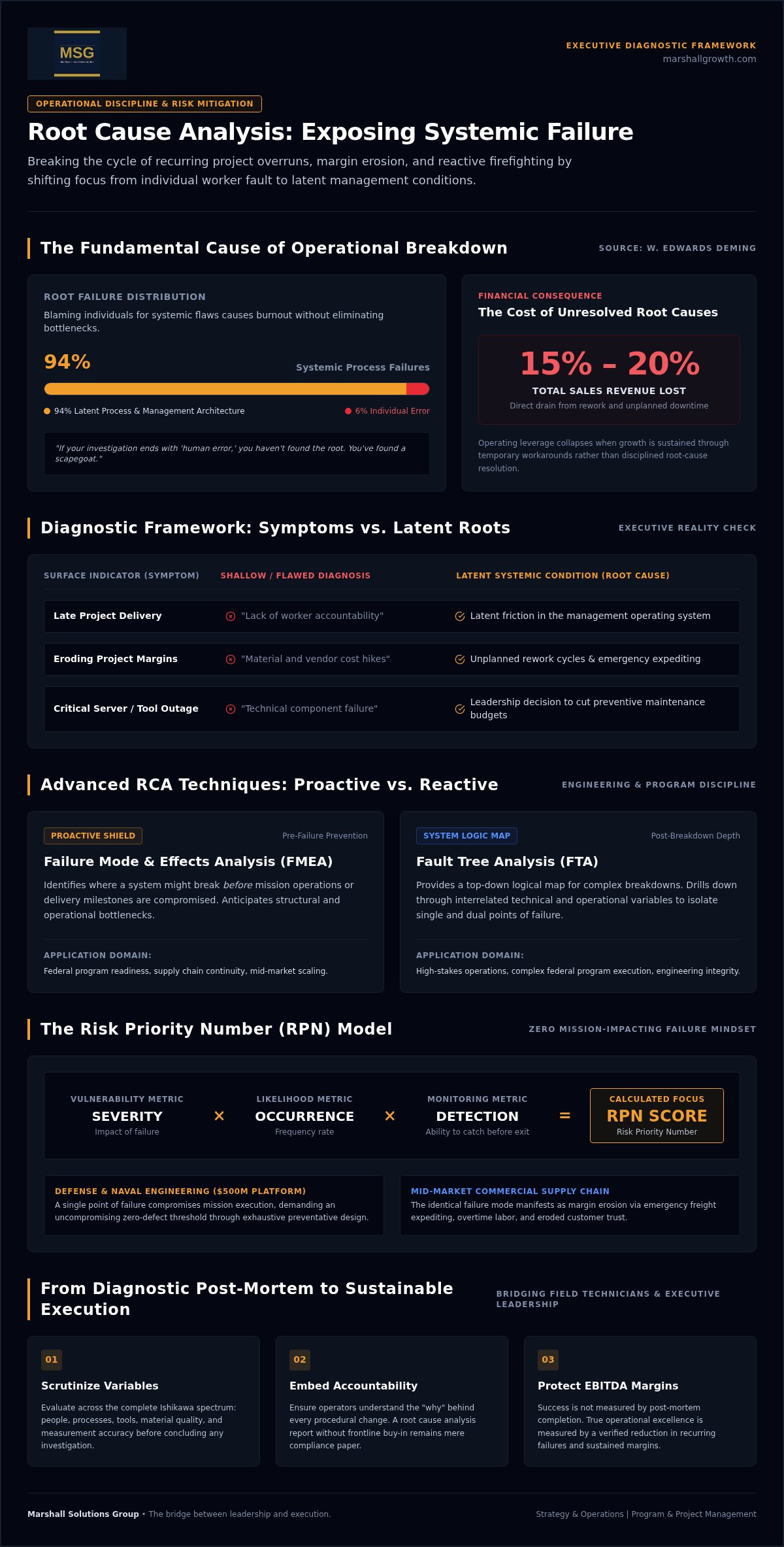
According to W. Edwards Deming, 94% of operational failures are rooted in systemic process issues, not individual worker error. If your leadership team is stuck in a cycle of recurring project overruns and constant firefighting, it's tempting to blame a lack of accountability. However, blaming people for systemic flaws is a strategy for burnout, not growth. To break this loop, you must move past surface-level symptoms and apply rigorous root cause analysis techniques that expose the underlying bottlenecks stalling your scale.
This guide provides the diagnostic frameworks and implementation strategies required to isolate these failures and restore operational discipline to your organization. We'll examine why standard corrective actions often fail and how to implement the strong systemic changes that protect your margins. It's time to stop managing the symptoms and start leading the solution.
Key Takeaways
- Distinguish between acute symptoms and the latent systemic conditions that allow failures to recur across your organization.
- Master advanced root cause analysis techniques, including Failure Mode and Effects Analysis (FMEA), to anticipate and prevent operational bottlenecks.
- Adopt a "zero mission-impacting failure" mindset by applying disciplined engineering principles to your core business processes.
- Transition from diagnostic post-mortems to sustainable execution by embedding accountability into your management operating system.
Table of Contents
The Diagnostic Framework: Moving Beyond Symptoms to Root Causes
Operational friction often presents as late project deliveries or eroding margins. These aren't the problems; they're the indicators. When leaders fixate on the symptom, they miss the latent conditions within the management operating system. This shallow diagnosis leads to a cycle of rework that drains capital and destroys operating leverage. Most efforts to apply root cause analysis techniques fail because teams default to individual blame. If your investigation ends with "human error," you haven't found the root. You've found a scapegoat. Real discipline requires looking at the environment that allowed the error to occur.
Is your team fixing the problem, or just the immediate crisis? To better understand the mechanics of this diagnostic process, watch this helpful video:
Failing to align with root cause analysis principles ensures that today's fire will return tomorrow. This lack of precision costs organizations between 15% and 20% of total sales revenue through rework and unplanned downtime. You cannot scale a business built on workarounds.
The 5 Whys and Fishbone Diagram: Practical Executive Application
Root cause analysis is the systematic process of identifying the fundamental breakdown in a system to prevent recurrence. Utilizing structured root cause analysis techniques allows leaders to move past technical excuses to leadership gaps. For instance, "the server crashed" becomes "the maintenance budget was cut." The Ishikawa diagram further categorizes these frictions across people, processes, and tools. This ensures that every variable, from material quality to measurement accuracy, is scrutinized before a solution is finalized.
Advanced Root Cause Analysis Techniques for Mission-Critical Operations
In high-stakes environments, waiting for a failure is not an option. You must predict it. While basic methods resolve simple stops, mission-critical operations require advanced root cause analysis techniques like Failure Mode and Effects Analysis (FMEA) and Fault Tree Analysis (FTA). FMEA acts as a proactive shield. It identifies where a system might break before the mission is compromised. Conversely, FTA provides a top-down logical map for complex breakdowns, such as those found in federal program execution. Choosing the right tool requires balancing the speed of diagnosis with the necessity of depth. A quick fix on a non-critical process is acceptable. Systemic risks demand an exhaustive investigation.
FMEA for Risk Mitigation in Federal and Industrial Environments
A "zero mission-impacting failure" mindset is the standard in military engineering. We apply this same discipline to business processes by calculating a Risk Priority Number (RPN). This score multiplies the severity, occurrence, and detection of a vulnerability to focus leadership on the highest-impact threats. For example, a single point of failure in a $500M naval engineering platform can be catastrophic. In a mid-market supply chain, that same failure mode might simply erode margin through emergency expediting. By integrating these findings into Operational Performance Assessments, leaders can drive EBITDA growth by removing hidden operational waste. Utilizing ASQ's root cause analysis tools ensures your team remains grounded in proven methodologies rather than guesswork. If your growth is outpacing your capacity, it's time to conduct a Strategy & Operations audit to identify these latent risks before they manifest.
Implementing RCA: Building a Culture of Accountability and Execution
Identifying the problem is only half the battle. A diagnosis is a post-mortem that fails if it doesn't force a change in your Operational Excellence Framework. Many organizations treat root cause analysis techniques as a box-ticking exercise for compliance. That's a mistake. We act as "Embedded Operators" who stay through the implementation phase. We bridge the gap between the field technician and the CEO. If the operator doesn't understand the "why," the fix won't last. Success isn't a finished report; it's a measurable reduction in recurring failures and improved project margins.
Leaders must foster an environment where truth is valued over comfort. Utilizing the OSHA incident investigation framework helps teams look beyond surface-level mistakes to uncover systemic deficiencies. This builds a culture of prevention rather than blame.
From Diagnosis to Disciplined Execution
Disciplined execution demands clear decision rights. Corrective actions fail when ownership is vague. We integrate RCA findings directly into company-wide KPIs and SOPs to ensure the new process becomes the standard. This leadership-led model differs from "deck-and-disappear" consulting. Applying disciplined root cause analysis techniques requires skin in the game. If persistent failures are stalling your capacity, a Strategy & Operations audit will provide the clarity needed to stabilize your systems.
Stabilize Your Operations Through Disciplined Execution
Persistent operational failures aren't just inconveniences. They're margin killers that stall your growth. By moving beyond surface symptoms and applying disciplined root cause analysis techniques, you transition from constant firefighting to strategic scaling. We've led engineering departments in $500M mission-critical environments where failure wasn't an option. Our team brings that same veteran-led precision to your organization. We don't just deliver a presentation and exit. As veteran-owned, embedded operators, we stay through the implementation phase because we have skin in the game. We ensure your new processes stick and your team stays accountable to the results. It's time to stop managing symptoms and start solving the fundamental breakdowns in your system. Schedule a Leadership & Operations Assessment with Marshall Solutions Group today. You've built the vision; let's build the engine that sustains it.
Frequently Asked Questions
What is the most effective root cause analysis technique for small businesses?
The 5 Whys is the most effective starting point for small businesses because it requires no specialized software or expensive certifications. It's a low-overhead method that forces teams to drill down into procedural gaps. For more complex cross-functional issues, a Fishbone diagram provides better structure. The goal is to move from surface symptoms to the systemic failures stalling your growth.
How do I know if my team has found the true root cause or just a contributing factor?
You've found the true root cause when removing that specific condition prevents the failure from recurring entirely. Contributing factors make an event more likely but don't cause it alone. Effective root cause analysis techniques require you to test your findings. If the failure mode remains possible after your fix is implemented, you've only addressed a symptom or a secondary factor.
Can root cause analysis be used for leadership and cultural problems?
Root cause analysis is essential for diagnosing leadership and cultural problems. Most culture issues are actually symptoms of unclear decision rights or misaligned incentives. By treating a lack of accountability as a process defect, you can identify the specific management gaps causing the friction. This approach moves the conversation from personal blame to systemic operational discipline and measurable leadership improvement.
How often should a company perform a formal root cause analysis?
Formal analysis should occur immediately following any mission-impacting failure, significant near-miss, or chronic project overrun. It isn't a scheduled meeting; it's a tactical response to operational friction. Applying root cause analysis techniques consistently ensures that small errors don't evolve into catastrophic failures. If your project margins are eroding over time, a formal diagnostic review is mandatory to protect your EBITDA.
Disclaimer
The information provided in this article is for general informational and educational purposes only and does not constitute legal, financial, accounting, engineering, or other professional advice. Marshall Solutions Group, Inc. makes no representations or warranties regarding the completeness or applicability of this information to any specific situation. Readers should consult appropriately qualified professionals before making decisions requiring specialized professional advice.