Operational Readiness Checklist: The Leader’s Guide to Disciplined Execution (2026)
By CJ Marshall, President & Founder
Use an operator-led operational readiness checklist to clear leadership bottlenecks, verify organizational capacity, and protect project margins before launch.

Article by
Chelvis “CJ” Marshall
Chelvis “CJ” Marshall is President & Founder of Marshall Solutions Group, a management consulting firm specializing in Strategy & Operations, Organizational Leadership & Change, and Program & Project Management. A retired U.S. Navy Senior Chief who advanced from E-1 to E-8 in 10 years, CJ transitioned into Fortune 500 enterprise leadership, where his commercial experience has included more than $20 million in contract value. He brings operator-level experience leading teams, complex programs, and mission-critical operations. His work focuses on bridging leadership and execution—helping organizations translate strategic direction into disciplined execution, stronger accountability, and measurable business results.
Operational readiness isn't an administrative milestone checked off the night before launch; it is a command function designed to protect your margin. When growth outpaces operational capacity, leadership bottlenecks form fast. You already know the frustration of watching strong strategic plans stall because ownership is muddy and managers are stuck firefighting. A disciplined operational readiness checklist bridges that divide between executive intent and ground-level execution.
You shouldn't have to step into every decision just to keep a program on schedule and on budget. This guide provides an operator-led framework to verify organizational capacity, eliminate leadership bottlenecks, and protect project profitability before committing critical resources. Ahead, we break down the four core pillars of execution readiness and the clear go/no-go criteria required to keep your operations stable under scale.
Key Takeaways
- Discover why strategic plans fail when authority and accountability diverge, and how to fix frontline execution gaps early.
- Apply a four-pillar operational readiness checklist to stress-test standard operating procedures and infrastructure before capacity bottlenecks threaten delivery.
- Pinpoint the leadership and owner bottlenecks that pull executives into daily firefighting and steadily erode project margins.
- Evaluate when embedded operational leadership and fractional COO support outperform traditional slide-deck consulting models.
Table of Contents
The Strategy-to-Execution Gap: Why Readiness Fails
Most strategic initiatives don't fail because the original vision was flawed. They collapse because leadership confuses planning with readiness. Traditional consulting often delivers an impressive slide deck and disappears, leaving frontline teams with broad goals and zero tactical support. When accountability is pushed onto department managers who lack actual decision rights, the executive team becomes a massive leadership bottleneck. The resulting operational friction stalls delivery and leaves teams guessing on priorities.
To see how disciplined teams establish objective verification gates before go-live, watch this breakdown:
Launching operations before verifying organizational capacity triggers immediate labor inefficiency, unbudgeted overtime, and margin erosion. Project Management Institute data reveals that 31% of complex projects fail to achieve their intended business benefits, suffering multiple simultaneous execution breakdowns. For growing mid-market companies, this dynamic causes revenue growth without proportional profit. An operational readiness checklist stops this margin bleed by objectively confirming workflow stability before capital and customer commitments are finalized.
Defining "Ready" vs. "Planning"
Planning maps out what should happen under ideal conditions on paper. Readiness verifies what can happen under genuine operational friction. Execution breakdowns rarely stem from technical capability gaps; they occur when cross-functional communication fails and decision rights remain ambiguous. Veteran-led discipline replaces assumptions with verified capacity. It establishes clear command intent across every tier of management, ensuring frontline leaders have the operational framework to execute without founder intervention. A disciplined operational readiness checklist establishes that baseline, confirming that standard operating procedures, tooling, and leadership chains are locked in before execution begins.
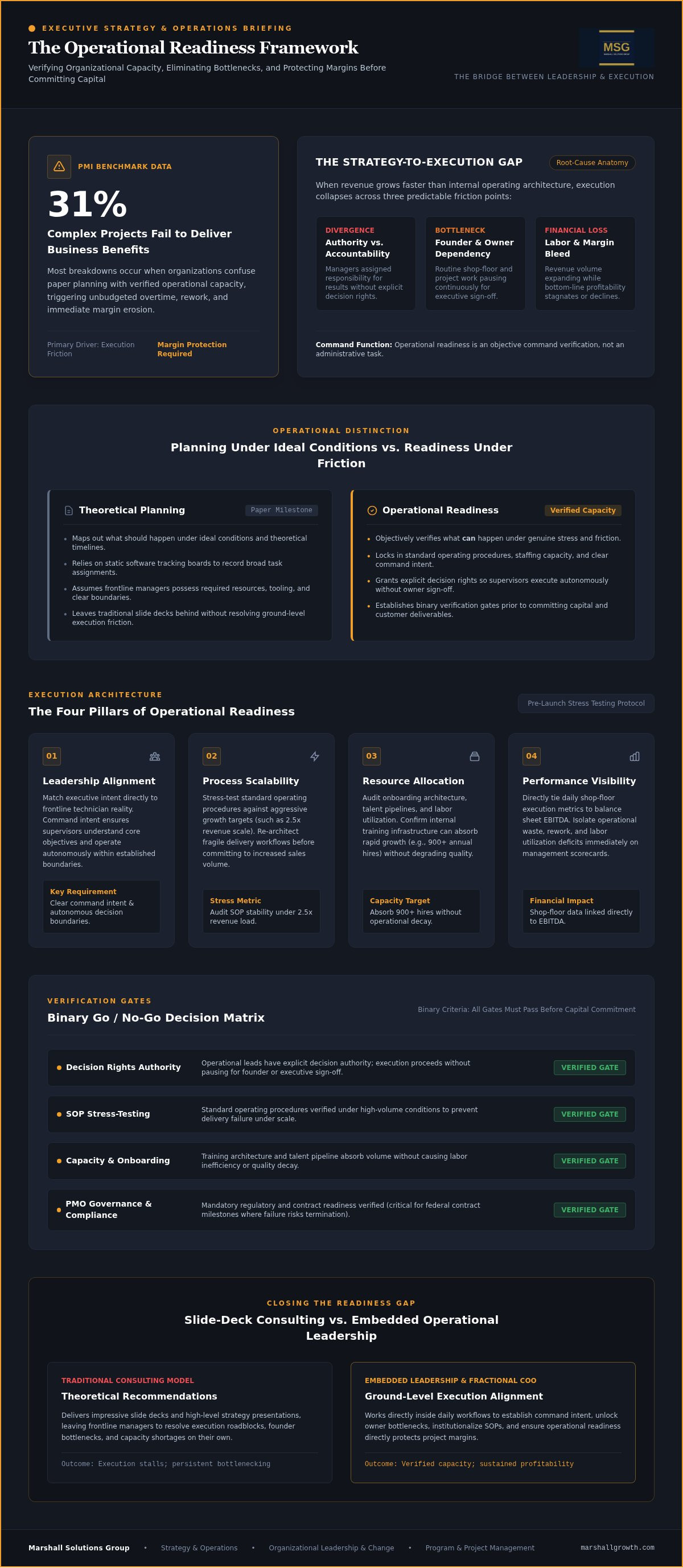
The 2026 Operational Readiness Checklist: Four Pillars of Execution
Software tracking boards don't solve execution deficits. Tools merely record tasks; disciplined leaders verify capacity. To protect margins and prevent delivery failures, an operational readiness checklist must evaluate four operational pillars before committing critical capital:
- Leadership Alignment: Executive intent must match frontline technician reality. Command intent means every supervisor understands the mission objectives and operates autonomously within assigned boundaries.
- Process Scalability: Audit standard operating procedures under stress. If your systems buckle when scaling toward a 2.5x revenue target, your delivery models require restructuring before adding sales volume.
- Resource Allocation: Verify talent pipelines, utilization baselines, and onboarding architecture. Scaling firms must prove their training systems can absorb rapid growth, such as 900+ annual hires, without degrading operational quality.
- Performance Visibility: Connect daily shop-floor metrics directly to EBITDA performance. When operational waste, rework, and labor utilization remain invisible on management scorecards, margin erosion is inevitable.
The Mission-Critical Readiness Scorecard
Executing under pressure requires binary verification. Does each operational lead have explicit decision authority, or does routine work pause for owner sign-off? PMO governance must also confirm regulatory readiness, particularly for federal contract milestones where compliance failures trigger immediate contract termination. Review our detailed Operational Readiness Assessment for deeper diagnostic criteria across complex programs.
Before launching high-stakes initiatives, conduct a structured Leadership & Operations Assessment to verify frontline capacity and isolate operational friction before it reaches your balance sheet.
Closing the Readiness Gap: From Assessment to Action
Discovering operational gaps is only half the battle; remediating them before launch is where execution stalls. In many growing firms, completing an operational readiness checklist exposes an acute founder bottleneck: the owner remains the sole clearinghouse for day-to-day operational decisions. Traditional consulting firms answer this friction with another slide presentation and walk away. When delivery margins are on the line, theoretical models fail. You don't need advice from the sidelines. You need skin in the game. Embedded operational leadership works directly inside daily workflows, aligning advisory incentives with measurable EBITDA performance.
The Role of Fractional Leadership in Scaling Operations
Fractional COO support delivers seasoned operational capability without the fixed overhead of a full-time C-suite hire. Rather than leaving managers to resolve failing workflows alone, fractional leaders re-engineer standard operating procedures, establish clear decision rights, and eliminate cross-functional drag. Veteran-led leadership brings proven composure to complex federal programs and commercial operations, structuring governance rhythms that hold up under real-world pressure.
Closing execution gaps requires disciplined accountability, not passive monitoring. When an operational readiness checklist reveals capability deficits that your internal team can't resolve alone, embedded leadership protects project profitability and preserves operating margins. Explore our Leadership & Operations Assessment to audit organizational baseline capacity, eliminate critical bottlenecks, and align your management structure for disciplined execution.
Turn Operational Strategy into Disciplined Results
Execution discipline separates sustainable growth from margin-eroding chaos. A strategic plan only succeeds when workflows absorb volume, decision rights are unambiguous, and frontline managers hold the authority to act. Implementing a systematic operational readiness checklist eliminates costly guesswork and protects your profitability before delivery starts.
Marshall Solutions Group provides the embedded leadership required to stabilize high-stakes environments. As an SBA-certified SDVOSB backed by 60+ years of combined leadership experience and zero mission-impacting failures on $500M naval platforms, we help teams bridge the gap between planning and execution.
You don't have to carry every operational bottleneck alone. Stop the chaos and start executing. Speak with an MSG Operator about your Operational Readiness Assessment and build the organizational capacity your company needs to scale with confidence.
Frequently Asked Questions
What is the difference between a project plan and an operational readiness checklist?
A project plan maps timelines, deliverables, and resource allocations on paper. In contrast, an operational readiness checklist verifies whether your frontline teams, systems, and standard operating procedures can withstand live execution. Plans assume operating environments behave predictably. Readiness confirms actual operational capacity, ensuring workflows absorb volume surges before you launch high-stakes programs or commit client capital.
When should a company hire an operations consultant to conduct a readiness assessment?
Bring in an external advisor when internal leadership bottlenecks stall delivery, or when revenue expands without improving profitability. Engaging an operating partner is critical before bidding on major federal task orders, restructuring service delivery, or taking on enterprise commitments. An objective third-party audit uncovers blind spots, tests management bandwidth, and ensures operational controls work before customer delivery begins.
How does operational readiness impact project profitability and EBITDA?
Unverified readiness leads directly to margin erosion through emergency overtime, delivery delays, and high rework rates. Applying a formal operational readiness checklist ensures labor utilization targets are realistic and cross-functional handoffs are clear. By eliminating execution friction and operational bottlenecks before launch, companies avoid post-deployment firefighting and protect project margins, directly strengthening company-wide EBITDA.
What are the key indicators that a founder-led business is unready to scale?
A business isn't ready to scale when founders remain the clearinghouse for routine approvals and managers lack authority to enforce accountability. Other warning signs include standard operating procedures that exist only in binders, chronic delivery fires, and declining operating margins during revenue growth. When leadership capacity can't keep pace with contract volume, scaling only amplifies operational dysfunction.
Disclaimer
The information provided in this article is for general informational and educational purposes only and does not constitute legal, financial, accounting, engineering, or other professional advice. Marshall Solutions Group, Inc. makes no representations or warranties regarding the completeness or applicability of this information to any specific situation. Readers should consult appropriately qualified professionals before making decisions requiring specialized professional advice.