The ROI of a Fractional COO: Recapturing EBITDA and Scaling Beyond the Founder
By CJ Marshall, President & Founder
Calculate the ROI of a fractional COO by recapturing lost EBITDA from operational friction. Learn to scale beyond the founder and build a self-managing team.

Article by
Chelvis “CJ” Marshall
Chelvis “CJ” Marshall is President & Founder of Marshall Solutions Group, a management consulting firm specializing in Strategy & Operations, Organizational Leadership & Change, and Program & Project Management. A retired U.S. Navy Senior Chief who advanced from E-1 to E-8 in 10 years, CJ transitioned into Fortune 500 enterprise leadership, where his commercial experience has included more than $20 million in contract value. He brings operator-level experience leading teams, complex programs, and mission-critical operations. His work focuses on bridging leadership and execution—helping organizations translate strategic direction into disciplined execution, stronger accountability, and measurable business results.
Most founders believe their growth ceiling is a sales problem; it's actually an execution bottleneck. You've built a successful company, but you're likely the primary reason it's stopped growing. You feel the weight of every decision. You watch profit margins erode while high-level strategy gathers dust on a shelf. It's exhausting to manage systems that only function when you're personally involved. You know the business needs to evolve, but you can't find the exit from the daily grind.
This article moves past corporate fluff to define the measurable ROI of a fractional COO. We'll show you how to recapture the 23% of revenue typically lost to operational friction and how to build a self-managing leadership team. You'll learn a practical framework to calculate the return on embedded execution so you can finally move your organization toward a 2.5x revenue growth trajectory.
Key Takeaways
- Stop treating operational friction as an unavoidable cost of doing business. Learn how to recapture lost margins by identifying the process redundancies that drain your bottom line.
- Move beyond "deck-and-disappear" consulting. Discover why embedded execution is the only way to bridge the gap between high-level strategy and field-level results.
- Calculate the true ROI of a fractional COO by measuring the delta between leadership costs and the recaptured EBITDA gained from stabilized operations.
- Break the founder bottleneck. Implement the systems and leadership frameworks necessary to prepare your business for a 2.5x revenue growth trajectory without the associated chaos.
Table of Contents
Calculating the Direct ROI: Recapturing EBITDA Lost to Operational Friction
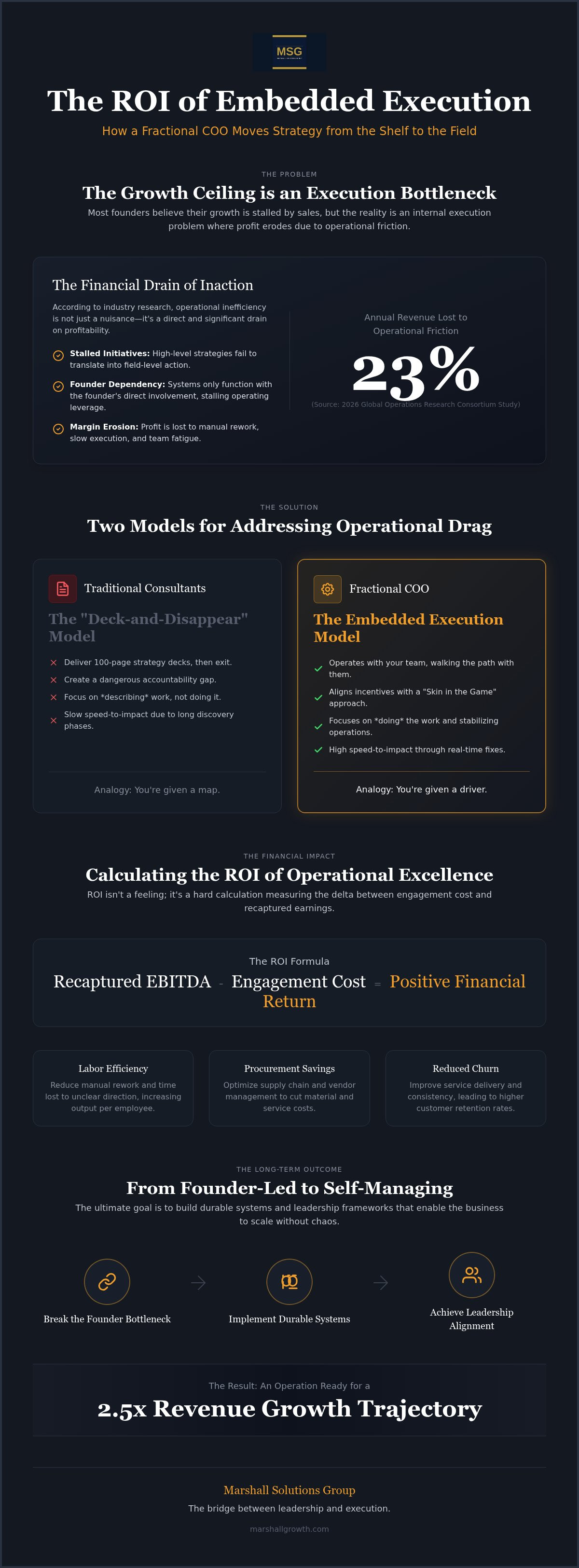
ROI isn't a vague feeling of improvement. It's a hard financial calculation. To determine the ROI of a fractional COO, you must measure the delta between the engagement cost and the recaptured EBITDA. Most mid-market companies lose 23% of their annual revenue to operational inefficiency, according to a 2026 study by the Global Operations Research Consortium. This is the cost of inaction. It's the literal price you pay for stalled initiatives, manual rework, and missed targets.
To better understand the financial impact of this leadership model, watch this breakdown of how an operator integrates into your business:
Hiring a full-time COO is a heavy commitment. Total compensation for a full-time executive often reaches $276,000 or more, excluding benefits and equity. The Fractional executive model provides the same senior-level judgment without the massive overhead. By focusing on "Recapture Zones" like labor efficiency, procurement savings, and reduced churn, these engagements typically pay for themselves quickly. You aren't just buying advice; you're buying back your margin.
The Hidden Financial Drain of the Founder Bottleneck
When a founder remains the primary operator, the business hits an invisible ceiling. Operating leverage stalls because every decision requires your personal approval. Shifting from operator to strategist is a financial necessity, not a luxury. Leadership alignment improves project margins and delivery speed. When your team stops waiting for you to clear every hurdle, the velocity of the business increases. This transition recaptures the profit previously lost to slow execution and executive fatigue.
Fractional COO vs. Management Consultants: Comparing Embedded Execution to Advisory Decks
Traditional consultants specialize in the "Deck-and-Disappear" model. They deliver 100-page strategy decks and move to the next client. This creates a dangerous accountability gap. If the strategy fails, the consultant is long gone. A fractional COO operates with embedded delivery. They don't just suggest a path; they walk it with your team. This "Skin in the Game" approach aligns incentives. Implementation support is the priority, ensuring that high-level goals actually reach the field. It's about doing the work, not just describing it.
Speed to impact is significantly higher with an embedded operator. Advisors often spend weeks in discovery before offering a single recommendation. An operator identifies friction points and fixes them in real-time. This direct action is what drives the ROI of a fractional COO. You aren't paying for a presentation; you're paying for a stabilized operation. It's the difference between a map and a driver. If you want to see how this transition looks in practice, start with a Leadership & Operations Assessment to identify your specific execution gaps.
The Operator-Led Model: Why Military Command Experience Translates to Business ROI
Military command teaches "Mission Command." This framework prioritizes decentralized execution based on clear intent rather than micromanagement. In a business context, this reduces mission-impacting failures. An operator with veteran-led experience understands how to speak to the boardroom about EBITDA while speaking to the field about process. This dual-language capability ensures that strategy doesn't get lost in translation. It builds a durable bridge between leadership and execution. Structured systems thrive when leaders empower their teams to act within a defined framework.
Scaling Without Chaos: The Long-Term ROI of Operational Readiness
Scaling isn't about buying more software. It's about building durable systems that function when you aren't in the room. The first step toward a measurable return is a Leadership & Operations Assessment. This diagnostic identifies the structural cracks that prevent a business from functioning independently. A self-managing company isn't built on apps; it's built on repeatable processes and clear accountability. When you stop being the primary operator, the business finally has the room to grow.
Long-term enterprise value depends on how easily the business can be handed over. This is where a Founder Transition Plan becomes a critical asset. Investors and buyers pay a premium for operational discipline. Businesses that demonstrate high operating leverage and low founder dependency trade at significantly higher multiples during M&A or succession. The true ROI of a fractional COO is the delta between a business tied to a person and a business built as a scalable, sellable asset.
Executing the Operational Readiness Assessment
Growth in mission-critical sectors often stalls due to five specific red flags: unclear reporting lines, siloed data, reactive decision-making, high talent churn, and inconsistent fulfillment. Addressing these requires a scalable workforce and a structured talent pipeline. Transitioning from chaos to control isn't a one-time event. It's the result of rigorous, structured accountability. By implementing a framework that empowers field-level execution, you prepare the organization for a 2.5x revenue growth trajectory without the associated operational collapse. This is how you bridge the gap between your high-level strategy and real-world results.
From Operational Bottleneck to Scalable Asset
Leadership is about more than setting a vision. It's about ensuring that vision survives the reality of the field. You've seen how operational friction drains EBITDA and how founder dependency creates a growth ceiling. The ROI of a fractional COO is found in the transition from chaos to a stabilized, self-managing organization. By embedding execution into your team, you move beyond static strategy decks and start recapturing lost margins. As a veteran-owned and operator-led firm, Marshall Solutions Group has negotiated $10M in enterprise contracts and managed $500M federal transformation programs. We provide the disciplined urgency needed to bridge the gap between your goals and your results. It's time to stop being the bottleneck and build a scalable asset. Schedule your Leadership & Operations Assessment with Marshall Solutions Group. Your business is ready for the next level; let's build the systems to get it there.
Frequently Asked Questions
How do you measure the ROI of a fractional COO in the first 90 days?
ROI in the first 90 days is measured by the stabilization of core processes and the identification of immediate "Recapture Zones." Within this window, an embedded operator identifies the specific friction points causing margin erosion. Success is defined by the successful transition of the founder out of daily tactical firefighting and the implementation of a structured accountability framework that improves project delivery speed.
Is a fractional COO more cost-effective than a full-time executive hire?
A fractional model is more cost-effective because it eliminates the massive overhead of a $276,000 average total compensation for full-time executives. You pay for targeted execution rather than permanent presence. This model allows mid-market companies to access the same veteran-led leadership that managed $500M federal transformation programs without the heavy financial burden of a permanent C-suite hire.
What industries benefit most from the ROI of fractional operational leadership?
The ROI of a fractional COO is most pronounced in mission-critical sectors like aerospace, defense, and biopharma. Regional field-services firms and federal infrastructure contractors also see substantial gains. These industries often face complex fulfillment models and high founder dependency. Structured systems and veteran-led discipline are required to manage these high-stakes environments and drive a 2.5x revenue growth trajectory without operational collapse.
How does a fractional COO impact a company’s EBITDA and valuation?
Fractional leadership impacts EBITDA by recapturing revenue lost to operational friction and labor inefficiency. By building a self-managing company, you reduce the "founder risk" that depresses valuation multiples. A business with documented systems and a scalable workforce pipeline trades at a premium during M&A. It demonstrates durable profitability and readiness for expansion, which significantly increases the final enterprise valuation.
Disclaimer
The information provided in this article is for general informational and educational purposes only and does not constitute legal, financial, accounting, engineering, or other professional advice. Marshall Solutions Group, Inc. makes no representations or warranties regarding the completeness or applicability of this information to any specific situation. Readers should consult appropriately qualified professionals before making decisions requiring specialized professional advice.