Resource Management in Project Management: An Operator’s Guide to Capacity and Execution
By CJ Marshall, President & Founder
Learn how resource management in project management drives capacity, execution, and margin. A practical guide for operations and project leaders.

Article by
Chelvis “CJ” Marshall
Chelvis “CJ” Marshall is President & Founder of Marshall Solutions Group, a management consulting firm specializing in Strategy & Operations, Organizational Leadership & Change, and Program & Project Management. A retired U.S. Navy Senior Chief who advanced from E-1 to E-8 in 10 years, CJ transitioned into Fortune 500 enterprise leadership, where his commercial experience has included more than $20 million in contract value. He brings operator-level experience leading teams, complex programs, and mission-critical operations. His work focuses on bridging leadership and execution—helping organizations translate strategic direction into disciplined execution, stronger accountability, and measurable business results.
Most project failures aren't caused by a lack of talent. They're caused by a lack of discipline in how that talent is deployed. You've likely seen your top performers become permanent bottlenecks while project margins bleed out through poor allocation. This happens when resource management in project management is treated as a clerical task rather than a leadership priority. It's a common struggle for leaders who can't accurately forecast their next hire because they don't have a clear view of their team's true capacity.
This guide will show you how to transform your allocation process into a strategic discipline that drives measurable operational performance. We'll examine the mechanics of capacity planning and the frameworks required to achieve predictable delivery and improved operational leverage. By the end, you'll have the tools to move from reactive scheduling to proactive execution.
Key Takeaways
- Move beyond basic scheduling by aligning your people and time against specific business objectives through disciplined execution.
- Learn how ineffective resource management in project management leads to labor inefficiency and erodes project margins.
- Break the founder bottleneck by defining clear ownership and decision rights for team allocation across the organization.
- Establish a scalable system by conducting a rigorous inventory of team capabilities and current commitments to ensure mission success.
Table of Contents
Defining Resource Management: Beyond the Spreadsheet Exercise
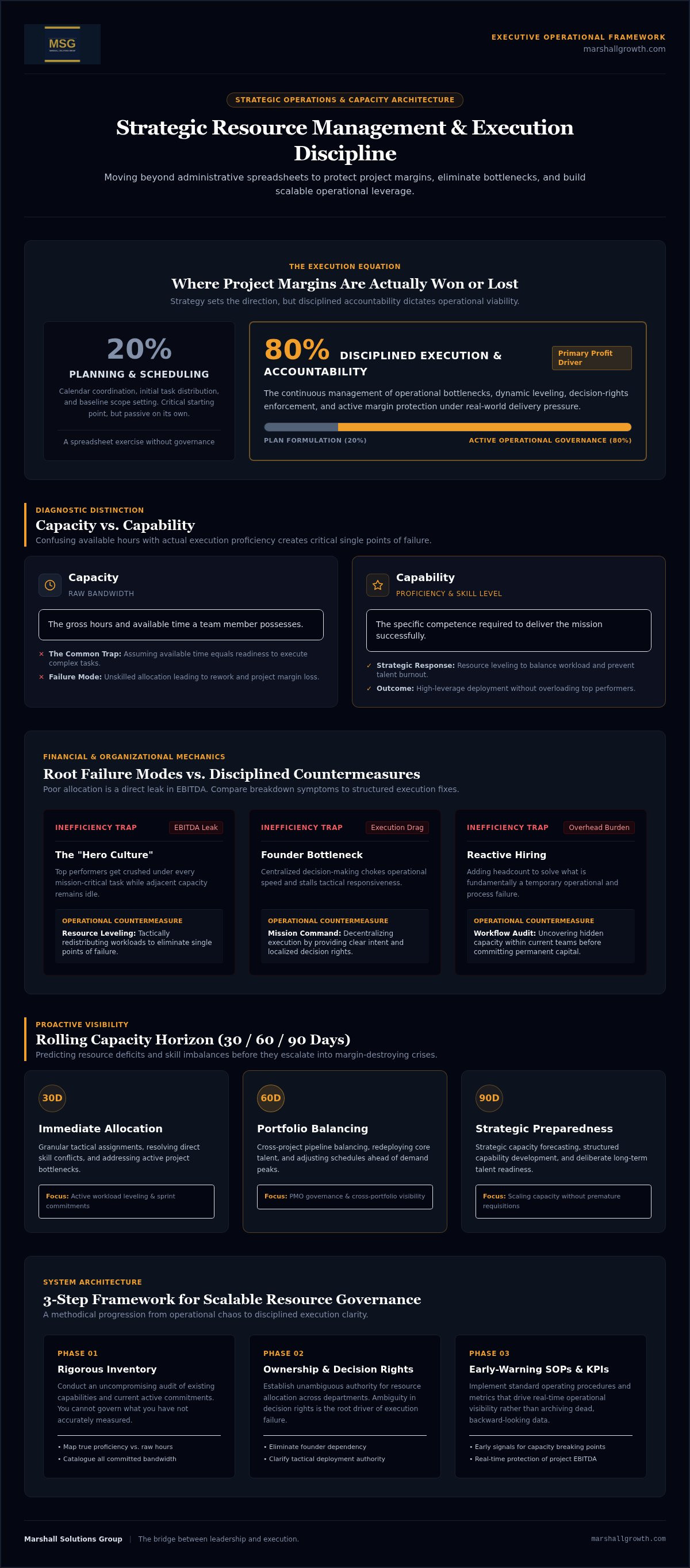
Resource management isn't a passive administrative function. It's the strategic alignment of people, equipment, and time against your core business objectives. While many treat resource management as a simple scheduling exercise, seasoned operators know better. Effective resource management in project management requires you to look beyond the calendar and into the mechanics of performance. Planning is only 20% of the battle. The remaining 80% is disciplined execution and the high level of accountability required to protect your project margins. Without this discipline, your strategy is just a list of wishes.
When resource management in project management fails, the symptoms are unmistakable and expensive. You'll likely see a "hero culture" emerge where your top performers are crushed by every critical task while others sit idle. This leads to chronic missed deadlines and significant margin erosion caused by labor inefficiency. If these symptoms feel familiar, use our Leadership & Operations Assessment to diagnose the underlying root causes before they cripple your organizational growth.
Capacity vs. Capability: The Operator's Distinction
Capacity is the raw bandwidth available to your team. Capability is the specific skill level required to execute a task successfully. Founders often confuse the two, assuming that because a team member has the time (capacity), they possess the proficiency (capability) to deliver. This logic leads to the chronic over-commitment of your most valuable talent, creating single points of failure across your operations. Resource leveling is the tactical tool used to redistribute workloads and prevent burn-out in mission-critical environments.
Strategic Resource Allocation and the Financial Cost of Inefficiency
Poor allocation isn't just a scheduling error; it's a direct leak in your EBITDA. When resource management in project management is neglected, you pay for labor inefficiency that directly erodes project profitability. Many leaders overlook the hidden cost of resource inefficiency, treating human capital as an infinite supply. This waste often stems from the "Founder Bottleneck." Centralized decision-making chokes the system and prevents your team from moving at the speed of the market. To scale, you must adopt "Mission Command" from our Operator’s Framework. It allows you to decentralize execution by providing clear intent and letting your team manage the tactical distribution of effort.
Before you open a new requisition, examine your existing workflows. Hiring is a permanent solution to what might be a temporary process failure. Improving resource management in project management often reveals hidden capacity that makes a new hire unnecessary. If you're struggling to identify these gaps, an operational assessment can provide the clarity you need to optimize your current team before adding overhead.
Forecasting Capacity in High-Stakes Environments
Execution requires a forward-looking lens. You need a rolling view of 30, 60, and 90 days to predict resource gaps before they become crises. This is where PMO governance becomes vital. It provides the cross-portfolio visibility needed to move people where they're most effective. Reactive hiring is expensive. It forces you to pay a premium for talent under pressure. Proactive capacity planning ensures you're building for the mission, not just reacting to the fire.
Building a Scalable Resource Management System
A scalable system isn't built on software; it's built on structured accountability. To fix your operations, you must follow a methodical path from chaos to clarity. First, conduct a rigorous inventory of existing capabilities and current commitments. You can't manage what you haven't measured. Next, establish clear ownership and decision rights for resource allocation. Ambiguity is the enemy of execution. Finally, implement SOPs and KPIs that drive visibility rather than just collecting dead data. These metrics must act as early warning systems for resource management in project management, signaling when capacity is reaching a breaking point.
At Marshall Solutions Group, we don't believe in detached advisory. We take a skin-in-the-game approach, staying through the implementation phase to ensure your new system actually holds up under pressure. We're interested in the health and scalability of your organization, not just the delivery of a presentation.
From Planning to Execution: Ensuring Accountability
Strategy sets your direction, but leadership drives your execution. Most organizations fail because they leave a gap between the plan and the daily reality of the team. Achieving Operational Excellence requires a self-managing team that understands the mission intent. To test your current structure, ask yourself this: Who owns the resource conflict when two projects collide? If the answer isn't a specific role with clear authority, you don't have a system; you have a bottleneck. Effective resource management in project management demands that these collisions are resolved through predefined frameworks, not through executive intervention every time a fire starts.
Bridging the Gap Between Capacity and Execution
Effective resource management in project management is the difference between a plan that looks good on paper and one that actually delivers results. You've seen how poor allocation erodes margins and creates leadership bottlenecks. To scale, you must move from reactive scheduling to a disciplined system of clear ownership and proactive forecasting. Marshall Solutions Group provides the steady hand needed to navigate these operational frictions. We're a veteran-owned and operator-led firm with over 60 years of combined leadership experience. As an SBA-certified SDVOSB and VOSB, we focus on the mechanics of growth by staying through the implementation phase.
Stop being the bottleneck. Learn how Marshall Solutions Group drives operational performance through disciplined execution. You have the talent to reach the next level. Now it's time to build the system that allows them to succeed.
Frequently Asked Questions
What is the difference between resource management and project management?
Project management provides the framework for the mission, while resource management focuses on the tactical deployment of assets required to execute it. Project management tracks timelines and deliverables. Resource management ensures that human capacity and technical capability are available to meet those milestones. One handles the "what" and "when," while the other handles the "who" and "how" of operational success.
How do I identify a resource bottleneck before it impacts my project margin?
Identify bottlenecks by looking for the "hero culture" symptom where a single person is on the critical path for every high-value task. Monitor utilization rates closely. If your top performers consistently hit utilization rates above 90%, you have a single point of failure. This creates labor inefficiency and missed deadlines that directly erode your project margins and EBITDA.
When should a growing company move from spreadsheets to a formal PMO?
Transition to a formal PMO when your resource management in project management requires cross-portfolio visibility that a flat document cannot provide. Spreadsheets fail when multiple projects compete for the same talent pool. When you can no longer predict hiring needs 90 days in advance or resolve resource conflicts without executive intervention, your operations have outgrown your manual tools.
How does resource management change in federal government contracting?
Federal contracting demands a higher level of compliance, labor category tracking, and reporting rigor compared to the private sector. You aren't just managing time. You're managing specific labor qualifications and security clearances required by the contract. Resource management in project management for agencies like the DoD requires a structured system that ensures every associate meets strict mission-critical requirements.
Disclaimer
The information provided in this article is for general informational and educational purposes only and does not constitute legal, financial, accounting, engineering, or other professional advice. Marshall Solutions Group, Inc. makes no representations or warranties regarding the completeness or applicability of this information to any specific situation. Readers should consult appropriately qualified professionals before making decisions requiring specialized professional advice.