Applying Military Leadership Principles to Business: The Operator’s Framework
By CJ Marshall, President & Founder
Stop being the bottleneck. Learn how applying military leadership principles to business can fix founder-dependency and bridge your strategy-execution gap.

Article by
Chelvis “CJ” Marshall
Chelvis “CJ” Marshall is President & Founder of Marshall Solutions Group, a management consulting firm specializing in Strategy & Operations, Organizational Leadership & Change, and Program & Project Management. A retired U.S. Navy Senior Chief who advanced from E-1 to E-8 in 10 years, CJ transitioned into Fortune 500 enterprise leadership, where his commercial experience has included more than $20 million in contract value. He brings operator-level experience leading teams, complex programs, and mission-critical operations. His work focuses on bridging leadership and execution—helping organizations translate strategic direction into disciplined execution, stronger accountability, and measurable business results.
Most business owners think they have a leadership problem when they actually have a discipline problem. You’ve built a company that functions, but it only works because you're the one holding every piece together. It's exhausting. You see your strategy crumble the moment it hits the field, and your margins are bleeding out through operational friction. We understand the weight of founder-dependency; it's a trap that limits your growth and erodes your peace of mind.
This article will show you how to stop being the bottleneck by applying military leadership principles to business. We’ll bridge the gap between high-level strategy and ground-level execution using the same systems that keep $500M naval platforms operational. You'll discover the Operator’s Framework for building a self-managing team, improving operating leverage, and creating predictable results in high-stakes environments.
Key Takeaways
- Identify the specific friction points where high-level plans fail and learn how to replace abstract theory with a disciplined, execution-first operating system.
- Master the framework of Mission Command to empower your team with the "what" and "why" while decentralizing the "how" for radical accountability.
- Discover the tactical advantages of applying military leadership principles to business to eliminate founder-dependency and stabilize your operating leverage.
- Understand why mission-critical environments require an "Embedded Operator" approach to ensure that leadership systems actually survive the reality of field execution.
Table of Contents
The Strategy-Execution Gap: Why Military Principles Drive Business Results
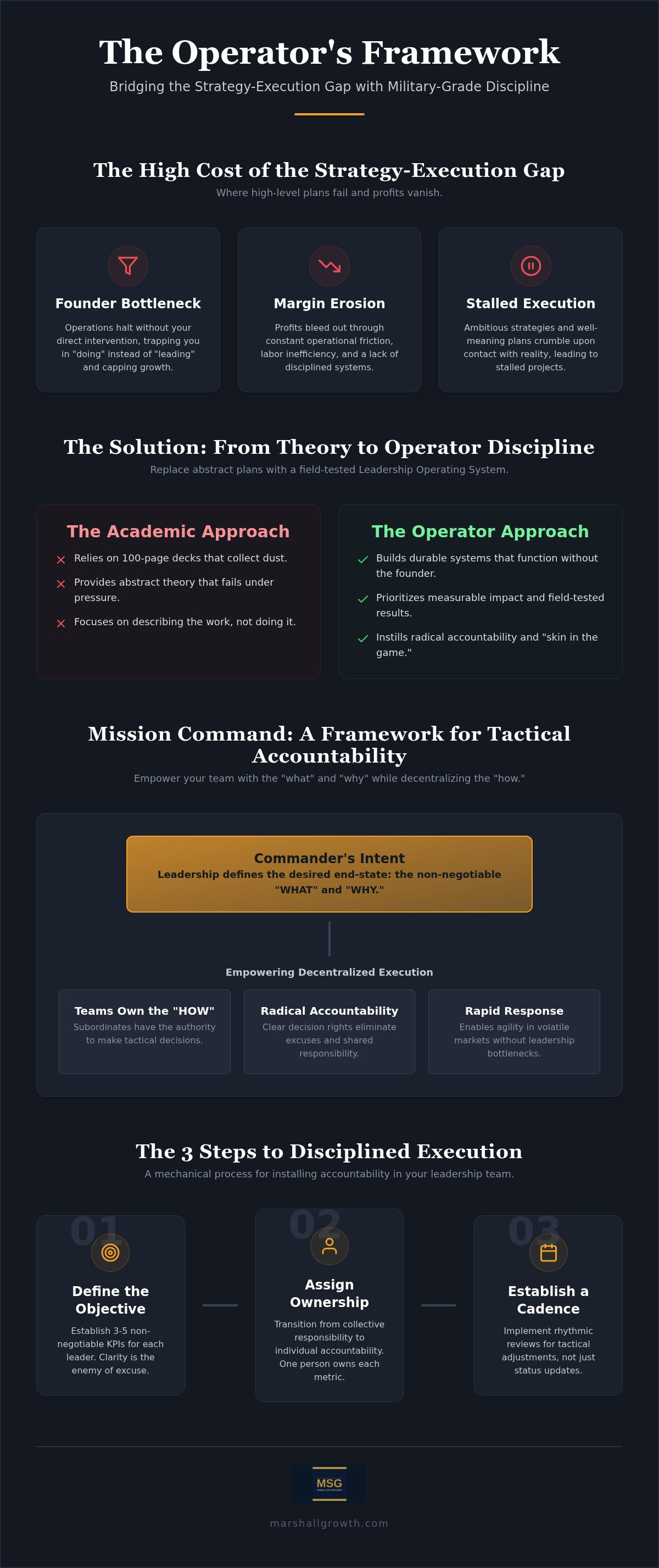
Strategy is cheap. Execution is expensive. Most organizations fail because their high-level plans lack the operational discipline to survive contact with reality. This friction point is the strategy-execution gap. It's where EBITDA vanishes and projects stall. Applying military leadership principles to business solves this by providing a mechanical Leadership Operating System. It prioritizes field-tested results over academic theory. This framework adapts the foundational Principles of War to ensure every resource is aligned with the objective.
To better understand this concept, watch this helpful video:
The difference between an operator and an academic is simple: one does the work, the other describes it. In management consulting, you're often sold 100-page decks that collect dust. Operators don't have time for fluff. They focus on integration, durability, and measurable impact. They build systems that function when the pressure is high and the founder isn't in the room. This is about radical accountability. It's about skin in the game.
Overcoming the Founder Bottleneck Through Disciplined Systems
Founders often become their own primary bottleneck. You're trapped in the "doing" because you haven't established the systems to allow for "leading." This leads to margin erosion and severe labor inefficiency. It's a failure of structure, not a lack of effort. Applying military leadership principles to business forces a transition from personality-driven management to system-driven execution. Identifying these gaps is the first step toward scalability. We recommend starting with a Leadership & Operations Assessment to pinpoint exactly where your execution is breaking down. Stop guessing. Start measuring.
Mission Command: A Tactical Accountability Framework for Leadership Teams
Mission Command isn't a suggestion; it's a structural requirement for scale. It involves giving subordinates the "what" and the "why" while allowing them to own the "how." This eliminates the friction of constant oversight and founder-dependency. This method is a core component of Applying the Principles of War to Business, where decentralized authority enables rapid response times in volatile markets. The linchpin of this framework is "Commander’s Intent." It’s a clear statement of the desired end state that ensures every team member knows the goal, even when the initial plan breaks down.
This approach builds a durable accountability framework for leadership teams by clarifying decision rights. You aren't just handing off work; you're empowering leaders to lead. When you stop being the primary decision-maker, your organization gains the capacity to grow without your direct intervention. It transforms your leadership from a collection of individuals into a synchronized unit.
The Mechanics of Decentralized Execution
Discipline is a mechanical process, not a feeling. Applying military leadership principles to business means moving beyond abstract concepts into these structured actions:
- Step 1: Define the Objective. Establish 3-5 non-negotiable KPIs for each executive leader. Clarity is the enemy of excuse.
- Step 2: Assign Ownership. Transition from collective responsibility to individual accountability. One person must own each metric, or no one does.
- Step 3: Establish a Cadence. Implement rhythmic weekly or monthly reviews to monitor variances. These aren't status updates; they're tactical adjustments.
If you want to stop the EBITDA erosion caused by poor execution, our Strategy & Operations Consulting provides the embedded support needed to install these systems and stabilize your growth.
Implementing Operator-Level Discipline in Mission-Critical Environments
Leadership principles are useless if they don't survive the first week of implementation. Most consulting firms provide theory; we provide presence. The role of the Embedded Operator is to ensure that applying military leadership principles to business isn't just a discussion but a daily reality. For federal contractors and industrial firms, reliability is a survival requirement. These mission-critical environments demand zero-defect execution and rigorous risk management. We operate with a "Skin in the Game" model. This means we stay through the implementation phase until these disciplined habits become your default operating system. We don't just deliver a plan. We ensure the plan works under fire. This level of commitment separates a steady hand from a detached advisor.
Scaling Leadership Capacity Without Operational Chaos
Moving from a founder-dependent model to a self-managing organization requires a shift in how you lead. Our Executive Coaching program helps leaders adapt to these high-accountability systems without creating operational chaos. This transition focuses on building "cross-level fluency." You need a leadership team that speaks to both the C-suite and the field technician with equal precision. When your team understands the mechanics of growth, you stop being the primary bottleneck. You gain the leverage needed to scale. Stabilize your operations. Build durable systems. Leading is the work. It requires a refusal to accept mediocrity and a deep-seated belief in the power of structured systems. This is how you achieve predictable project execution in high-stakes environments.
Secure Your Operational Foundation
Execution is the highest form of strategy. Leading is hard; scaling is harder. Transitioning from a founder-led bottleneck to a self-managing organization requires a mechanical shift in how you lead. By applying military leadership principles to business, you replace operational chaos with a disciplined framework built for high-stakes environments. You've seen how Mission Command and decentralized execution empower your team to own the "how" while you focus on the objective.
Marshall Solutions Group is a veteran-owned firm with 60+ years of combined leadership experience. We've managed $500M mission-critical assets without failure. Our embedded delivery model ensures we stay through implementation; we don't just give advice. It's time to stabilize your growth and protect your margins. Schedule a Leadership & Operations Assessment with MSG today. Your team is ready to lead. Give them the system to do it.
Frequently Asked Questions
What are the 5 military leadership principles most applicable to business?
The most effective principles for scaling a business include:
- Mission Command
- Commander’s Intent
- Unity of Effort
- Decentralized Execution
- Radical Accountability
Applying military leadership principles to business requires moving beyond theory to focus on these mechanical systems. These principles ensure every team member understands the desired end state, allowing them to make critical decisions without constant oversight.
How does Mission Command differ from traditional top-down management?
Mission Command differs by focusing on the "what" and "why" rather than dictating the "how." Traditional top-down management often involves micromanaging tasks, which creates bottlenecks and stifles innovation. This framework builds accountability by defining clear decision rights. It allows for faster execution because the people closest to the problem have the authority to solve it without waiting for approval from the top.
Why do military-style accountability frameworks fail in some corporate cultures?
These frameworks fail when they are treated as academic exercises rather than operational changes. Without skin in the game or an embedded operator to oversee implementation, habits don't change. Failure also occurs when there is a lack of cross-level fluency between executives and field technicians. Success requires a commitment to high accountability and structured systems that survive high-pressure environments instead of just slide decks.
Can a small business implement military leadership principles without being too rigid?
Yes, because military discipline is designed to enable agility, not just follow rules. Implementing these systems reduces the founder-dependency that keeps small businesses stuck. By applying military leadership principles to business, you create a self-managing organization where predictable results replace daily chaos. Discipline provides the stability needed for your team to act decisively without waiting for permission or constant clarification from the owner.
Disclaimer
The information provided in this article is for general informational and educational purposes only and does not constitute legal, financial, accounting, engineering, or other professional advice. Marshall Solutions Group, Inc. makes no representations or warranties regarding the completeness or applicability of this information to any specific situation. Readers should consult appropriately qualified professionals before making decisions requiring specialized professional advice.