Improving Leadership Team Alignment: From Strategic Intent to Disciplined Execution
Marshall Solutions Group · reviewed by CJ Marshall
Stop wasting 20% of your payroll on friction. Learn a disciplined system for improving leadership team alignment and turning strategic intent into execution.

Article by
Chelvis “CJ” Marshall
Chelvis “CJ” Marshall is Founder & Managing Partner of Marshall Solutions Group, a management consulting firm specializing in Strategy & Operations, Organizational Leadership & Change, and Program & Project Management. A retired U.S. Navy Senior Chief who advanced from E-1 to E-8 in 10 years, CJ later transitioned into Fortune 500 enterprise leadership, negotiating more than $20M in contracts within three years. He brings operator-level experience leading teams, complex programs, and mission-critical operations. His work centers on being the bridge between leadership and execution—helping organizations translate strategic direction into disciplined execution, stronger accountability, and measurable results.
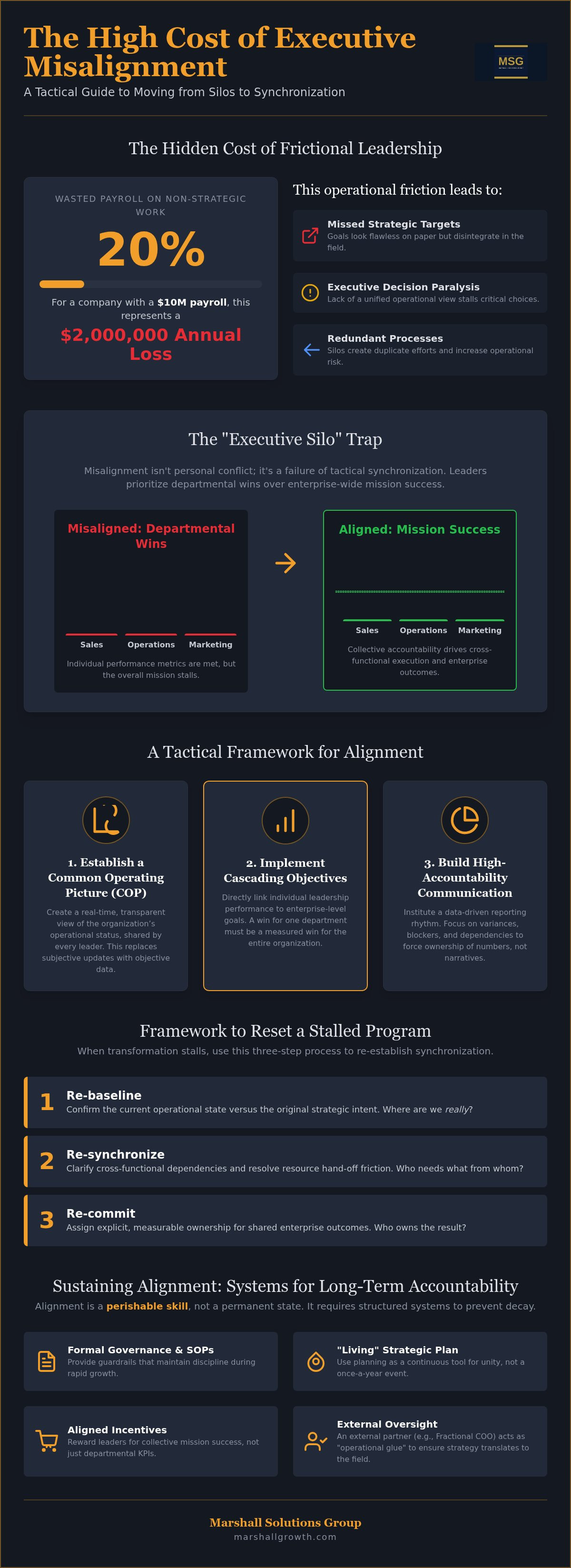
Research from March 2026 reveals that up to 20% of your payroll is likely wasted on work that doesn't align with your strategic priorities. For a company with a $10M payroll, that's $2M lost every year to friction and silos. You've likely felt this drain through missed targets and executive-level decision paralysis. Improving leadership team alignment isn't about getting everyone to nod in agreement during a quarterly offsite. It's about building a disciplined system where intent translates into action without constant oversight.
You know that a plan is only as good as its execution, yet operational friction continues to stall your progress. This guide moves beyond the theory of team building to focus on tactical synchronization and operational accountability within your executive suite. We'll explore how to dismantle silos, reduce operational waste, and establish clear ownership for cross-functional goals. It's time to transform your leadership from a group of individual experts into a unified front that executes with precision.
Key Takeaways
- Distinguish between emotional agreement and tactical synchronization to avoid the "Executive Silo" trap that prioritizes departmental wins over mission-critical goals.
- Establish a Common Operating Picture (COP) to ensure every leader has a real-time, transparent view of the organization’s operational status.
- Implement a systematic approach to improving leadership team alignment by linking individual leadership performance to enterprise-level execution through Cascading Objectives.
- Identify why strategic intent naturally decays over time and how structured accountability systems prevent a return to operational friction.
Table of Contents
The Hidden Cost of Misalignment: Why Strategy Fails at the Executive Level
Misalignment is rarely a matter of personal conflict. It's a failure of tactical synchronization. Leaders often agree on high-level goals but fail to coordinate the actual mechanics of reaching them. This creates the "Executive Silo" trap. Here, department heads prioritize their own vertical wins over enterprise-wide mission success. Improving leadership team alignment requires a shift from individual performance to collective accountability. In founder-led organizations, this friction often surfaces during scaling. Informal communication that once drove growth cannot replace the need for rigorous, formal systems. Leadership alignment is the disciplined synchronization of vision, strategy, and cross-functional execution.
Achieving Strategic Alignment requires moving beyond the boardroom. It demands a hard look at how resources and structure actually support the mission. Without this focus, your team is just a group of individuals chasing separate targets.
The Friction of Leadership Silos in Mission-Critical Operations
Silos are more than an annoyance; they're a source of redundant processes and heightened operational risk. For federal contractors, this lack of unity can jeopardize program delivery and damage reputation. Improving leadership team alignment is the only way to bridge the "Planning-Execution Gap." This is where a strategy looks flawless on paper but disintegrates in the field due to a lack of leadership unity. When leaders operate in isolation, they lose sight of the cross-functional dependencies that drive performance.
If you aren't sure where your friction points lie, a Leadership & Operations Assessment can diagnose the disconnects between your intent and your results. Success isn't a byproduct of a good plan. It's the result of leaders who own the enterprise outcome together. Use our LinkedIn resources to learn more about identifying these gaps and building a more synchronized executive team.
A Tactical Framework for Improving Leadership Team Alignment
Improving leadership team alignment requires more than a shared vision. It demands a "Common Operating Picture" (COP). This isn't just a dashboard; it's a shared understanding of the mission's real-time status across every department. You must implement "Cascading Objectives" that tie individual leadership performance directly to enterprise-level operational excellence. This ensures that a win for the VP of Operations is also a win for the CFO. To maintain this, develop a high-accountability communication rhythm. Replace fluff-filled updates with data-driven reporting that highlights variances and blockers. This "tough love" approach to data forces leaders to own their numbers rather than hiding behind departmental jargon.
When a transformation program stalls, use this three-step framework to reset your leadership synchronization:
- Re-baseline: Confirm the current operational state versus the original strategic intent.
- Re-synchronize: Clarify cross-functional dependencies and resolve resource hand-off friction.
- Re-commit: Assign explicit, measurable ownership for shared enterprise outcomes.
Synchronizing Strategy with Daily Operational Execution
Alignment decays without the anchor of formal governance. Standard Operating Procedures (SOPs) and clear governance structures act as the guardrails for rapid growth. Use Strategic Planning not as a yearly event, but as a living document for leadership unity. This process is essential for improving leadership alignment because it forces trade-off decisions before resources are wasted. Finally, audit your incentives. If leaders are rewarded only for departmental KPIs, they'll naturally revert to silos. Aligned incentives ensure the team is rewarded for collective mission success. If your team is struggling to bridge the gap between intent and execution, consulting with an embedded operator can help reset your operational rhythm.
Sustaining Alignment: Systems for Long-Term Accountability
Alignment is not a permanent state; it is a perishable skill. Without structured systems, the "off-site high" evaporates within weeks, replaced by the friction of daily fire drills. Improving leadership team alignment requires an external perspective to act as the operational glue between strategy and execution. A Fractional COO or Operating Partner provides this oversight, ensuring that the synchronization established in the boardroom actually translates to the field. This isn't about delivering a presentation. Real alignment requires skin-in-the-game implementation rather than a deck-and-disappear engagement. This methodical approach to improving leadership team alignment ensures that everyone stays focused on enterprise goals. Veteran-led discipline brings a level of accountability that is necessary during high-pressure growth phases, where the cost of a single misstep is amplified. We don't just point out problems; we embed with your team to solve them.
The Role of Assessments in Maintaining Leadership Effectiveness
Continuous synchronization depends on identifying emerging blind spots before they stall your mission. Periodic organizational leadership consulting acts as a diagnostic audit for your executive team’s health. These assessments allow you to integrate risk and compliance management directly into the alignment cycle, turning potential liabilities into operational strengths. As your company scales, you must focus on building leadership capacity at every level. If your middle management doesn't mirror the alignment of your executive suite, your strategy will fail at the point of contact. Maintaining this discipline ensures that your organization remains a well-oiled machine, capable of sustaining performance long after the initial planning phase is over. It’s about building a legacy of execution, not just a temporary fix.
Move from Strategic Intent to Disciplined Execution
Strategic intent is worthless without a disciplined system to carry it out. Misalignment drains resources and creates friction that stalls growth. Improving leadership team alignment requires a transition from individual wins to collective enterprise accountability. By establishing a Common Operating Picture and implementing cascading objectives, you bridge the gap between the boardroom and the field. Marshall Solutions Group brings 60+ years of military command and Fortune 500 experience to your organization. As an SBA-certified SDVOSB, we offer an operator-led model with skin-in-the-game implementation. We're ready to help you dismantle silos and build a unified front that executes with precision. Connect with Marshall Solutions Group to align your leadership team for disciplined execution. Your strategy deserves a team that's as committed to the outcome as you are.
Frequently Asked Questions
What is the most common cause of leadership team misalignment?
The most common cause is the "Executive Silo" trap. This happens when leaders prioritize departmental KPIs over mission-critical enterprise goals. Without a Common Operating Picture, departments naturally drift toward vertical optimization. This results in fragmented data and redundant processes. It creates operational friction that stalls decision-making and leads to missed performance targets despite having a clear high-level strategy.
How do you measure leadership alignment in a measurable way?
You measure alignment by tracking the synchronization of cross-functional KPIs rather than just individual department wins. Quantify this by analyzing the "Planning-Execution Gap," which is the delta between strategic intent and actual operational outcomes. Improving leadership team alignment shows up in the data as increased decision-making speed and a measurable reduction in operational waste caused by miscommunication.
Can a leadership team be aligned but still fail to execute?
Yes. Teams often achieve emotional agreement in the boardroom but fail because they lack tactical synchronization in the field. Agreement on a vision doesn't guarantee success if the underlying systems, SOPs, and resources aren't synchronized. Execution fails when leaders don't have a structured framework for accountability or the operator-level discipline to see complex initiatives through to completion.
How long does it typically take to achieve leadership team alignment?
An initial operational reset usually takes 30 to 90 days. This depends on the complexity of your current silos and the state of your existing systems. However, alignment is a perishable skill. Improving leadership team alignment is an ongoing process. It requires maintaining high-accountability communication rhythms and periodic assessments to ensure the team remains synchronized as the organization scales or faces new pressures.
Disclaimer
The information provided in this article is for general informational and educational purposes only and does not constitute legal, financial, accounting, engineering, or other professional advice. Marshall Solutions Group, Inc. makes no representations or warranties regarding the completeness or applicability of this information to any specific situation. Readers should consult appropriately qualified professionals before making decisions requiring specialized professional advice.