Leadership Blind Spots Assessment: Identifying the Operational Bottlenecks Stalling Growth
Marshall Solutions Group · reviewed by CJ Marshall
Stalled projects? A leadership blind spots assessment pinpoints the operational bottlenecks caused by executive habits. Bridge the gap from strategy to execu...

Article by
Chelvis “CJ” Marshall
Chelvis “CJ” Marshall is Founder & Managing Partner of Marshall Solutions Group, a management consulting firm specializing in Strategy & Operations, Organizational Leadership & Change, and Program & Project Management. A retired U.S. Navy Senior Chief who advanced from E-1 to E-8 in 10 years, CJ later transitioned into Fortune 500 enterprise leadership, negotiating more than $20M in contracts within three years. He brings operator-level experience leading teams, complex programs, and mission-critical operations. His work centers on being the bridge between leadership and execution—helping organizations translate strategic direction into disciplined execution, stronger accountability, and measurable results.
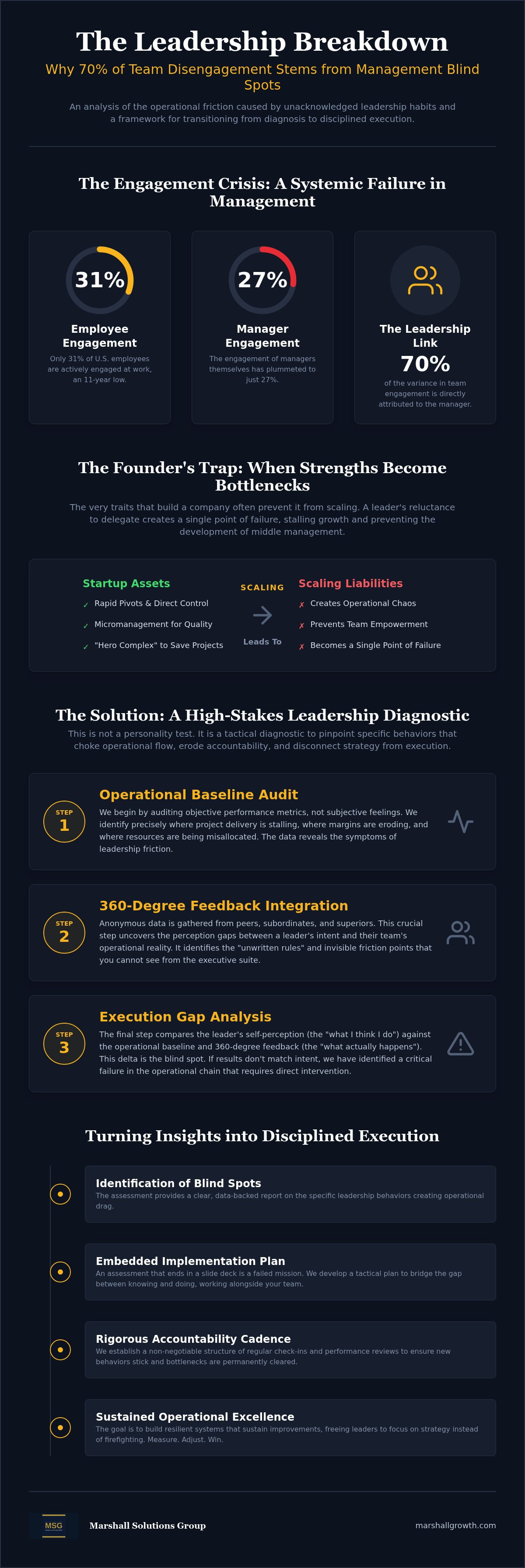
In 2026, only 31% of U.S. employees are engaged at work, an 11-year low that points directly to a breakdown in management. Managers account for 70% of the variance in team engagement, yet their own engagement has plummeted to 27%. You likely feel this friction every day. Projects stall. Accountability vanishes. The strategy you spent months refining never quite hits the ground. It's often the "Founder's Trap" in action. The leader becomes the primary bottleneck.
A professional leadership blind spots assessment uncovers these hidden gaps before they transition from personal habits into organizational failures. We'll provide a tactical framework to identify executive risks, align strategy with execution, and drive measurable operational improvements. Stop guessing where the friction starts. Start fixing the systems that hold your organization back.
Key Takeaways
- Recognize how individual leadership habits evolve into systemic bottlenecks that paralyze mission-critical decision-making.
- Implement a tactical leadership blind spots assessment to bridge the high-stakes gap between executive perception and operational reality.
- Audit operational baselines alongside 360-degree feedback to pinpoint exactly where delivery is stalling and why.
- Transition from diagnostic reports to active implementation by embedding accountability into the core of your growth strategy.
Table of Contents
What is a Leadership Blind Spots Assessment in Mission-Critical Environments?
A leadership blind spots assessment isn't a soft-skills exercise or a generic personality test. It is a tactical diagnostic. We use it to pinpoint specific behaviors that choke operational flow and erode team accountability. In high-stakes environments, these gaps usually manifest as bottlenecking. This happens when a leader’s need for absolute control slows mission-critical decision-making to a crawl. Execution stops. Friction grows. Strategy fails. While standard tests focus on how you feel, an operator-led diagnostic focuses on the friction points between your strategy and your results.
A leadership blind spot is an unacknowledged behavior that directly creates operational inefficiency. It’s the invisible friction. It’s the unwritten rule that stops progress. Most consultants treat these as personality quirks. We treat them as systemic risks. If a behavior prevents a team from hitting a milestone, it isn't a quirk; it's a failure in the operational chain. Assess. Align. Execute.
The Founder’s Trap: When Strengths Become Operational Bottlenecks
The traits that build a company often destroy its ability to scale. Rapid pivots and micromanagement are assets in a garage; they're liabilities during the scaling phase. This is the "hero complex." It's a primary blind spot where the leader feels they must personally save every project. This behavior doesn't just exhaust the founder. It actively prevents middle management from developing. You can't scale a hero. You can only scale systems. When a leader refuses to delegate, they create a single point of failure. The organization stops growing because the leader has stopped learning how to lead at scale. Precision matters. Results count.
A Framework for Conducting a High-Stakes Leadership Diagnostic
A high-stakes leadership blind spots assessment requires more than a standard survey. It demands a rigorous, three-step diagnostic process to move from theory to tactical reality. We don't just ask how you feel; we look at how you operate. Audit. Analyze. Align.
- Step 1: Operational Baseline. Audit your current performance metrics. Identify exactly where delivery is stalling and where resources are being wasted.
- Step 2: 360-Degree Feedback. Gather anonymous data from peers and subordinates. This identifies perception gaps that you cannot see from the executive suite.
- Step 3: Execution Gap Analysis. Compare your self-perception against actual program outcomes and SOP compliance. If the results don't match the intent, you've found a blind spot.
For a broader evaluation framework, review our Leadership & Operations Assessment: A Checklist for Scalable Execution.
Integrating Operational Data into the Assessment Process
Subjective feedback is insufficient without reviewing operational performance metrics. This data-driven layer is critical for a high-impact leadership blind spots assessment. We use project delivery timelines and margin improvements as objective thermometers for leadership effectiveness. These numbers don't lie. They provide a clear, unbiased view of whether a leader's habits are driving growth or creating friction.
A leader’s self-awareness must be validated by the team’s ability to execute without their direct intervention. If the machine stops when you step away, the system is broken. You can't lead what you can't measure. Start by aligning your executive team with operational reality to ensure long-term stability.
Turning Assessment Insights into Disciplined Execution
Identification is only the first phase. A leadership blind spots assessment that ends with a slide deck is a failed mission. Real transformation requires an embedded implementation plan that bridges the gap between knowing and doing. At Marshall Solutions Group, we utilize a "skin in the game" approach. We stay through the implementation of leadership changes because we value execution as the highest form of strategy. Our team works alongside yours to ensure that identified gaps don't revert to old habits.
Establishing a rigorous cadence of accountability is non-negotiable. This structure ensures that new behaviors stick and operational bottlenecks are permanently cleared. We help you build the systems that sustain these improvements long after the initial diagnostic. Many leaders treat assessment as a one-time event. That's a mistake. It must be a fundamental realignment of your organization’s leadership-driven program management. Constant vigilance maintains operational excellence. Measure. Adjust. Win.
The Operator-Led Path to Leadership Alignment
Our veteran-owned expertise brings military-grade discipline to the executive assessment process. We guide organizations through the transition from chaos to control using proven, structured frameworks. This isn't passive reflection; it's tactical recalibration. By providing fractional executive support, we offer the grounded pragmatism of leaders who have managed complex systems in high-pressure environments. We focus entirely on the mechanics of growth and the health of the partner organization. If you're ready to neutralize the hidden gaps stalling your progress, contact Marshall Solutions Group to discuss a tailored path toward disciplined execution.
Moving from Diagnostic to Disciplined Implementation
Leadership is the primary engine of your operation. When that engine stalls, the cause is rarely a lack of talent; it's usually a lack of visibility. Identifying these gaps requires a tactical leadership blind spots assessment that links executive behavior to measurable outcomes. We don't just hand you a report and disappear. As an SBA-certified SDVOSB with extensive military command and Fortune 500 experience, we provide the steady hand needed to navigate high-pressure environments. We've managed complex systems in the real world and know how to avoid the "Founder’s Trap." Success demands more than a good plan; it requires alignment and high accountability. It's time to clear the bottlenecks and reclaim your growth trajectory. Contact Marshall Solutions Group for a comprehensive Leadership & Operations Assessment today. Your organization deserves an operational system that works as hard as you do.
Frequently Asked Questions
How does a leadership blind spots assessment differ from a standard 360 review?
A standard 360 review often stops at subjective feedback and personality traits. A leadership blind spots assessment goes further by linking those perceptions to specific operational failures and friction points. It uses performance data to validate feedback. This transforms a soft exercise into a tactical diagnostic that identifies exactly why your team's execution is stalling.
Can an assessment help with federal program management compliance?
Yes, it is a critical component for maintaining accountability in high-stakes environments. By identifying leadership gaps, you ensure better alignment with federal oversight and documentation requirements. This proactive approach helps prevent the systemic mismanagement that often leads to audit failures or program delays. It keeps your operations compliant and your mission on track.
How long does it take to see operational results after an assessment?
Immediate improvements often appear within the first 30 to 60 days of implementation. While the leadership blind spots assessment provides the roadmap, the speed of results depends on the cadence of accountability you establish. By clearing specific bottlenecks and realigning decision-making, organizations typically see measurable gains in project delivery timelines and team engagement shortly after changes are embedded.
What happens if a founder is identified as the primary leadership bottleneck?
We address the "Founder’s Trap" with direct, operator-led support. Identification is just the starting point for a structured transition from chaos to control. We help founders delegate effectively by building robust systems and empowering middle management. This shift moves the organization away from a single point of failure and toward a scalable model that doesn't rely on one person.
Disclaimer
The information provided in this article is for general informational and educational purposes only and does not constitute legal, financial, accounting, engineering, or other professional advice. Marshall Solutions Group, Inc. makes no representations or warranties regarding the completeness or applicability of this information to any specific situation. Readers should consult appropriately qualified professionals before making decisions requiring specialized professional advice.