How to Run a Quarterly Business Review (QBR) That Drives Execution
By CJ Marshall, President & Founder
Learn how to run a quarterly business review (QBR) that functions as a tactical reset, holding your leadership team accountable to drive real execution.

Article by
Chelvis “CJ” Marshall
Chelvis “CJ” Marshall is President & Founder of Marshall Solutions Group, a management consulting firm specializing in Strategy & Operations, Organizational Leadership & Change, and Program & Project Management. A retired U.S. Navy Senior Chief who advanced from E-1 to E-8 in 10 years, CJ transitioned into Fortune 500 enterprise leadership, where his commercial experience has included more than $20 million in contract value. He brings operator-level experience leading teams, complex programs, and mission-critical operations. His work focuses on bridging leadership and execution—helping organizations translate strategic direction into disciplined execution, stronger accountability, and measurable business results.
Sixty percent of failing business priorities never receive a definitive decision; they simply fade into the background while your margins erode. You've likely sat through these sessions before. They feel like passive status updates where leadership reads slides instead of solving problems. It's a cycle of founder dependency and stalled initiatives that keeps your strategy locked in a document rather than active in the field. You need to learn how to run a quarterly business review (QBR) that functions as a tactical reset rather than a historical report.
This article provides a disciplined framework to hold your leadership team accountable and align your long-term vision with immediate action. We'll examine how to eliminate bottlenecks and bridge the gap between high-level strategy and daily execution. By the end, you'll have the tools to transform your reviews into high-stakes sessions that drive measurable operational performance.
Key Takeaways
- Reframe your review as an operational reset to identify why priorities fail and how to pivot before margins erode.
- Implement specific pre-work protocols to ensure your leadership team arrives with validated data instead of anecdotal reports.
- Learn how to run a quarterly business review (QBR) that decentralizes decision-making and empowers your team to execute without constant founder intervention.
- Establish a disciplined rhythm of weekly accountability to ensure QBR commitments translate into measurable operational results.
Table of Contents
Beyond the Slide Deck: Reclaiming the QBR as a Tactical Reset
Stop treating your QBR as a post-mortem. It's a tactical intervention. Most standard reviews fail because they obsess over lagging indicators, focusing on revenue or churn data that's already set in stone. To understand how to run a quarterly business review (QBR) that drives execution, you must pivot toward lead measures. These are the predictive behaviors and operational inputs that dictate next month's profit. Failing to make this distinction leads to chronic labor inefficiency and silent margin erosion as your team works on the wrong priorities.
We advocate for a "Mission Command" philosophy. This approach, rooted in high-stakes military leadership, empowers middle managers to own their results rather than just following orders. It removes the founder as the primary bottleneck. When your leadership team understands the intent, they can execute with disciplined urgency. To better understand this concept, watch this helpful video:
The Difference Between Reporting Data and Driving Results
Passive reporting is a presentation. Active reviewing is a correction. Many leaders confuse the two, resulting in meetings that feel like status updates rather than strategic resets. You can utilize a Leadership & Operations Assessment to identify specific execution gaps before the meeting begins. This ensures the conversation stays focused on high-impact friction points rather than trivial metrics.
The Operator Mindset defines quarterly accountability as a commitment to the mechanics of the business. It prioritizes the durability of systems over the ego of the presenter. In this environment, data is not a weapon used for blame; it's a diagnostic tool used to restore operational health. Mastering how to run a quarterly business review (QBR) requires this level of grounded pragmatism to move from theory into reality.
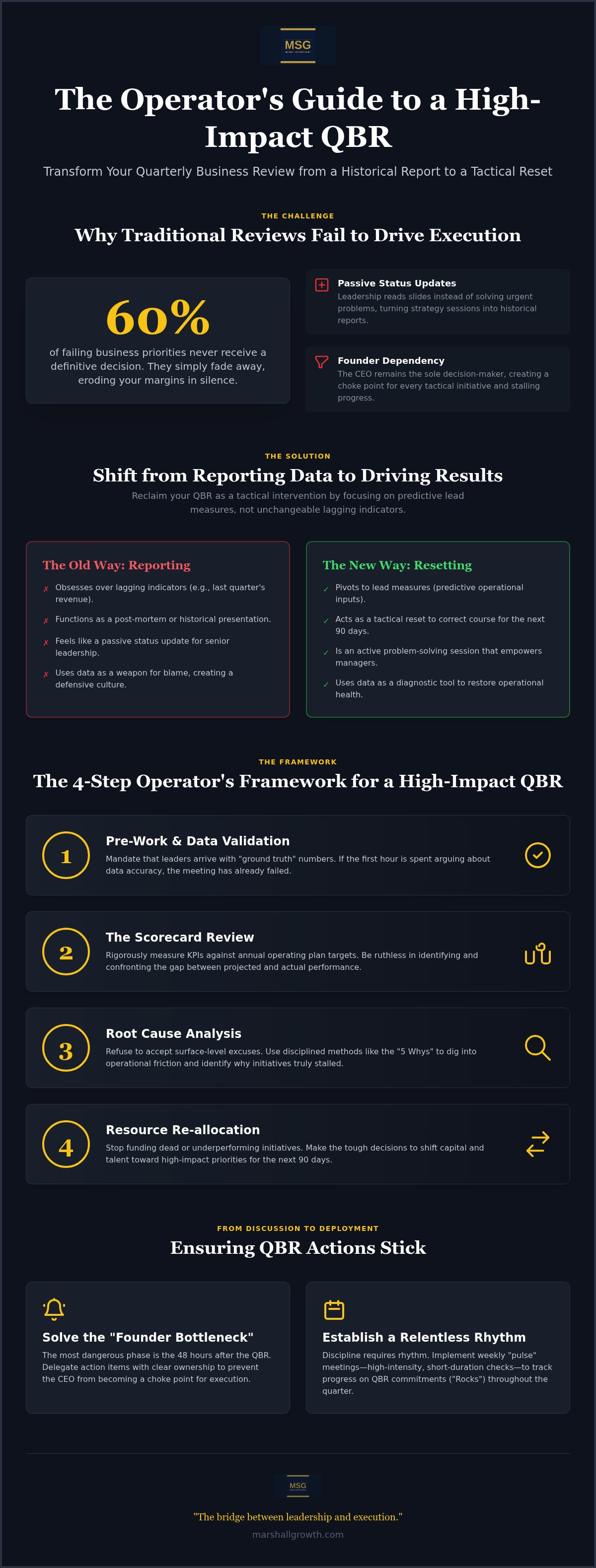
The Operator’s Framework for a High-Impact QBR
Execution isn't a happy accident; it's the result of disciplined scrutiny. To understand how to run a quarterly business review (QBR) that actually shifts the needle, you need a repeatable system. This framework moves beyond simple status updates to focus on the mechanics of growth.
- Step 1: Pre-work and Data Validation. Leadership must arrive with "ground truth" numbers. If you spend the first hour arguing about data accuracy, you've already lost the room.
- Step 2: The Scorecard Review. Measure KPIs against your annual operating plan targets. Be ruthless about the gap between projected and actual performance.
- Step 3: Root Cause Analysis. Don't accept surface-level excuses. Use the "5 Whys" to dig into operational friction points and identify why initiatives stalled.
- Step 4: Resource Re-allocation. Stop funding dead initiatives. Shift capital and talent toward high-impact priorities for the next 90 days.
Building Your QBR Agenda: Three Pillars of Accountability
Your agenda must move from high-level intent to tactical reality. First, verify strategy alignment to ensure daily actions still serve the long-term mission. Second, conduct a performance review using a structured operational performance assessment framework to quantify efficiency. Finally, transition into execution planning. This is where you set your "Rocks," the three to five priority objectives that define success for the upcoming quarter. If your leadership team is struggling to maintain this level of discipline, professional Strategy & Operations Consulting can provide the external perspective needed to restore order. This framework ensures your QBR is a tool for growth, not a ritual of stagnation.
From Discussion to Deployment: Ensuring QBR Actions Stick
The most dangerous phase of any QBR is the 48 hours after the meeting ends. Strategy often dies in the transition from the boardroom to the operational floor. To master how to run a quarterly business review (QBR), you must solve the "Founder Bottleneck." This occurs when the CEO remains the sole decision-maker, creating a choke point for every tactical initiative. You must delegate action items while maintaining control through clear, standardized reporting structures.
Discipline requires a relentless rhythm. Establish weekly pulses to track QBR commitments throughout the quarter. These aren't long, winding meetings; they're high-intensity checks on the "Rocks" identified during your review. Mastering how to run a quarterly business review (QBR) is only half the battle; the rest is about the discipline of the follow-through.
- Weekly Pulses: High-frequency checks to ensure action items stay on track.
- SOP Integration: Baking identified improvements into your company's Standard Operating Procedures.
- Accountability Alignment: Mirroring applying military leadership principles to business to ensure strategic intent translates into tactical movement.
Closing the Execution Gap with Embedded Leadership
If your leadership team lacks the bandwidth to manage these resets, fractional COO support provides the necessary bridge. This approach prioritizes actual implementation over the quarterly presentation. An embedded leader ensures that the company-wide scorecard remains visible and updated between cycles. It's the difference between a one-time event and a durable system of growth. High accountability means no one hides behind a slide deck while the business stagnates.
Standardize Your Execution Strategy
A successful QBR is more than a quarterly checkpoint; it's the heartbeat of your operational discipline. By shifting from passive reporting to a tactical reset, you eliminate the ambiguity that stalls growth. You've seen how to run a quarterly business review (QBR) that prioritizes lead measures and breaks the founder bottleneck. The transition to deployment requires a relentless rhythm of accountability and standardized systems.
Execution is the highest form of strategy. Marshall Solutions Group brings over 60 years of combined leadership experience to your organization. As a veteran-owned and operator-led firm, we specialize in operational excellence and program management. We don't just deliver presentations; we embed ourselves to ensure your initiatives succeed. Strengthen your leadership execution with Marshall Solutions Group. Your team is ready for the stability that professional systems provide. Scale with precision.
Frequently Asked Questions
What is the ideal duration for a Quarterly Business Review?
The ideal duration for a QBR is between two and four hours of high-intensity focus. While some firms suggest full-day sessions, these often devolve into passive reporting and slide-deck fatigue. A concentrated timeframe forces your leadership team to prioritize the most critical friction points. This ensures you leave with a clear tactical plan rather than just a list of observations.
Who should attend the QBR in a founder-led company?
In a founder-led organization, the QBR must include the founder and the primary heads of operations, finance, and sales. Including an external perspective, such as a fractional COO, helps mitigate founder dependency and leadership bottlenecks. The goal is to move toward a Mission Command model where department heads own their results. This structure empowers your middle management to execute without constant oversight.
How is a QBR different from a standard monthly management meeting?
A QBR is a strategic reset, while a monthly meeting focuses on short-term variance. Monthly sessions track progress against the current plan; however, learning how to run a quarterly business review (QBR) involves reassessing the plan itself. You shift from analyzing what happened last month to re-allocating resources for the next 90 days. It's the difference between checking the map and changing the route.
What are the most important KPIs to track in an operational QBR?
You should prioritize lead measures that predict future performance rather than just lagging indicators like revenue. Key metrics include labor efficiency, project utilization rates, and milestone completion for your primary objectives. Tracking these operational KPIs reveals silent margin erosion before it impacts your bottom line. This data-driven approach ensures your leadership team remains focused on the mechanics of growth.
Disclaimer
The information provided in this article is for general informational and educational purposes only and does not constitute legal, financial, accounting, engineering, or other professional advice. Marshall Solutions Group, Inc. makes no representations or warranties regarding the completeness or applicability of this information to any specific situation. Readers should consult appropriately qualified professionals before making decisions requiring specialized professional advice.