Operations Strategy Framework: A Checklist for Disciplined Execution in 2026
Marshall Solutions Group · reviewed by CJ Marshall
Stop letting good strategy fail. Our operations strategy framework provides a checklist for disciplined execution to close the gap between planning and results.

Article by
Chelvis “CJ” Marshall
Chelvis “CJ” Marshall is Founder & Managing Partner of Marshall Solutions Group, a management consulting firm specializing in Strategy & Operations, Organizational Leadership & Change, and Program & Project Management. A retired U.S. Navy Senior Chief who advanced from E-1 to E-8 in 10 years, CJ later transitioned into Fortune 500 enterprise leadership, negotiating more than $20M in contracts within three years. He brings operator-level experience leading teams, complex programs, and mission-critical operations. His work centers on being the bridge between leadership and execution—helping organizations translate strategic direction into disciplined execution, stronger accountability, and measurable results.
Eighty-nine percent of operations leaders report that their technology investments have failed to deliver expected results. This PwC data reveals a massive execution gap. Software alone cannot bridge it. It's clear that a sophisticated plan is useless without a practical operations strategy framework to drive it. You've likely felt this friction. You have the strategic goals, yet accountability slips and performance remains inconsistent when the stakes are highest. It's frustrating to watch margins erode while your team manages the plan instead of the outcome.
We're moving past generic consulting theory to provide a checklist for disciplined execution in 2026. You'll learn how to identify hidden bottlenecks and align your people with your processes for measurable impact. We'll break down the mechanics of organizational stability to turn your strategy into a repeatable, high-performance reality. Strategy meets execution. Discipline over theory.
Key Takeaways
- Stop relying on generic consulting theory and use a diagnostic operations strategy framework to uncover the hidden bottlenecks stalling your organizational growth.
- Build a durable foundation for 2026 by aligning leadership, systems, people, and risk management around a single, unified execution plan.
- Transition from managing activities to driving results by implementing high-stakes metrics that ensure accountability at every level of your organization.
- Close the "execution gap" by adopting an embedded operator model that stays through implementation to deliver measurable margin improvements.
Table of Contents
Why Generic Operations Strategy Frameworks Fail Mission-Critical Firms
Most consulting firms deliver theories that crumble upon contact with reality. A high-stakes operations strategy framework isn't a static document; it's a diagnostic for leadership alignment and process durability. Generic "deck-and-disappear" consulting fails because it ignores the root-cause friction found in complex environments. These advisors identify symptoms but leave before the hard work of implementation begins. For federal contractors, a performance-driven assessment goes beyond a standard internal audit. It doesn't just check boxes for compliance; it ensures your organization can actually deliver on large-scale transformation programs without breaking under the weight of administrative friction.
The Operator’s Perspective on Strategic Alignment
Real-world leadership experience beats theoretical management every time. When you've commanded in high-pressure environments, you see bottlenecks that academics miss. Effective Operations management requires more than just resource balancing. Strategy usually dies during execution for three specific reasons:
- Lack of clarity: Teams don't know the "why" behind the "what."
- Poor accountability: No one owns the outcome when things go sideways.
- Siloed systems: Data and people are trapped in isolated departments.
This is why a practical operations strategy framework must be built on grounded pragmatism. We focus on the mechanics of growth, ensuring every tier of leadership is synchronized. Alignment isn't a feeling; it's a measurable state of operational readiness. You need an embedded partner who understands that success requires more than a plan. It requires a relentless focus on the health and scalability of the entire organization. Discipline over theory. Action over decks.
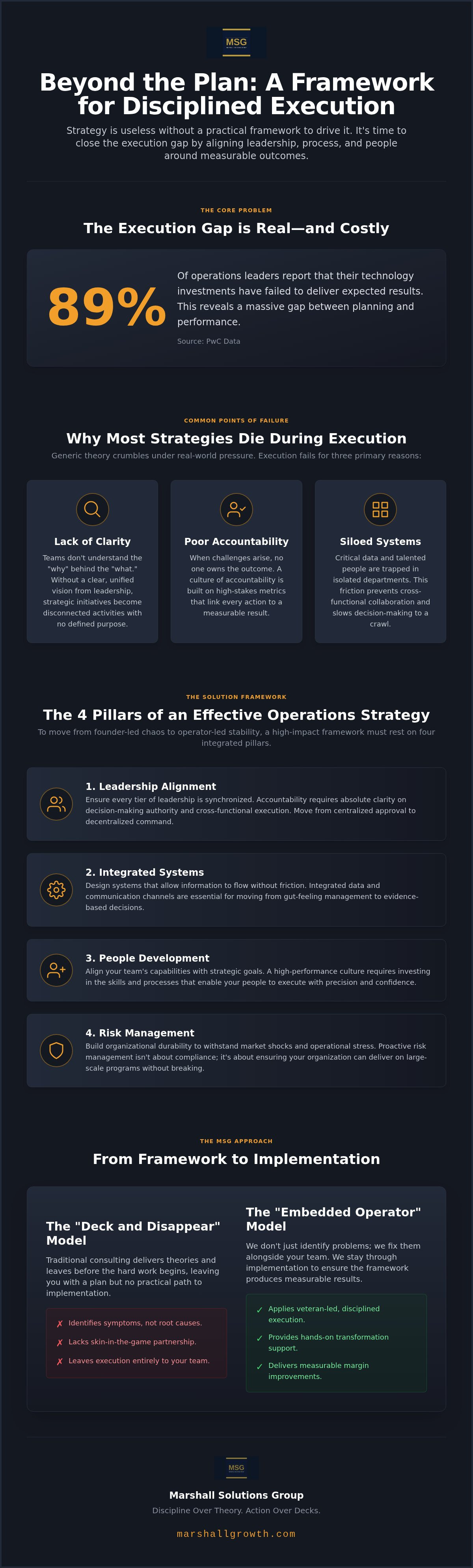
The 4 Pillars of an Effective Operations Strategy Framework
Moving from founder-led chaos to operator-led stability requires a rigid foundation. A high-impact operations strategy framework rests on four pillars: Leadership Alignment, Integrated Systems, People Development, and Risk Management. Competitors often treat these as isolated silos. We view them as an integrated engine. Integrated systems ensure information flows without friction. Risk management builds durability against market shocks. You can't scale with precision if your leadership is disconnected from the frontline reality.
Execution requires data. Track key metrics for operational performance to move from gut-feeling management to evidence-based decisions. We recommend starting with a Leadership & Operations Assessment to map your current-state gaps. This isn't a theoretical exercise. It's a tactical reset for your organization.
Auditing Leadership Alignment and Accountability
The executive suite is often the primary bottleneck. Use a leadership blind spots assessment to identify habits stalling your growth. Accountability requires absolute clarity. Evaluate who holds decision-making authority and how cross-functional execution happens. If your team waits for the founder to approve every minor process, you aren't scaling. You're just getting bigger. True stability comes from decentralized command and disciplined systems. If you want to stop guessing and start executing, a Leadership & Operations Assessment can reset your foundation and provide the clarity your team needs to perform.
From Framework to Implementation: The MSG Approach
Execution is where strategy either lives or dies. At Marshall Solutions Group, we move beyond the diagnostic phase using our "Embedded Operator" model. We don't just identify problems; we fix them alongside your team. This skin-in-the-game partnership distinguishes our approach from traditional firms that deliver a deck and disappear. We stay through the entire transformation program to ensure your operations strategy framework produces measurable results.
For growing organizations, operations management consulting for small business bridges the critical gap between high-level vision and daily output. We apply veteran-led discipline to navigate high-pressure environments. We focus on durability. We prioritize action. Our goal is to move your organization from planning to execution by aligning leadership, people, and processes around measurable outcomes.
Executing the Operational Transformation Program
A structured transition requires three non-negotiable steps to ensure long-term stability:
- Prioritize framework findings: Rank results based on mission-impact, risk mitigation, and margin improvement. Don't try to fix everything at once. Focus on the levers that drive the most value first.
- Align the workforce: Use proven change management frameworks like Prosci ADKAR to ensure your people adopt new processes. Strategy fails when the people expected to execute it don't understand the "why" behind the change.
- Establish a PMO: Build a Program Management Office for governance and delivery oversight. This creates long-term sustainability and ensures that operational gains don't evaporate after the initial push.
This methodical approach ensures your organization moves from a chaotic current state to a streamlined future state. We provide the management-level oversight and military-grade precision needed to scale. No fluff. Just results.
Operational Readiness: Turning Strategy into Durable Results
Scaling isn't about hope; it's about systems. You've seen why generic theories fail and how a disciplined operations strategy framework serves as a diagnostic for leadership alignment. Moving from chaos to stability requires more than a deck. It requires a partner with skin in the game. We bring military-grade discipline as a veteran-owned firm to every transformation program. As an SBA-certified SDVOSB, we offer federal primes strategic teaming advantages backed by a record of zero mission-impacting failures on high-stakes naval platforms. Don't let operational friction stall your growth. It's time to align your people and processes around measurable outcomes. Speak with an Embedded Operator at Marshall Solutions Group today to bridge the gap between planning and execution. You've got the vision; we'll help you build the mechanics to sustain it.
Frequently Asked Questions
What is the difference between an operational audit and an operations strategy framework?
An operational audit is a retrospective snapshot that focuses on compliance and task-level efficiency. In contrast, an operations strategy framework is a forward-looking diagnostic designed to ensure leadership alignment and process durability. While audits tell you what happened, frameworks define exactly how you'll execute. It's the difference between checking a box and building a high-performance engine for growth.
How often should a founder-led company update its operations strategy framework?
You should review your framework annually or whenever your organization hits a significant scaling milestone. Founder-led companies often outgrow their systems every 12 to 18 months. If you notice decision-making bottlenecks or inconsistent performance in high-stakes environments, it's time for an update. Constant refinement ensures your systems remain durable as your mission complexity increases and your team expands.
What are the red flags that indicate a framework is failing during the execution phase?
The most common red flag is persistent operational friction despite having a clear plan. If leadership tiers show a lack of accountability or if performance becomes inconsistent during high-stakes events, your execution is failing. Watch for siloed systems where data doesn't move across departments. These gaps indicate that your operations strategy framework isn't actually integrated into the daily mechanics of your organization.
How does an operations strategy framework impact federal contract compliance and risk management?
A robust framework provides the management-level oversight needed to satisfy federal governance requirements. It builds risk management directly into your processes, ensuring you meet mandatory cybersecurity standards even as regulatory landscapes shift. By establishing a Program Management Office, you ensure long-term sustainability and delivery oversight. This disciplined approach mitigates the risk of mission-impacting failures on complex government programs and high-stakes platforms.
Disclaimer
The information provided in this article is for general informational and educational purposes only and does not constitute legal, financial, accounting, engineering, or other professional advice. Marshall Solutions Group, Inc. makes no representations or warranties regarding the completeness or applicability of this information to any specific situation. Readers should consult appropriately qualified professionals before making decisions requiring specialized professional advice.