Operational Metrics: An Operator's Guide to Growth
Marshall Solutions Group · reviewed by CJ Marshall
Move beyond dashboards. Discover the vital few key metrics for operational performance that connect daily activity to your bottom line and drive disciplined ...

Article by
Chelvis “CJ” Marshall
Chelvis “CJ” Marshall is Founder & Managing Partner of Marshall Solutions Group, a management consulting firm specializing in Strategy & Operations, Organizational Leadership & Change, and Program & Project Management. A retired U.S. Navy Senior Chief who advanced from E-1 to E-8 in 10 years, CJ later transitioned into Fortune 500 enterprise leadership, negotiating more than $20M in contracts within three years. He brings operator-level experience leading teams, complex programs, and mission-critical operations. His work centers on being the bridge between leadership and execution—helping organizations translate strategic direction into disciplined execution, stronger accountability, and measurable results.
Most operational dashboards are nothing more than high-priced distractions that bury the truth under a mountain of data. You're likely staring at dozens of charts every morning, yet you still can't tell if your team's daily activity is actually moving the needle on your bottom line. Tracking the right key metrics for operational performance isn't about seeing everything. It's about seeing what matters.
You know that data without direction is just noise, and in high-stakes environments, noise leads to hesitation. This guide cuts through the clutter to help you identify the vital few indicators that bridge the gap between your strategic vision and disciplined execution. We'll provide a lean framework for operational visibility. You'll learn how to isolate the three to five metrics that drive the most impact, ensuring every level of your organization remains accountable to the mission.
Key Takeaways
- Stop reacting to history by distinguishing between lagging indicators and the leading activities that actually predict process health.
- Focus your oversight by identifying the key metrics for operational performance that represent the "Vital Few" driving the majority of your results.
- Eliminate hesitation by integrating metrics with SOP development, turning raw data into a standardized trigger for tactical execution.
- Build a lean framework that aligns executive strategy with frontline accountability to move from planning to disciplined growth.
Table of Contents
What Are Key Metrics for Operational Performance?
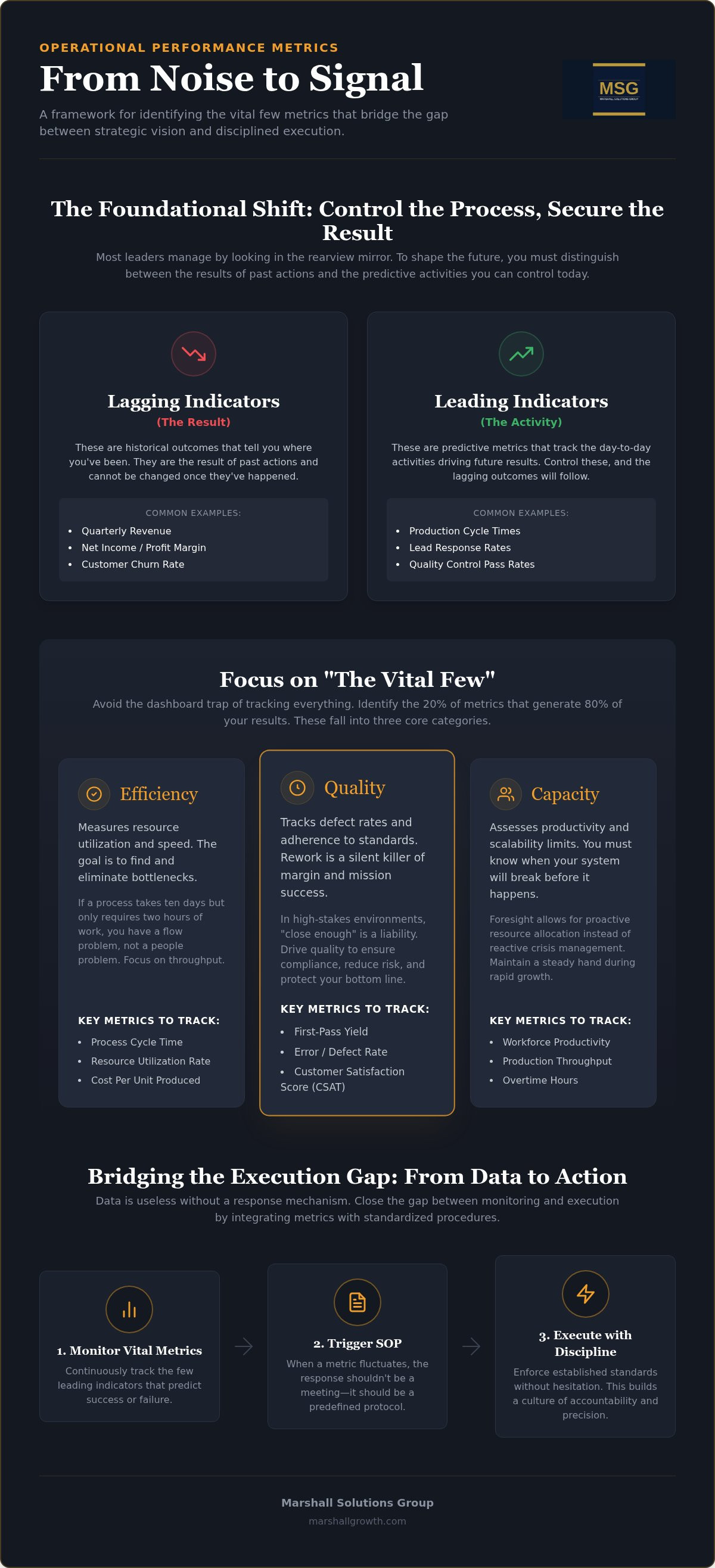
Operational metrics aren't just numbers on a spreadsheet; they're the pulse of your organization. They serve as real-time indicators of day-to-day process health and efficiency. While financial statements tell you where you've been, key metrics for operational performance tell you where you're going. Most leaders fail because they manage by looking in the rearview mirror. They react to history instead of shaping the future.
The distinction between indicators is critical. Lagging indicators, like quarterly revenue or net income, represent the final results of past actions. You can't change them once they've happened. Leading indicators, however, are predictive. They track activities such as production cycle times, lead response rates, or quality control pass rates. If you control the leading activities, the lagging results take care of themselves. Control the process. Secure the result.
Don't fall for vanity metrics. High website traffic or a large social following might look good in a board deck, but if they don't drive margin or mission success, they're a liability. These data points provide a false sense of progress while operational friction continues to erode your bottom line. Focus on what moves the needle.
Signal vs. Noise in Operational Reporting
In complex, mission-critical environments, it's easy to get buried in data. Noise is any metric that doesn't directly influence your core organizational goals. To find the signal, you must ruthlessly audit your reporting structures. A Leadership & Operations Assessment provides the necessary clarity to establish these performance standards. It strips away the non-essential and forces alignment across the executive suite. Operational excellence is the alignment of people and processes around measurable outcomes.
The Vital Few: 3 Categories of Metrics for Scalable Execution
Avoid the dashboard trap. Most tracking systems are built on volume, not impact. To scale effectively, you must identify the 20% of key metrics for operational performance that generate 80% of your results. This is the "Vital Few." It requires a refusal to accept mediocrity in your reporting. Focus on the mechanics of growth. Eliminate the noise.
Your metrics must evolve with your lifecycle. What works for a startup will fail a mid-market firm. This is especially true in operations management for small business, where precision is the only way to scale without breaking the culture. For federal programs, throughput is the primary measure of success. It's the rate at which your system generates finished outcomes. If your throughput stalls, your mission fails. You cannot manage what you do not measure with accuracy.
Efficiency, Quality, and Capacity Indicators
Efficiency measures resource utilization and process cycle time. Find the bottlenecks. If a process takes ten days but only requires two hours of actual work, you have a flow problem, not a people problem. Quality tracks first-pass yield and error rates. In high-stakes environments, rework is a silent killer of margin. Identifying the key metrics for operational performance that drive quality ensures compliance and reduces risk. Finally, Capacity assesses workforce productivity and scalability limits. You need to know when your system will hit a wall before it happens. This foresight allows for proactive resource allocation rather than reactive crisis management. It's about maintaining a steady hand during rapid growth.
Bridging the Execution Gap: Turning Data into Action
Data is useless without a response mechanism. This is the "Execution Gap," where leaders possess the right dashboard but lack the tactical discipline to pivot. To close this gap, you must integrate your monitoring with robust SOP development. Standardize exactly how your team responds to metric fluctuations. Monitoring key metrics for operational performance is only half the battle. If your first-pass yield drops, the response shouldn't be an emergency meeting; it should be a predefined protocol. Standardizing your key metrics for operational performance allows you to scale with precision rather than chaos.
Why do certain numbers remain stagnant despite your best efforts? Often, the issue isn't technical. A leadership blind spots assessment frequently reveals that the primary bottleneck is a leader's hesitation to enforce established standards. If you ignore a metric for three weeks, your team will ignore it for three months. Stop accepting "close enough" as a standard. Secure the process. Secure the result.
Establishing a Culture of Accountability
Use metrics as a coaching tool, not a disciplinary hammer. High-performance teams thrive on clarity, not fear. When the numbers slip, it's an opportunity to refine the system and identify where the process broke down. Metrics without accountability are merely suggestions that teams will eventually ignore. This is where Fractional COO support becomes vital. We build the frameworks that sustain high performance, ensuring that strategy, people, and processes remain aligned around measurable outcomes. We don't just deliver a plan. We embed the discipline required to execute it, providing the oversight needed to bridge the gap between where you are and where you need to be.
Move From Observation to Execution
Effective oversight isn't about collecting more data; it's about mastering the 'Vital Few.' By isolating the key metrics for operational performance that predict future results, you move from reactive firefighting to proactive command. This transition requires a culture where SOPs dictate the response to every fluctuation and accountability is a shared standard.
Marshall Solutions Group brings veteran-led leadership and Navy command experience to your organization. As an SBA-certified SDVOSB, we use a hands-on, skin-in-the-game implementation model to ensure strategy translates into results. We don't just deliver a presentation; we embed the systems that drive durability. Speak with an MSG Operating Partner about your performance goals to start building a more disciplined operation. Your path to scalable growth is waiting.
Frequently Asked Questions
What is the difference between a KPI and an operational metric?
KPIs represent your high-level strategic goals, such as annual revenue or market share. In contrast, operational metrics are the tactical, real-time indicators of day-to-day process health. Think of KPIs as the destination and operational metrics as the engine's RPM. You monitor the engine to ensure you actually reach the destination without a breakdown.
How many operational metrics should a small business track?
Most small businesses drown in data. You should focus on the "Vital Few," typically three to five key metrics for operational performance that directly impact your bottom line. Tracking too many indicators creates noise and leads to analysis paralysis. Identify the specific levers that drive 80% of your operational results and ignore the rest.
What are the best metrics for tracking federal program management performance?
In federal environments, throughput is the primary measure of mission success. You should track milestone variance to ensure schedule adherence and resource utilization to manage taxpayer-funded assets. Quality metrics, such as first-pass yield on deliverables, are also critical for risk management. These indicators ensure that program execution remains aligned with agency objectives and strict compliance requirements.
Why do operational metrics often fail to improve business results?
Metrics fail when they lack a response mechanism. Tracking key metrics for operational performance is useless if your team doesn't have a standardized SOP for when numbers slip. Failure often stems from a lack of executive accountability. If leaders don't enforce the standards established by the data, the metrics become mere suggestions that the organization eventually ignores.
Disclaimer
The information provided in this article is for general informational and educational purposes only and does not constitute legal, financial, accounting, engineering, or other professional advice. Marshall Solutions Group, Inc. makes no representations or warranties regarding the completeness or applicability of this information to any specific situation. Readers should consult appropriately qualified professionals before making decisions requiring specialized professional advice.