Navigating Federal Government Bureaucracy: An Operator’s Guide to Program Execution
By CJ Marshall, President & Founder
Successfully navigating federal government bureaucracy means turning hurdles into a disciplined execution framework. Protect project profitability and scale ...

Article by
Chelvis “CJ” Marshall
Chelvis “CJ” Marshall is President & Founder of Marshall Solutions Group, a management consulting firm specializing in Strategy & Operations, Organizational Leadership & Change, and Program & Project Management. A retired U.S. Navy Senior Chief who advanced from E-1 to E-8 in 10 years, CJ transitioned into Fortune 500 enterprise leadership, where his commercial experience has included more than $20 million in contract value. He brings operator-level experience leading teams, complex programs, and mission-critical operations. His work focuses on bridging leadership and execution—helping organizations translate strategic direction into disciplined execution, stronger accountability, and measurable business results.
Bureaucracy isn't an obstacle to be avoided. It's a high-stakes operational environment that demands a steady hand and a battle-tested framework. Most leaders feel the weight of administrative rework and reporting bottlenecks as they scale, watching their margins erode under the pressure of complex federal requirements. Successfully navigating federal government bureaucracy requires moving beyond reactive compliance toward proactive program management. It's about establishing order where others see only noise.
You can transform these hurdles into a disciplined execution framework that drives performance and protects your project profitability. This guide outlines how to build a scalable PMO, reduce owner dependency, and maintain operational control in the face of shifting regulations like the 2026 FAR overhaul. We'll explore the shift from rigid compliance to outcome-based execution. You'll learn to ensure your growth doesn't outpace your operational capacity or sacrifice your bottom line.
Key Takeaways
- Identify the symptoms of operational friction, such as margin erosion and leadership bottlenecks, that cause federal programs to stall.
- Transition from passive compliance to a disciplined Management Operating System (MOS) that prioritizes high-accountability execution over simple process mapping.
- Learn how navigating federal government bureaucracy effectively requires establishing clear decision rights to eliminate the founder as a primary program bottleneck.
- Bridge the gap between strategy and results by utilizing an embedded operator model that focuses on tactical implementation rather than theoretical advice.
Table of Contents
Decoding the Bureaucracy Trap: Why Federal Programs Stall
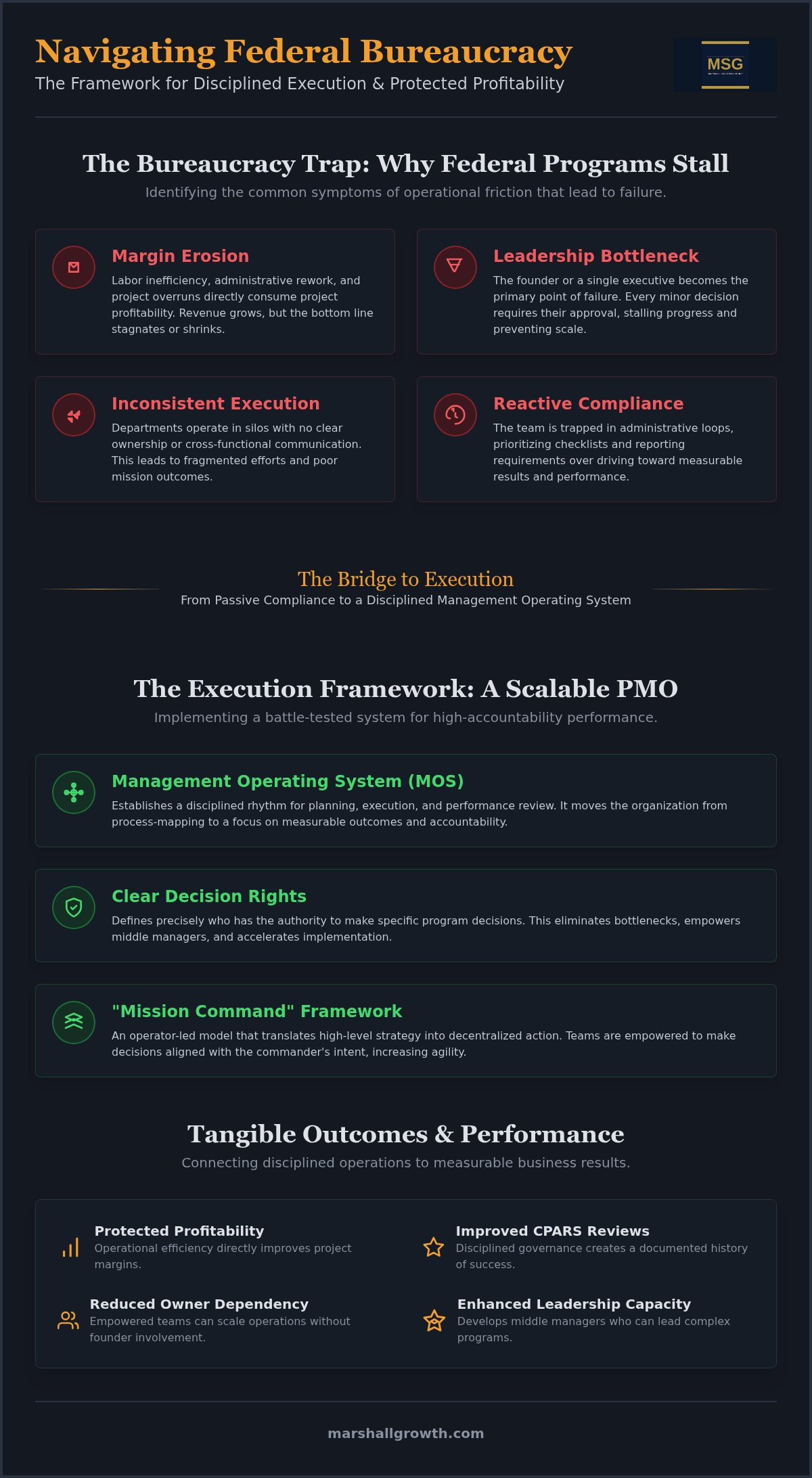
Federal programs rarely fail due to a lack of strategy. They fail during implementation. When navigating federal government bureaucracy, leaders often encounter a specific set of symptoms that signal deep-seated operational friction. These include inconsistent execution across departments, a lack of clear decision rights, and revenue growth that fails to improve bottom-line profitability. Traditional management models often collapse here. They prioritize rigid compliance over tactical agility, leaving program leaders stuck in administrative loops.
To better understand this concept, watch this helpful video:
Effective execution when navigating federal government bureaucracy requires more than just knowing the FAR. The financial consequences of poor navigation are immediate. Labor inefficiency and project overruns don't just delay timelines; they directly erode your EBITDA. When your team spends more time managing reporting requirements than delivering mission outcomes, your project margins disappear.
The Hidden Cost of Operational Friction in GovCon
Most firms rely on "deck-and-disappear" consulting. They deliver a presentation and leave the heavy lifting to your already overwhelmed staff. This fails to address the root cause of leadership-team misalignment. You need a Leadership & Operations Assessment to pinpoint where your current systems can't scale.
Our approach applies the precision of military engineering discipline to the federal civil service environment. We don't just hand over a plan. We embed with your team to ensure every process drives a measurable business outcome. This transition from theory to execution is the only way to protect your margins while meeting complex federal demands. Connect with us on LinkedIn to see how we drive results.
The Execution Framework: Navigating Federal PMO and Compliance
Success in the federal space depends on your ability to scale beyond individual effort. When navigating federal government bureaucracy, the founder often becomes the primary bottleneck. You must establish clear decision rights and accountability frameworks immediately. This isn't about creating charts; it's about defining who has the authority to pull the trigger on specific program decisions. Without this, your growth will stall as every minor issue waits for your personal approval.
Implementation requires a disciplined Management Operating System (MOS). This system prioritizes execution over simple process mapping. It ensures that your team isn't just following a checklist but is driving toward measurable mission outcomes. You also need a workforce development pipeline. Your middle managers must be bilingual, capable of speaking credibly to agency leads while providing tactical direction to field technicians. This ensures that strategy doesn't get lost in translation between the boardroom and the job site.
Strategic PMO Governance for Mission-Critical Environments
We utilize a "Mission Command" framework to translate high-level strategy into decentralized action. This approach relies on applying military leadership principles to business to manage high-volume task orders effectively. It empowers your team to make decisions within the commander's intent, reducing the need for constant oversight.
Disciplined governance directly impacts your CPARS reviews. By aligning internal KPIs with federal performance requirements, you create a documented history of success. If you're struggling to move from planning to performance, consider a strategy and operations consulting engagement to shore up your framework. You can also follow our updates on LinkedIn to learn more about our operator-led approach.
Beyond the Slide Deck: Building Leadership Capacity for Federal Success
The gap between federal strategy and results is always execution. Navigating federal government bureaucracy requires more than a static plan; it requires an embedded advisory model that lives in the daily grind. Teaming with an SBA-certified SDVOSB like Marshall Solutions Group (MSG) provides a dual advantage. It strengthens your socioeconomic profile while adding direct operator-level expertise. We bring the discipline of managing $500M federal transformation programs directly to your project. Accountability is the cornerstone of this success. Developing a company-wide scorecard creates the visibility required for total federal compliance. It ensures every team member knows exactly how their performance impacts the mission.
Transitioning from Compliance-Heavy to Performance-Driven
Leaders must move from simply managing the contract to leading the program. Managing the contract is defensive. It focuses on avoiding penalties. Leading the program is offensive. It focuses on driving outcomes. This shift ensures long-term scalability without sacrificing margin. MSG has a proven track record of negotiating $10M+ enterprise contracts and managing 1,500 personnel across three countries. We know how to stabilize daily systems so you can scale without chaos. If your leadership team is a bottleneck, fractional operational leadership can provide the relief you need. We provide the steady hand needed to drive performance while you focus on high-level growth. Connect with our team on LinkedIn to discuss your execution framework. Don't let administrative friction stall your mission.
Drive Execution Excellence in Federal Programs
Successful execution isn't a theory; it's a discipline. You've learned that navigating federal government bureaucracy effectively requires moving beyond passive compliance to active program leadership. This means establishing clear decision rights, implementing a rigorous Management Operating System, and building a workforce that speaks the language of both agency leads and technical operators. You must eliminate leadership bottlenecks to protect your project margins and ensure long-term scalability.
Marshall Solutions Group provides the steady hand your organization needs to maintain operational control. As an SBA-certified SDVOSB with 60+ combined years of leadership experience, we've managed $500M federal transformation programs. We don't just deliver slide decks; we embed with your team to drive measurable results. Speak with Marshall Solutions Group about bridging the gap between your federal strategy and execution. Your mission deserves a partner who values execution as the highest form of strategy.
Frequently Asked Questions
How do I handle federal contract modifications and scope creep?
Establish a rigorous baseline for every task order and treat any deviation as a formal change request immediately. Scope creep happens when project controls are lax. You must maintain a clear log of all agency requests and reconcile them against the original Statement of Work. Use disciplined reporting to ensure the Contracting Officer acknowledges additions before labor hours are burned.
What is the most effective PMO structure for a mid-market federal contractor?
A hybrid PMO that combines centralized governance with decentralized execution is most effective. This approach empowers project leads to make tactical decisions while the central PMO manages reporting and compliance. It removes the founder as a bottleneck. You need a structure that prioritizes measurable outcomes over activity tracking to ensure your growth doesn't outpace your operational capacity.
How can a veteran-owned consulting firm help primes navigate bureaucracy?
A veteran-owned firm like Marshall Solutions Group brings cross-level fluency to complex programs. We speak the language of both the field technician and the agency lead. Navigating federal government bureaucracy is easier when your team has direct operational command experience. Our SDVOSB status also strengthens your socioeconomic profile, providing a strategic teaming advantage while we embed with your team to drive execution.
What are the common signs that my federal program execution is failing?
Persistent margin erosion and administrative rework are the loudest warning signs. If your leadership team is stuck in daily firefighting or if project delivery is inconsistent across different sites, your framework is broken. Failing programs often show revenue growth without proportional profitability. You'll also see leadership bottlenecks where every minor decision requires executive approval, stalling the mission and killing your scalability.
Disclaimer
The information provided in this article is for general informational and educational purposes only and does not constitute legal, financial, accounting, engineering, or other professional advice. Marshall Solutions Group, Inc. makes no representations or warranties regarding the completeness or applicability of this information to any specific situation. Readers should consult appropriately qualified professionals before making decisions requiring specialized professional advice.