Project Risk Management Plan: Template for Execution
By CJ Marshall, President & Founder
Stop using a risk management plan for projects that fails under pressure. Our template turns your plan into a tool for execution that protects project margins.

Article by
Chelvis “CJ” Marshall
Chelvis “CJ” Marshall is President & Founder of Marshall Solutions Group, a management consulting firm specializing in Strategy & Operations, Organizational Leadership & Change, and Program & Project Management. A retired U.S. Navy Senior Chief who advanced from E-1 to E-8 in 10 years, CJ transitioned into Fortune 500 enterprise leadership, where his commercial experience has included more than $20 million in contract value. He brings operator-level experience leading teams, complex programs, and mission-critical operations. His work focuses on bridging leadership and execution—helping organizations translate strategic direction into disciplined execution, stronger accountability, and measurable business results.
Most versions of a risk management plan for projects are nothing more than expensive insurance policies that fail the moment a real crisis hits. You've seen the symptoms. Projects start with healthy margins only to end in the red because of delays that everyone saw coming but no one owned. It's exhausting to watch profitability erode while teams hide behind complex PMO frameworks that prioritize paperwork over performance. You need a system that drives action, not one that just logs complaints.
A functional plan must serve as a tactical tool for execution, not a static document buried in a digital folder. This guide provides a clear, operator-led framework to identify and neutralize threats before they impact your bottom line. We're moving past the theory to deliver an actionable template that shifts the burden of decision-making from the owner to the system. You'll learn how to build a culture of accountability that protects your project margins and ensures your strategy actually reaches the finish line.
Key Takeaways
- Transform your risk management plan for projects from a passive spreadsheet into a proactive leadership tool that identifies root causes before they erode your margins.
- Utilize a five-step execution template to score risks by probability and business impact, ensuring your team focuses on high-stakes threats rather than minor distractions.
- Implement a "Mission Command" approach to risk, empowering department leads to execute mitigation strategies without waiting for executive approval.
- Reduce owner-dependency by establishing clear decision rights and accountability structures that keep projects on schedule and within budget.
Table of Contents
The Anatomy of a Mission-Critical Project Risk Management Plan
A risk management plan for projects is a proactive framework for identifying, assessing, and neutralizing threats to your margins and timelines. It's not a static document. It's an offensive tool. Most initiatives fail because leaders treat these plans as "deck-and-disappear" exercises. They build a spreadsheet to satisfy a PMO requirement, then never look at it again. This lack of discipline turns manageable issues into mission-ending failures.
True risk management is the bridge between project strategy and successful execution. In high-growth firms, you must differentiate between "known-unknowns" like material costs and the internal operational friction that stalls founder-led growth. The latter is often more dangerous. It manifests as leadership bottlenecks and a lack of team accountability. When you don't address these internal friction points, even the best-laid plans will fail.
Why Leadership Execution Outperforms Academic Theory
Academic theory prioritizes paperwork. Real-world execution prioritizes results. While traditional consultants hide behind vague terminology, an operator-led model mirrors the discipline of naval environments where failure isn't an option. Our team has managed $500M naval transformation programs where every risk had an owner and a clear trigger for action. We prioritize accountability over theory because we've seen the cost of hesitation.
Without this rigor, you face severe financial consequences. Margin erosion and labor inefficiency aren't just line items; they're the direct result of poor project risk management. When ownership is unclear, productivity drops and rework costs climb. Before you begin your next phase, conduct an Operational Readiness Assessment to ensure your team is prepared to execute under pressure. You don't need more meetings. You need a system that works when you aren't in the room.
A 5-Step Template for Project Risk Mitigation
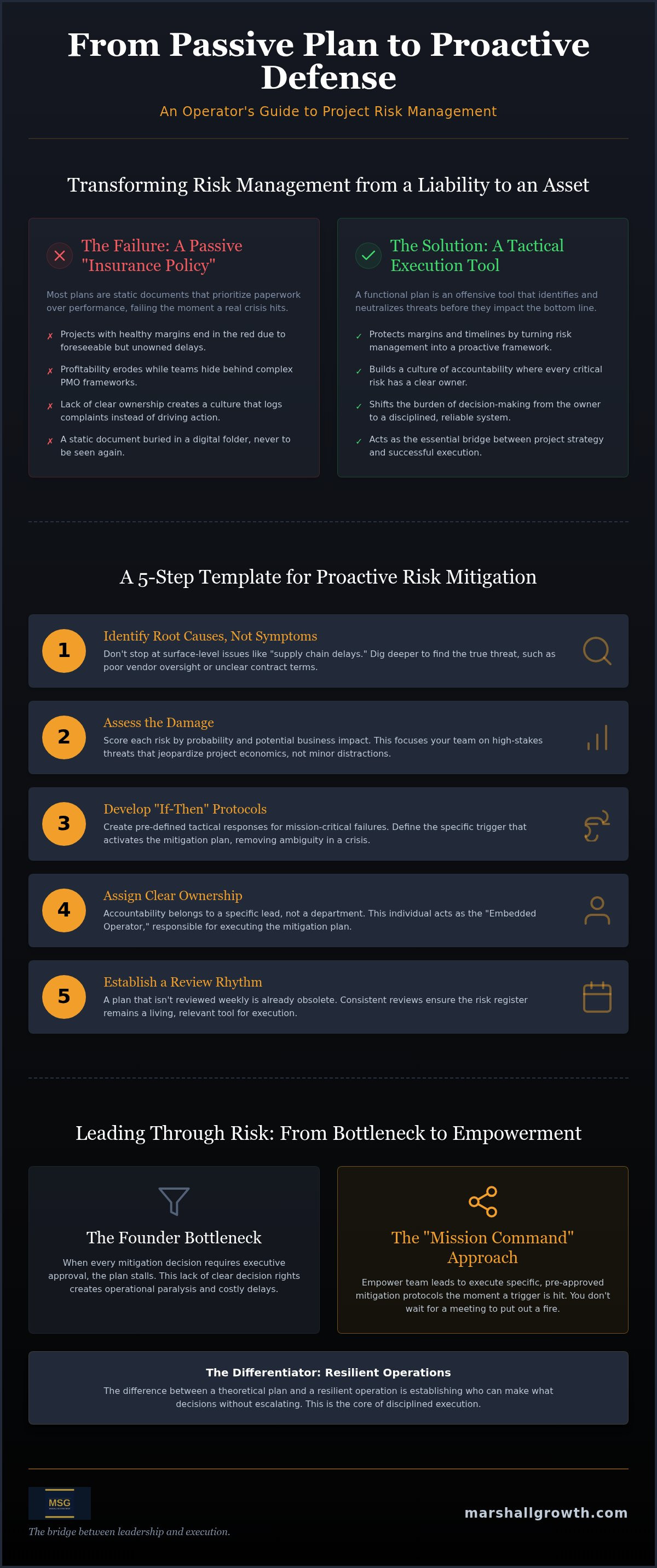
A disciplined risk management plan for projects requires more than a brainstorming session. It demands a structured, five-step template built for implementation. First, identify root causes. Don't stop at surface-level symptoms like "supply chain issues." Dig deeper. Is the real threat a lack of contract clarity or poor vendor oversight? Second, assess the damage. Use PMI's risk analysis and management standards to score probability against financial impact. This ensures you prioritize threats that actually jeopardize project economics.
Third, develop "if-then" protocols. These are tactical responses for mission-critical failures. Fourth, assign ownership. Accountability belongs to a specific lead, not a department. This person acts as the "Embedded Operator" for that risk. Fifth, establish a review rhythm. A plan that isn't reviewed weekly is already obsolete. If your current team struggles with this level of discipline, consider how Strategic Gov Program Management frameworks can tighten your post-award execution.
Structuring Your Risk Register for Execution
Your register should be a living tool. Include columns for Risk ID, the specific Trigger, Impact Score, and the Mitigation Plan. Crucially, name the individual responsible for pulling the trigger. Founders must ask: "If this project fails, what is the most likely root cause we are ignoring today?" This question cuts through the fluff and identifies the leadership bottlenecks that stall growth. If you need a partner to help build these systems, speak with Marshall Solutions Group about our fractional operations support.
Leading Through Risk: Accountability and Ownership
In mid-market firms, the primary threat to a risk management plan for projects isn't external. It's the founder bottleneck. When every mitigation decision requires executive approval, the plan stalls. This lack of clear decision rights creates operational paralysis. Leaders must adopt a "Mission Command" philosophy. This involves empowering team leads to execute specific mitigation protocols the moment a trigger is hit. You don't wait for a meeting to put out a fire.
Signs of weak leadership alignment are obvious. You'll see inconsistent execution across different sites. If one project follows the SOP while another ignores it, your risk posture is compromised. Marshall Solutions Group operates with a "skin in the game" model. We don't just present a deck. We stay through implementation to ensure accountability is baked into your culture. This is the difference between a theoretical plan and a resilient operation.
Federal Program Governance and Prime Contractor Support
For prime contractors, an SDVOSB-led risk strategy does more than fill a socioeconomic requirement. It protects CPARS ratings through disciplined execution. Maintaining visibility across multi-site infrastructure requires rigorous SOPs and KPIs that track risk in real-time. Without these systems, you're flying blind. To identify where your bottlenecks are hiding, take our Leadership & Operations Assessment. It provides the diagnostic clarity needed to move from chaos to a scalable, high-performance environment.
Transitioning from Defensive Documentation to Mission Success
A functional risk management plan for projects isn't a safety net; it's a driver of profitability. You've learned how to identify root causes, score impacts with precision, and empower your team leads through Mission Command. These aren't academic exercises. They're the same tactical principles our veteran-led team used to manage $500M in mission-critical assets without a single operational failure. We don't just deliver a presentation and walk away. We stay embedded to ensure your incentives are aligned and your execution is disciplined across every site.
Stop managing risk in pieces. Partner with Marshall Solutions Group to drive disciplined execution in your most critical programs. Your next project doesn't have to be a gamble. Build a system that wins and scales with confidence.
Frequently Asked Questions
What is the primary goal of a risk management plan in project management?
The primary goal is to protect project margins and delivery timelines by neutralizing threats before they impact operations. It's not about avoiding all risk, but about controlled execution. By establishing a risk management plan for projects, you ensure that the team understands exactly what triggers a mitigation protocol. This prevents the founder bottleneck and keeps the mission moving forward under pressure.
How often should a project risk register be updated?
A risk register must be a living tool reviewed during every weekly operational meeting. Static documents are useless in high-stakes environments. You should update the register whenever a new threat is identified or a mitigation trigger is reached. Constant vigilance ensures that your risk management plan for projects remains relevant as conditions change across multi-site infrastructure deployments.
What is the difference between a project risk and a project issue?
A risk is a potential threat that hasn't happened yet, while an issue is a current problem requiring immediate fire-fighting. Risks are handled through proactive mitigation strategies defined in your planning phase. Issues demand reactive correction. Effective leadership focuses on managing risks to prevent them from ever becoming mission-impacting issues that erode your profitability and stall your growth.
How do I handle project risks that are outside of my team’s control?
You handle uncontrollable risks by developing robust contingency plans and clearly defining your escalation paths. If a supply chain failure or regulatory shift is inevitable, your plan must outline "if-then" protocols to pivot resources or adjust timelines. Don't waste time trying to control the wind. Focus on adjusting the sails through disciplined execution and transparent communication with your prime contractors.
Disclaimer
The information provided in this article is for general informational and educational purposes only and does not constitute legal, financial, accounting, engineering, or other professional advice. Marshall Solutions Group, Inc. makes no representations or warranties regarding the completeness or applicability of this information to any specific situation. Readers should consult appropriately qualified professionals before making decisions requiring specialized professional advice.