Preparing for CPARS: Strategic Guide for Contractors
By CJ Marshall, President & Founder
Don't let CPARS ratings surprise you. Our guide details how federal contractor PMO support builds a disciplined system to secure the Exceptional ratings you ...

Article by
Chelvis “CJ” Marshall
Chelvis “CJ” Marshall is President & Founder of Marshall Solutions Group, a management consulting firm specializing in Strategy & Operations, Organizational Leadership & Change, and Program & Project Management. A retired U.S. Navy Senior Chief who advanced from E-1 to E-8 in 10 years, CJ transitioned into Fortune 500 enterprise leadership, where his commercial experience has included more than $20 million in contract value. He brings operator-level experience leading teams, complex programs, and mission-critical operations. His work focuses on bridging leadership and execution—helping organizations translate strategic direction into disciplined execution, stronger accountability, and measurable business results.
Your CPARS rating is not a reflection of your performance. It is a reflection of your evidence. Many leaders treat the assessment process as a year-end administrative burden, only to be blindsided by a "Satisfactory" rating that feels like a failure. This disconnect happens when internal records don't align with government expectations. Proper federal contractor PMO support demands a disciplined, monthly cadence of documentation rather than a frantic year-end scramble.
We'll show you how to move from reactive reporting to a proactive performance management system. You'll learn to build a repeatable evidence collection framework that keeps your PMO and government leads in total alignment. This guide outlines how to eliminate surprises, reduce administrative friction, and secure the Exceptional ratings required to win future RFPs. Stop defending your past and start engineering your future wins through operational discipline.
Key Takeaways
- View CPARS as a permanent strategic asset that dictates your future probability of win. These ratings are the first thing source selection boards review when evaluating contractor risk.
- Establish a monthly cadence for evidence collection to avoid the chaos of year-end reporting. Aligning your internal KPIs with government evaluation areas ensures no achievement goes undocumented.
- Utilize structured federal contractor PMO support to move from reactive defense to proactive performance management. This approach builds a repeatable system for securing Exceptional ratings through disciplined execution.
- Navigate the 14-day rebuttal window with objective data rather than emotional appeals. Learning to draft professional, fact-based responses can mitigate negative claims and protect your contract standing.
Table of Contents
Why CPARS Ratings Are Your Most Valuable Business Asset
CPARS is your permanent record. It isn't a suggestion or a subjective opinion. Source selection boards treat these evaluations as the primary data point for assessing contractor risk. If your record shows technical slippage or management friction, you're a liability before the first page of your proposal is even read. High-impact federal contractor PMO support ensures this record remains an asset rather than a hurdle.
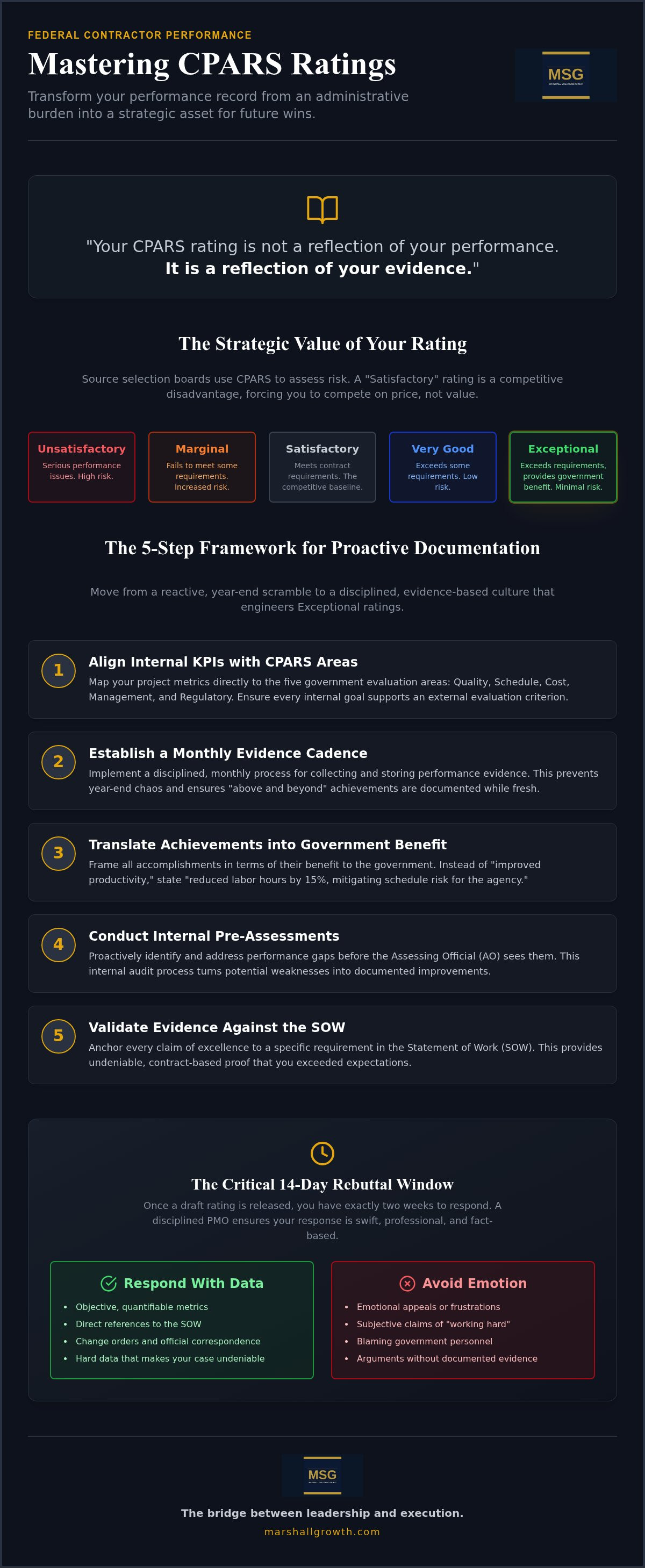
Your Probability of Win (pWin) hinges on these scores. In best-value acquisitions, a superior rating acts as a force multiplier. The five standard levels: Exceptional, Very Good, Satisfactory, Marginal, and Unsatisfactory, create a hierarchy of trust. Aiming for Exceptional isn't vanity. It's a strategic necessity. Poor ratings drive up business development costs because you're forced to spend more to prove your capability against your own history. When your past performance is questionable, you lose the benefit of the doubt. You're no longer competing on value; you're competing on damage control.
The Financial Consequences of a "Satisfactory" Rating
In technical sectors, Satisfactory is a competitive disadvantage. It tells the government you did exactly what was required and nothing more. Evaluation boards choose Exceptional firms even when prices are higher. This forces lower-rated contractors into a race to the bottom, buying work at razor-thin margins. Real success requires the disciplined execution found in Strategic Gov Program Management. Performance documentation is your most effective price-to-win strategy.
A 5-Step Framework for Proactive Performance Documentation
Waiting until the end of the performance year to document your success is a failure of leadership. High-impact federal contractor PMO support requires an operating system that captures data while it's fresh. This framework moves your team from a reactive scramble to a disciplined, evidence-based culture.
- Step 1: Align internal KPIs. Map your internal metrics directly to the five CPARS evaluation areas: Quality, Schedule, Cost, Management, and Regulatory.
- Step 2: Establish a monthly cadence. Monthly reports should feed a central evidence folder, ensuring no achievement is forgotten.
- Step 3: Map achievements to "benefit to the government" language. Evaluation boards don't care that you worked hard; they care that your efficiency reduced their risk.
- Step 4: Conduct internal assessments. Identify and fix performance gaps before the Assessing Official (AO) sees them.
- Step 5: Validate evidence against the SOW. Ensure every claim of excellence is anchored to a specific contract requirement.
If your team struggles to maintain this level of accountability, it's a sign that your underlying processes aren't scaling. A structured approach to federal contractor PMO support provides the visibility needed to catch these issues before they hit your permanent record.
Building a Monthly Evidence Collection Cadence
Real-time documentation is the only way to capture "above and beyond" instances. These are the moments where your team mitigated a risk that wasn't your fault. Use Leadership & Operations Assessments to audit your documentation quality. Quantify every result. Instead of claiming you "improved productivity," state that you "reduced labor hours by 15% through process automation." This precision leaves no room for subjective downgrades. If your reporting feels like a burden rather than a tool, it's time to re-evaluate your Strategy & Operations.
Managing the Review Cycle and Assessing Official Engagement
The 14-day window is a critical tactical moment. You have exactly two weeks to respond once the government releases the draft rating. Missing this window leaves your record undefended. Precision is mandatory here. Effective federal contractor PMO support ensures that responses are drafted, vetted, and submitted well before the clock runs out. This isn't just an administrative task; it's a legal right to provide your perspective on the record.
When the Assessing Official (AO) provides a rating that doesn't align with your performance data, you must engage the Reviewing Official (RO). The RO serves as the objective authority when disagreements occur. Provide the RO with undeniable evidence that makes a rating adjustment logical. Address "Marginal" claims with hard metrics. If the AO claims a schedule slip, provide the change order that authorized the delay. Data wins arguments. Emotion loses them.
Professional Response and Rebuttal Strategies
Acknowledge challenges while highlighting successful corrective actions. If a process failed, show how you applied change management in business process improvement to eliminate the root cause. This demonstrates high accountability and leadership. If discrepancies remain significant, request a formal meeting with the Contracting Officer (CO). These sessions allow for a candid exchange of facts that often resolve issues more effectively than a written rebuttal.
Maintain a disciplined communication loop with your COR and CO throughout the year. Surprises in a CPARS report are symptoms of poor federal contractor PMO support and weak operational visibility. Steady, transparent engagement ensures the final report is a formality, not a battle. Don't wait for the annual review to discuss performance gaps. Address them in real-time to ensure your record reflects your actual impact.
Turn Your Performance Record Into a Competitive Edge
CPARS ratings are more than administrative checkboxes; they're the engine of your future growth. By aligning internal KPIs with government evaluation areas and maintaining a disciplined evidence cadence, you eliminate the risk of a "Satisfactory" rating stalling your expansion. High-level federal contractor PMO support ensures your execution is documented with the same precision used to deliver the work.
Marshall Solutions Group is a veteran-owned and operator-led advisory with experience managing $500M+ federal transformation programs. Our embedded delivery model doesn't just offer advice; we stay through implementation to ensure your systems produce Exceptional results. Stop reacting to performance reviews. Speak with Marshall Solutions Group about Federal PMO Support today. Build the operational discipline that secures your next win and defines your reputation in the federal marketplace.
Frequently Asked Questions
What happens if I disagree with my CPARS rating?
You have a 14 day window to submit a formal rebuttal in the CPARS portal. This response must be objective and supported by evidence from your internal project controls. If you can't reach an agreement with the evaluator, the case moves to a Reviewing Official for a final decision. Maintaining disciplined federal contractor PMO support throughout the year ensures you have the data ready when these discrepancies arise.
Can a "Satisfactory" rating prevent me from winning future government contracts?
A "Satisfactory" rating can absolutely hurt your chances in a best value acquisition. While it technically means you met contract requirements, most source selection boards view it as the bare minimum. If a competitor has "Exceptional" ratings, they represent a lower risk to the government. This perception often forces Satisfactory rated contractors to lower their prices significantly just to remain competitive in the bidding process.
How far back do source selection boards look at CPARS ratings?
Source selection boards generally evaluate the last three years of performance for most contracts, though construction projects often require a six year history. This window means a negative rating is a long term liability that doesn't disappear quickly. Proactive federal contractor PMO support focuses on building a multi year streak of high performance. This consistent record proves to agencies that your organization is reliable and capable of handling complex transformation programs.
What is the difference between an Assessing Official and a Reviewing Official?
The Assessing Official (AO) is the individual responsible for the actual evaluation and narrative of your performance. They're typically your primary government point of contact. The Reviewing Official (RO) sits one level above the AO and provides oversight. If you disagree with the AO's findings, the RO is the person who reviews the evidence from both sides to ensure the final rating is objective and fair.
Disclaimer
The information provided in this article is for general informational and educational purposes only and does not constitute legal, financial, accounting, engineering, or other professional advice. Marshall Solutions Group, Inc. makes no representations or warranties regarding the completeness or applicability of this information to any specific situation. Readers should consult appropriately qualified professionals before making decisions requiring specialized professional advice.