Developing a Company-Wide Scorecard: An Operator’s Framework for Accountability
By CJ Marshall, President & Founder
Learn our 5-step framework for developing a company-wide scorecard. Bridge the gap between strategy and execution to drive accountability and stop margin ero...

Article by
Chelvis “CJ” Marshall
Chelvis “CJ” Marshall is President & Founder of Marshall Solutions Group, a management consulting firm specializing in Strategy & Operations, Organizational Leadership & Change, and Program & Project Management. A retired U.S. Navy Senior Chief who advanced from E-1 to E-8 in 10 years, CJ transitioned into Fortune 500 enterprise leadership, where his commercial experience has included more than $20 million in contract value. He brings operator-level experience leading teams, complex programs, and mission-critical operations. His work focuses on bridging leadership and execution—helping organizations translate strategic direction into disciplined execution, stronger accountability, and measurable business results.
Research indicates that 67% of well-formulated strategies fail because of poor execution. You likely feel this friction every day as the bottleneck for every major decision. While you may be considering developing a company-wide scorecard, your leadership team often lacks alignment on what success actually looks like. Strategy exists in a deck, but it never reaches the front lines. It's a common trap that leads to margin erosion and operational gridlock.
You'll learn how to build a high-impact scorecard that moves your strategy into a disciplined, measurable operating rhythm. This article provides an operator's framework for building a system that drives decentralized accountability through Mission Command. We'll examine how to assign clear ownership to every metric and bridge the gap between high-level leadership and daily tactical execution.
Key Takeaways
- Establish a single source of truth that shifts the scorecard from a static dashboard to an active leadership tool for organizational health.
- Master a tactical 5-step framework for developing a company-wide scorecard that connects high-level strategy to your team's weekly operating rhythm.
- Narrow your focus by identifying the five to seven critical success factors that must go right each quarter to maintain strategic momentum.
- Build a disciplined management operating system using a Red/Yellow/Green status system to drive decentralized accountability and proactive leadership intervention.
Table of Contents
The Architecture of High-Performance Scorecards
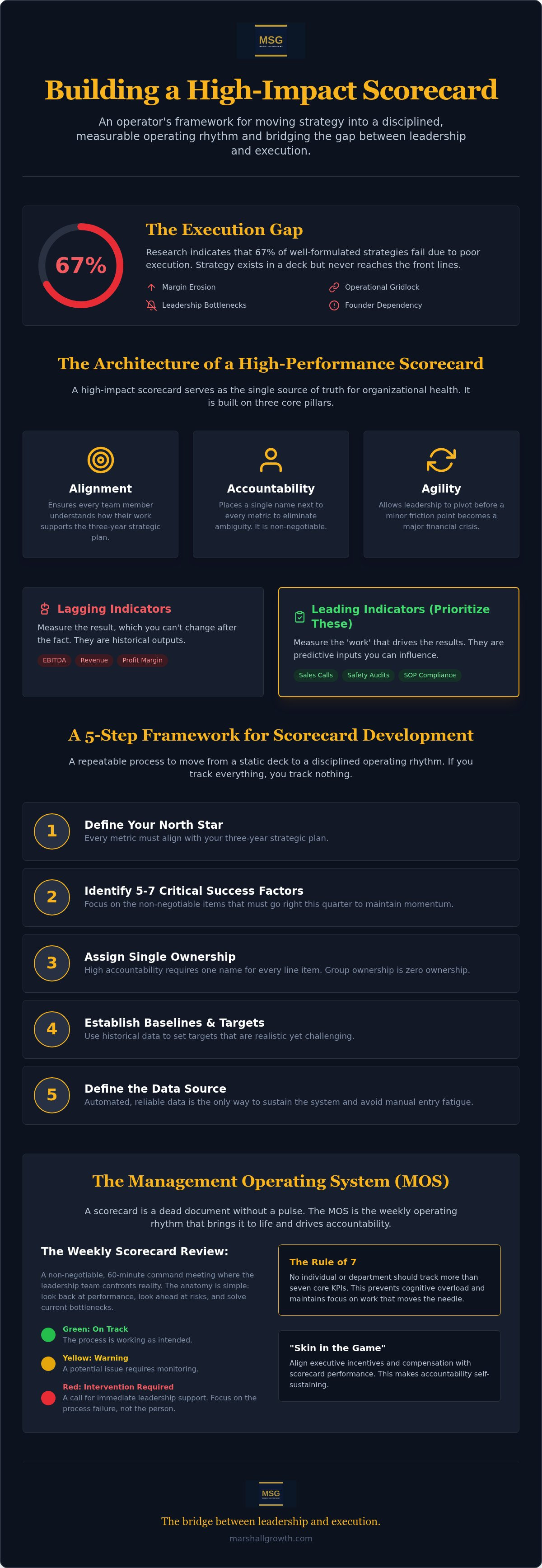
A high-impact scorecard serves as the single source of truth for your organizational health. It removes the guesswork from management. While many leaders are familiar with the Balanced Scorecard framework, implementation often fails because the resulting documents are too complex. They become static artifacts rather than active tools. Most scorecards fail for three reasons: they are too lagging, they lack clear ownership, or they are detached from the daily grit of the business. This lack of precision leads to margin erosion and leadership bottlenecks.
Developing a company-wide scorecard requires a focus on three core pillars: Alignment, Accountability, and Agility. Alignment ensures every team member understands how their work supports the three-year strategic plan. Accountability is non-negotiable; it places a single name next to every metric to eliminate ambiguity. Agility allows the leadership team to pivot before a minor friction point becomes a financial crisis. This structure creates clear guardrails for your staff. It reduces founder dependency by allowing the leadership team to manage by the numbers rather than relying on the founder's intuition, ultimately driving EBITDA growth.
Leading vs. Lagging Indicators: Measuring the Work, Not Just the Result
Lagging indicators, such as EBITDA and Revenue, represent results you can't change once they happen. Leading indicators measure the specific 'work' that drives those results, such as sales calls, safety audits, or SOP compliance. An operator-led scorecard must prioritize leading indicators to allow for mid-course corrections.
A 5-Step Framework for Scorecard Development
Theory alone doesn't scale. To move from a static deck to a disciplined operating rhythm, you need a repeatable process. Developing a company-wide scorecard starts with defining your North Star. Every metric must align with your three-year strategic plan. From there, identify five to seven critical success factors. These are the non-negotiable items that must go right this quarter to maintain momentum. If you track everything, you track nothing. Focus is your greatest operational asset.
High accountability requires a single name attached to every line item. When you implement a Balanced Scorecard, the goal is to eliminate group ownership, which is usually a mask for zero ownership. Use historical data to establish baselines and targets that are realistic yet challenging. Finally, define the data source. If a metric takes four hours of manual entry to update, your team will eventually ignore it. Automated, reliable data is the only way to sustain this system. For a deeper dive into your current state, a Leadership & Operations Assessment can identify where your execution is stalling.
Cascading Metrics: From Executive Strategy to Field Execution
Translating high-level financial goals into tactical field metrics requires the Rule of 7. No individual or department should track more than seven core KPIs. This prevents cognitive overload and maintains focus on the work that actually moves the needle. By Applying Military Leadership Principles to Business, you can use Mission Command to empower field-level decision-making. This framework allows your team to execute within established guardrails without waiting for founder approval. It improves operating leverage and protects your margins by decentralizing authority to those closest to the work.
Driving Accountability through the Management Operating System
A scorecard is a dead document without a pulse. Developing a company-wide scorecard requires more than just picking metrics; it demands a Management Operating System (MOS) to drive them. The Weekly Scorecard Review is the heartbeat of this system. This is a non-negotiable command meeting where the leadership team confronts reality. By using a Red/Yellow/Green status system, you can instantly identify where intervention is required. Green means on track. Yellow is a warning. Red is a call for immediate leadership support.
To ensure lasting impact, you must establish "Skin in the Game." This means aligning executive incentives with scorecard performance. When compensation is tied to these measurable results, accountability becomes self-sustaining. While weekly reviews handle tactical friction, you should also learn How to Run a Quarterly Business Review (QBR) to maintain long-term strategic alignment. This rhythm ensures that strategy never remains trapped in a slide deck.
The Weekly Operating Rhythm: Fixing Friction Before It Becomes a Failure
The anatomy of a high-impact, 60-minute scorecard review is simple: look back at last week's performance, look ahead at upcoming risks, and solve current bottlenecks. Handling "Red" metrics is the ultimate test of leadership. Instead of creating a culture of fear, focus entirely on process improvement. Ask what system failed rather than who failed. This shift in perspective transforms the review from a finger-pointing exercise into a tactical problem-solving session.
Disciplined reviews build a culture of ownership within the management team. It ensures that every leader treats their department's performance with the same urgency as the founder. When the leadership team owns the numbers, the founder is no longer the bottleneck for every operational correction. This shift is what allows a business to scale without sacrificing its margins.
Move from Strategy to Execution
Accountability isn't a feeling; it's a system. Developing a company-wide scorecard provides the guardrails your leadership team needs to execute without constant founder intervention. By prioritizing leading indicators and maintaining a disciplined weekly rhythm, you transform static goals into measurable results. This framework bridges the gap between high-level strategy and daily field operations, ensuring every team member understands their specific contribution to the mission.
Marshall Solutions Group brings an operator-led advisory model to your organization. With 60+ years of combined experience, we provide the steady hand needed to navigate operational friction. As a veteran-owned, results-focused firm, we stay through implementation. Schedule a Leadership & Operations Assessment to build your accountability framework. You have the framework. Now, build the discipline.
Frequently Asked Questions
What is the difference between a company scorecard and a dashboard?
A dashboard tracks real-time data and technical inputs, while a company-wide scorecard measures strategic progress and long-term health. Think of a dashboard as the gauges in a cockpit and the scorecard as the flight plan. Developing a company-wide scorecard requires moving beyond raw data to focus on accountability. It provides a structured framework to ensure every metric directly supports your three-year goals.
How many metrics should be on a company-wide scorecard?
Limit your scorecard to five to seven critical success factors per department or individual. This follows the Rule of 7 to prevent cognitive overload and maintain operational focus. If you track dozens of metrics, you track nothing. High-performance organizations prioritize leading indicators that allow for mid-course corrections. Focusing on a handful of non-negotiable targets ensures your leadership team stays aligned on what drives growth.
Who should be responsible for updating the scorecard data?
The individual owner assigned to each metric is responsible for updating and reporting their own data. Accountability fails when data collection is centralized in a single administrative role. When a leader owns the update, they must confront their performance before the weekly review. This decentralized approach builds a culture of ownership and ensures every manager is intimately familiar with the mechanics of their department's success.
How often should we change the metrics on our scorecard?
Review your metrics quarterly, but only change them if they no longer align with your strategic objectives or critical success factors. Consistency is vital for identifying long-term trends and historical baselines. Developing a company-wide scorecard isn't a one-time event; it requires an evolving operating rhythm. While you might adjust specific targets more frequently, the core metrics should remain stable enough to provide a durable source of truth.
Disclaimer
The information provided in this article is for general informational and educational purposes only and does not constitute legal, financial, accounting, engineering, or other professional advice. Marshall Solutions Group, Inc. makes no representations or warranties regarding the completeness or applicability of this information to any specific situation. Readers should consult appropriately qualified professionals before making decisions requiring specialized professional advice.