Family Business Succession Planning: Continuity Guide
By CJ Marshall, President & Founder
Effective succession planning for family business is an operational mission. Learn to transition authority and build systems that protect company value and g...

Article by
Chelvis “CJ” Marshall
Chelvis “CJ” Marshall is President & Founder of Marshall Solutions Group, a management consulting firm specializing in Strategy & Operations, Organizational Leadership & Change, and Program & Project Management. A retired U.S. Navy Senior Chief who advanced from E-1 to E-8 in 10 years, CJ transitioned into Fortune 500 enterprise leadership, where his commercial experience has included more than $20 million in contract value. He brings operator-level experience leading teams, complex programs, and mission-critical operations. His work focuses on bridging leadership and execution—helping organizations translate strategic direction into disciplined execution, stronger accountability, and measurable business results.
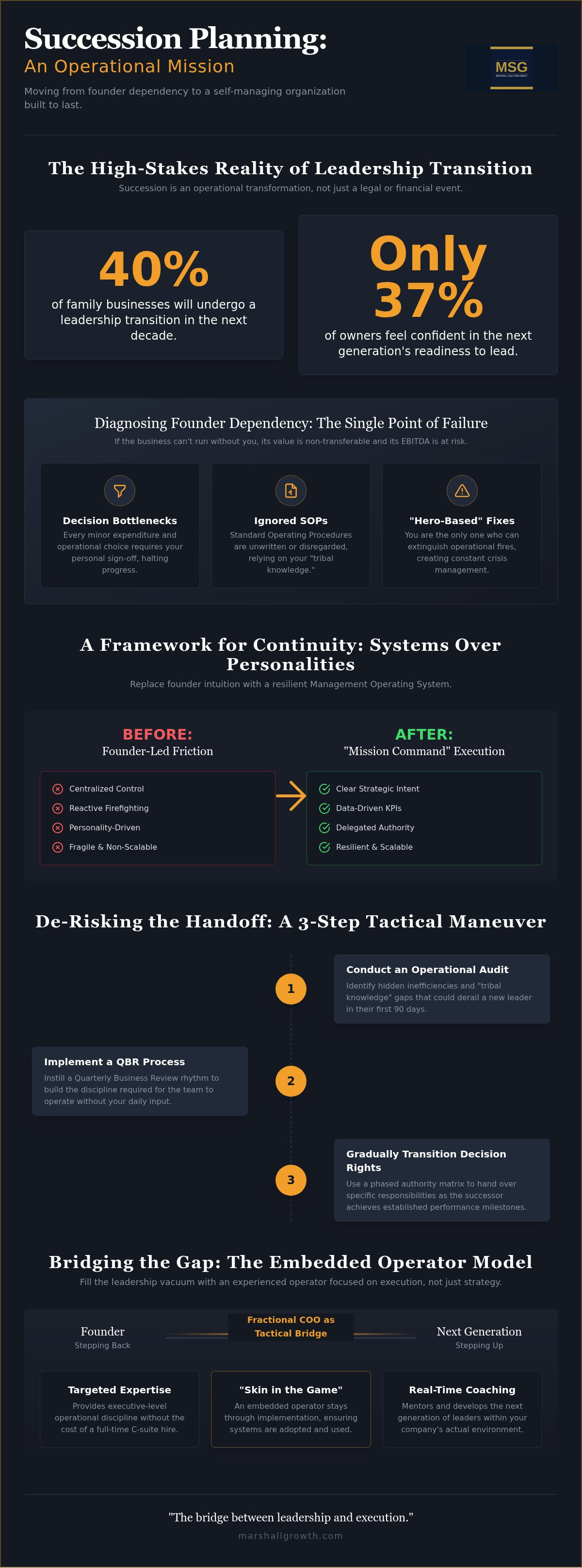
Nearly 40% of family businesses will undergo a leadership transition within the next decade, yet only 37% of owners feel confident in the next generation's readiness. Effective succession planning for family business isn't just a legal handoff. It's an operational mission. If every major decision stops at your desk, you haven't built a legacy. You've built a bottleneck. This dependency creates a fragile environment where company value and EBITDA are tied directly to your daily presence.
You've spent years building this company. You won't watch its margins erode during a clumsy transition. We know relinquishing control is high-stakes without a capable leadership bench. This guide provides a clear roadmap to move from founder-led friction to a self-managing organization. You'll learn how to transition actual authority, preserve growth momentum, and build a system that maintains performance long after you've left the room.
Key Takeaways
- Redefine succession as an operational mission to make the founder’s daily involvement optional without sacrificing business performance.
- Build a repeatable accountability framework that relies on structured systems rather than the unique intuition of a single leader.
- Adopt a "Mission Command" approach to provide successors with clear strategic intent and the actual authority to execute.
- Utilize an "Embedded Operator" model to bridge leadership gaps and maintain growth momentum during succession planning for family business.
Table of Contents
The Operational Risks of Succession: Why Most Family Transitions Stall
Most founders treat their exit as a legal or financial event. It isn't. It's an operational transformation. Operational succession is the deliberate process of making your daily presence optional for business performance. Without this shift, Succession planning for family business is just a title change that masks deep systemic fragility.
We call this the Single Point of Failure. If institutional knowledge, key relationships, and tactical "know-how" reside only in your head, the company's value is non-transferable. This dependency leads to margin erosion because the team lacks the systems to maintain efficiency without your intervention. Growth stalls while you're busy micromanaging the details and missing high-level opportunities.
Diagnosing Founder Dependency in Your Operations
You can't fix what you haven't diagnosed. Real-world succession planning for family business requires identifying where you've become a bottleneck. Look for these red flags in your daily workflow:
- Every expenditure or decision over $500 requires your personal sign-off.
- Standard Operating Procedures (SOPs) are unwritten or ignored by the team.
- "Hero-based" problem solving is the norm, where you're the only one capable of extinguishing operational fires.
Use our Leadership & Operations Assessment to pinpoint exactly where these dependencies are strangling your scalability. A "weak bench" isn't just a management issue; it's a financial liability. Buyers and successors discount the value of a business that can't run itself. If your team isn't trained to lead, your EBITDA is at risk the moment you step away.
A Framework for Leadership Continuity: Systems Over Personalities
Stop looking for a clone of yourself. It's a common trap that stalls growth. Effective succession planning for family business fails when you hunt for a "perfect" personality instead of building a resilient system. You need a structured accountability framework that defines success through objective data rather than founder intuition. This ensures the business remains stable and profitable regardless of who sits in the corner office.
We implement a "Mission Command" approach. It's a leadership philosophy rooted in military discipline. You provide your successor with clear strategic intent and defined outcomes. Then, you get out of the way. Give them the actual authority to execute without constant micromanagement. This handoff requires a Management Operating System (MOS) to track KPIs and performance in real time. When the data is visible, trust becomes a byproduct of performance rather than a leap of faith.
Steps to De-Risk the Leadership Transition
Transitioning authority is a tactical maneuver, not a singular event. Follow these steps to ensure a clean handoff during succession planning for family business:
- Step 1: Conduct an operational audit. Identify hidden inefficiencies or "tribal knowledge" gaps that could derail a new leader during their first 90 days.
- Step 2: Implement a Quarterly Business Review (QBR) process. This instills the rhythm and discipline required for a management team to operate without your daily input.
- Step 3: Gradually transition decision rights. Use a phased authority matrix to hand over specific responsibilities as the successor hits established performance milestones.
If you're unsure where to start, our Strategy & Operations Consulting provides the objective oversight needed to build these systems correctly.
The Embedded Operator Model: Bridging the Gap to the Next Generation
Many family firms face a leadership vacuum when the founder steps back. You might need executive-level oversight, but hiring a full-time COO at $250k or more often isn't feasible or necessary. A Fractional COO serves as a tactical bridge. This model provides the high-level operational discipline required for succession planning for family business without the overhead of a permanent hire. It's about filling the gap with an operator who focuses on execution, not just strategy.
We take a "skin in the game" approach. Unlike traditional consultants who deliver a slide deck and disappear, an embedded operator stays through the implementation phase. This involves coaching the next generation of leaders in real-time. Our team brings 60+ years of combined experience, including leading 137-person engineering departments and $500M naval platforms. That veteran-led discipline is critical in high-stakes environments like defense, biopharma, and industrial services where the margin for error is zero.
Evaluating Succession Partners for Family-Owned Firms
Theory doesn't move the needle. When choosing a partner, contrast academic advisors with operator-led firms that have managed 1,500+ personnel and mission-critical systems. You need a partner who speaks the language of the shop floor and the boardroom. Practical succession planning for family business requires a partner who has navigated high-pressure environments firsthand and understands the mechanics of growth.
For firms in federal contracting or infrastructure, our SBA-certified SDVOSB status is a key differentiator. We understand the compliance and governance rigors required to maintain contract readiness during a transition. If you're ready to move from planning to execution, connect with Marshall Solutions Group to secure your company's future and protect your legacy.
Securing Your Legacy Through Operational Excellence
Succession isn't a single event. It's a deliberate transition from a founder-dependent business to a self-managing organization. To protect your company’s value, you must prioritize systems over personalities and establish clear accountability frameworks. Effective succession planning for family business requires a steady hand and a proven methodology to ensure growth continues long after the handoff.
Marshall Solutions Group is veteran-owned and operator-led by former U.S. Navy Senior Chiefs. We bring 60+ years of combined leadership experience from Fortune 500 and federal environments to your transition mission. We don't just deliver plans; we stay to ensure execution. Take the first step toward a resilient future today. Schedule a Leadership & Operations Assessment with Marshall Solutions Group to identify your bottlenecks and build a roadmap for continuity. Your legacy deserves a strategy that works.
Frequently Asked Questions
When should a family business start succession planning?
It's best to start succession planning for family business at least three to five years before your target exit date. This window allows you to move from founder dependency to a systemized operating model. You need time to identify leadership gaps, document standard operating procedures, and test the new management structure under real conditions. Starting early ensures the transition is a strategic handoff.
What is the difference between a business coach and an operations consultant for succession?
A business coach typically focuses on personal development and high level theory. An operations consultant from Marshall Solutions Group focuses on tactical execution and systemic alignment. We don't just provide a roadmap; we embed with your team to build the accountability frameworks and processes that drive results. Our approach is built on military discipline and implementation, not just motivational advice.
Can a fractional COO help with family member transitions?
A fractional COO acts as a neutral tactical bridge during family transitions. We provide the objective oversight needed to coach next generation leaders without the emotional friction often found in family dynamics. By implementing a Management Operating System, we ensure the new leadership team is measured against clear KPIs. This maintains operational stability and protects company value while authority is being transferred.
How does operational discipline affect the valuation of a family business?
Operational discipline is a primary driver of business valuation during a transfer. Buyers and successors heavily discount companies where institutional knowledge resides only in the founder's head. By establishing rigorous systems and SOPs, you prove the business is a scalable asset rather than a personal job. Robust succession planning for family business preserves EBITDA by ensuring that productivity and margins remain stable.
Disclaimer
The information provided in this article is for general informational and educational purposes only and does not constitute legal, financial, accounting, engineering, or other professional advice. Marshall Solutions Group, Inc. makes no representations or warranties regarding the completeness or applicability of this information to any specific situation. Readers should consult appropriately qualified professionals before making decisions requiring specialized professional advice.