Transitioning From Founder to CEO: Building a Scalable Operating System
By CJ Marshall, President & Founder
Stop being your company's bottleneck. Transitioning from founder to CEO requires a scalable management operating system, clear accountability, and execution.
Article by
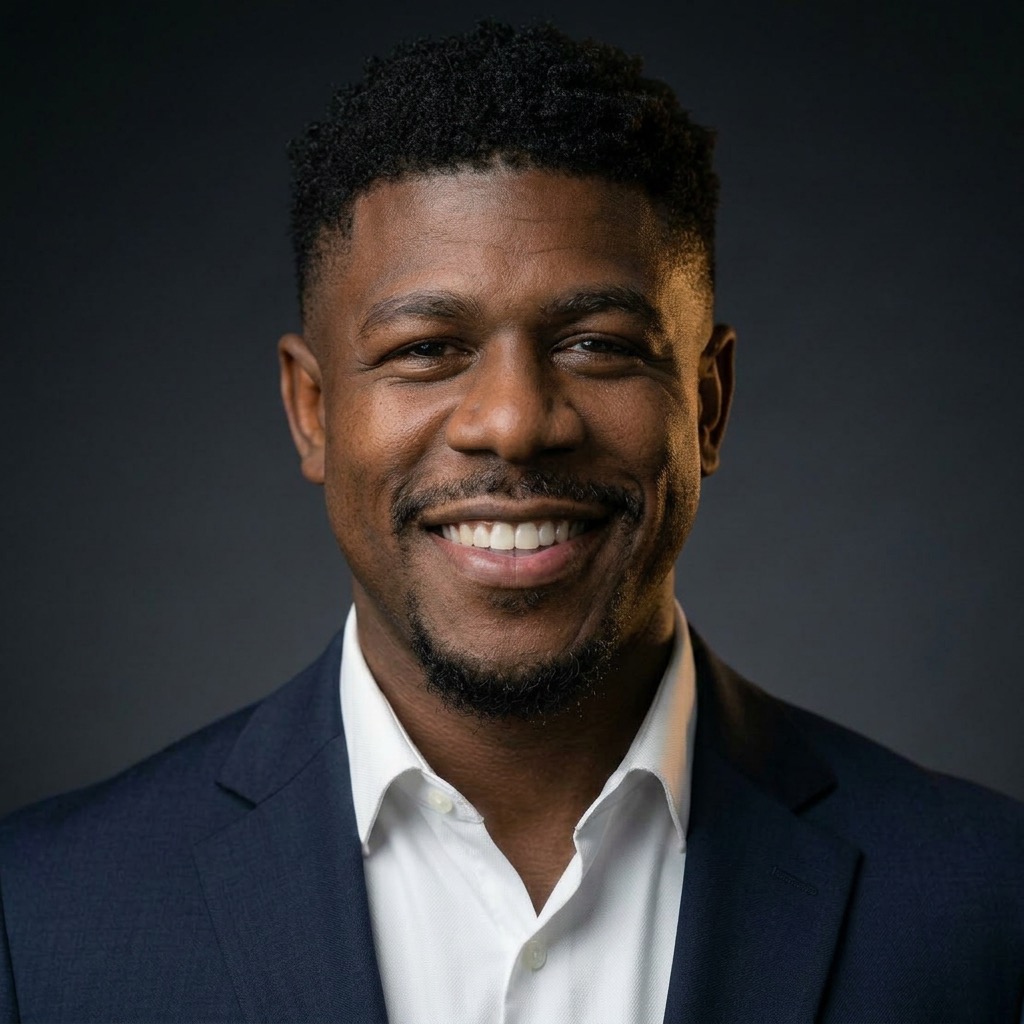
Chelvis “CJ” Marshall
Chelvis “CJ” Marshall is President & Founder of Marshall Solutions Group, a management consulting firm specializing in Strategy & Operations, Organizational Leadership & Change, and Program & Project Management. A retired U.S. Navy Senior Chief who advanced from E-1 to E-8 in 10 years, CJ transitioned into Fortune 500 enterprise leadership, where his commercial experience has included more than $20 million in contract value. He brings operator-level experience leading teams, complex programs, and mission-critical operations. His work focuses on bridging leadership and execution—helping organizations translate strategic direction into disciplined execution, stronger accountability, and measurable business results.
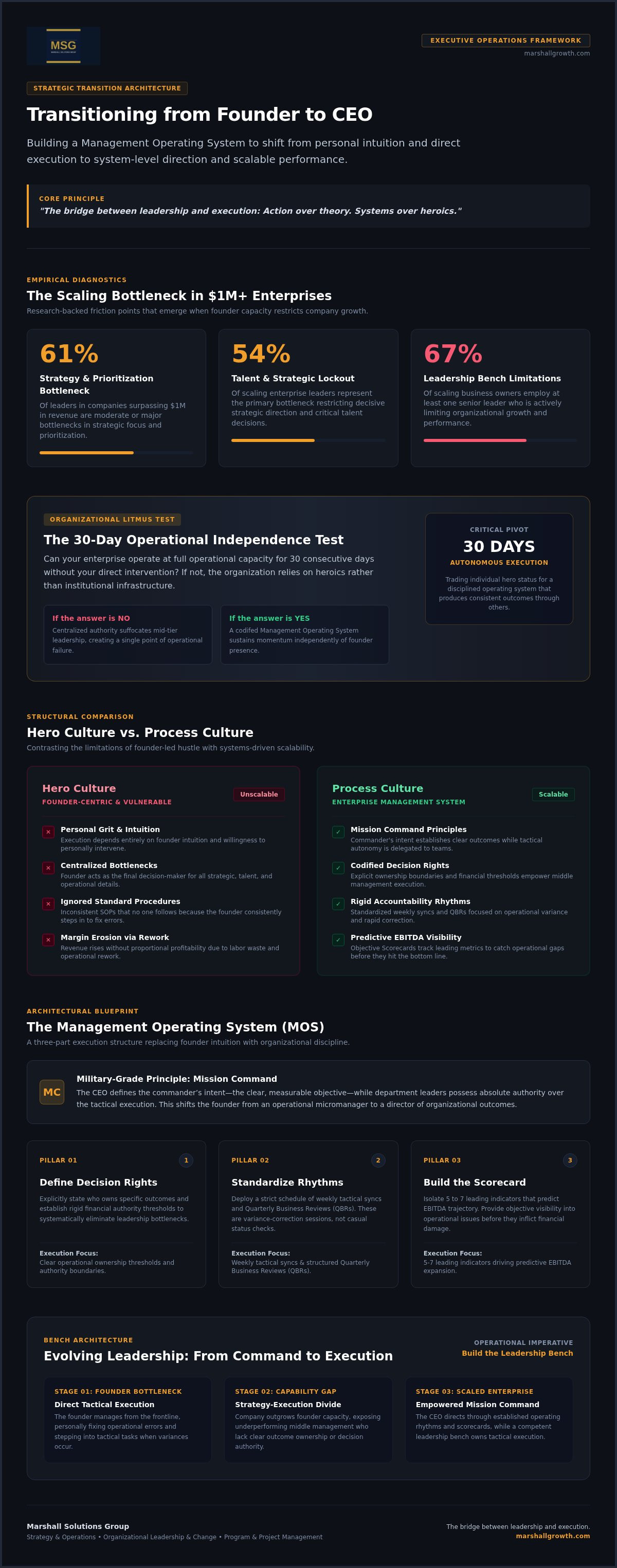
Recent studies confirm that 54% of leaders in companies surpassing $1M in revenue are the primary bottleneck for strategic focus and talent decisions. Your personal grit no longer scales. Transitioning from founder to CEO isn't just a career milestone; it's an engineering challenge that requires replacing your intuition with a repeatable framework. Action over theory. Systems over heroics.
You know the frustration of growth outstripping your operational capacity and the exhaustion of being involved in every minor choice. This article provides the blueprint for shifting from the primary doer to a strategic leader by implementing a disciplined Management Operating System. We'll examine how to establish accountability cadences, build operational visibility, and develop a leadership team that executes without your constant supervision. It's time to build a self-managing organization that delivers sustainable growth through disciplined execution.
Key Takeaways
- Identify why founder dependency creates a single point of failure and how to shift your focus from daily tasks to system-level oversight.
- Master the mechanics of transitioning from founder to CEO by building a Management Operating System that drives consistent results without your direct involvement.
- Learn to apply military-grade Mission Command to establish clear outcomes while delegating execution authority to your department leaders.
- Build a sustainable leadership bench that bridges the gap between your strategic vision and the team's daily performance.
Table of Contents
The Founder-CEO Gap: Why Growth Stalls at the Bottleneck
Growth stage companies often reach a point where the founder's personal capacity becomes the organization's primary ceiling. In the early days, your intuition was the engine. Now, it's a liability. Transitioning from founder to CEO requires moving from a mindset of direct execution to one of system direction. If you're still the final word on every operational detail, you've created a single point of failure that prevents scaling.
A national study of leaders in firms with over $1M in revenue found that 61% are moderate or major bottlenecks in strategic focus and prioritization. This dependency often manifests as founder's syndrome, where centralized authority suffocates middle management. The result isn't just stress; it's financial. You see revenue growth without proportional profitability, margin erosion due to inefficient rework, and inconsistent SOPs that no one follows because you're always there to save the day.
Diagnosing the 'Founder-Dependent' Organization
The litmus test for your organization is simple: Can your business operate at full capacity for 30 days without your direct intervention? If the answer is no, you have a hero culture rather than a process culture. Hero cultures rely on individual effort to overcome systemic gaps. Process cultures rely on reliable frameworks to drive outcomes. To identify your specific friction points, use a Leadership & Operations Assessment to audit your current decision rights. Transitioning from founder to CEO means trading your hero status for a scalable operating system that produces results through others.
Building the Management Operating System (MOS): Transitioning to Directing
The Management Operating System (MOS) is the bridge between strategic planning and daily operational performance. It replaces the founder’s intuition with a structured cadence of meetings, KPIs, and SOPs. When transitioning from founder to CEO, you must adopt the military principle of Mission Command. You provide the commander's intent—the clear, measurable objective—while empowering your team to determine the tactical execution. This shifts your role from a micromanager of individual tasks to a director of organizational outcomes.
Execution fails when expectations remain vague and unmeasured. To restructure organizational operations for scale, you need operational visibility without constant physical intervention. This transition requires moving from intuition to data-driven decision-making via Scorecards and Quarterly Business Reviews (QBRs). These mechanisms provide the objective truth needed to hold leaders accountable for performance. They ensure the business stays on track even when you aren't in the room.
Steps to Codify Your Operating Model
Building a durable MOS requires a methodical approach to tactical implementation. Successful organizations require more than a good plan; they require the disciplined execution of these foundational steps:
- Define Decision Rights. Explicitly state who owns specific outcomes and establish clear financial authority thresholds to prevent leadership bottlenecks.
- Standardize the Rhythms. Implement a rigid schedule of weekly tactical syncs and QBRs. These aren't status updates; they're alignment sessions focused on variance and correction.
- Build the Scorecard. Identify 5-7 leading indicators that predict EBITDA growth. These metrics allow you to spot operational failure before it impacts your bottom line.
If your current management rhythms feel like reactive chaos, connecting with an experienced Strategy & Operations Consulting partner can help install the disciplined systems required for transitioning from founder to CEO.
Scaling Leadership Capacity: From Command to Execution
You can't lead an organization from the front if you're constantly pulled back into the trenches to fix tactical errors. Successful transitioning from founder to CEO requires a reliable middle management layer, often called the leadership bench. Research shows that 67% of scaling business owners employ at least one senior leader who is actively limiting the company's growth. This capability gap creates a friction point where strategy dies due to underperforming execution.
We apply veteran-led discipline to bridge this divide. By evolving leadership style during company growth, you move from individual command to organizational execution. This transformation relies on the Operator’s Framework, which prioritizes reliability and accountability as core traits. If your managers don't hold people accountable, your operating system will fail regardless of your vision. Discipline. Reliability. Accountability.
Leveraging Fractional Leadership to Bridge the Gap
Hiring a full-time executive is often premature for firms crossing the mid-market threshold. A Fractional COO provides the stabilization you need without the overhead of a permanent hire. Unlike traditional consultants who deliver a presentation and leave, our embedded delivery model focuses on hands-on implementation. We stay until the system is durable. Ask yourself: Is your current leadership team capable of executing the next $10M in growth? If the answer is uncertain, you need an operator, not a coach. Transitioning from founder to CEO is about building the capacity to lead at scale while we manage the mechanics of the day-to-day.
Move from Heroics to High-Performance Execution
The shift from doing to directing isn't a loss of control; it's the acquisition of scale. You've seen why growth stalls at the founder bottleneck and how a Management Operating System provides the visibility you need to lead effectively. By building a leadership bench and applying disciplined rhythms, you ensure the organization executes your vision without your constant physical presence. Transitioning from founder to CEO is the ultimate test of your leadership architecture.
Marshall Solutions Group is veteran-owned and operator-led by retired U.S. Navy Senior Chief CJ Marshall. We bring 60+ combined years of experience and proven results in mission-critical environments. Don't let your company's potential be limited by your personal capacity. Speak with Marshall Solutions Group about bridging the gap between your strategy and execution. You've built the foundation; now build the system that lets it thrive.
Frequently Asked Questions
What is the main difference between a Founder and a CEO?
A Founder is the creator and primary doer who relies on intuition to build the business. A CEO is the director of the system who focuses on strategic alignment and organizational execution. While the founder role centers on birth and survival, the CEO role focuses on scalability and sustainability through disciplined management systems that replace individual heroics.
When is the right time to transition from Founder to CEO?
The right time to begin transitioning from founder to CEO is when your personal capacity becomes the company's primary bottleneck. This usually happens when growth outstrips your ability to oversee every detail, leading to inconsistent execution or margin erosion. If your leadership team can't execute the next phase of growth without your constant intervention, you must shift toward a formal operating model.
How do I stop being involved in every business decision?
You stop being involved in every decision by establishing clear decision rights and a structured Management Operating System (MOS). This involves setting commander's intent, defining the objective, while allowing your team to own the tactical execution. Implementing scorecards and weekly tactical syncs provides the operational visibility you need to hold managers accountable without resorting to micromanagement or becoming a single point of failure.
Can I be both the Founder and the CEO effectively?
Yes, you can be both, but it requires a fundamental shift in your daily priorities and leadership style. You must trade individual heroics for a process-driven culture that prioritizes reliability and accountability. Many leaders use fractional COO support to bridge this gap, allowing them to maintain their visionary role while installing the disciplined systems required to function as an effective CEO.
Disclaimer
The information provided in this article is for general informational and educational purposes only and does not constitute legal, financial, accounting, engineering, or other professional advice. Marshall Solutions Group, Inc. makes no representations or warranties regarding the completeness or applicability of this information to any specific situation. Readers should consult appropriately qualified professionals before making decisions requiring specialized professional advice.