The Strategic Benefits of a Fractional COO for Founder-Led Firms in 2026
Marshall Solutions Group · reviewed by CJ Marshall
Overcome founder bottlenecks and operational drift. Learn the benefits of a fractional COO for building scalable systems and disciplined execution without hi...

Article by
Chelvis “CJ” Marshall
Chelvis “CJ” Marshall is Founder & Managing Partner of Marshall Solutions Group, a management consulting firm specializing in Strategy & Operations, Organizational Leadership & Change, and Program & Project Management. A retired U.S. Navy Senior Chief who advanced from E-1 to E-8 in 10 years, CJ later transitioned into Fortune 500 enterprise leadership, negotiating more than $20M in contracts within three years. He brings operator-level experience leading teams, complex programs, and mission-critical operations. His work centers on being the bridge between leadership and execution—helping organizations translate strategic direction into disciplined execution, stronger accountability, and measurable results.
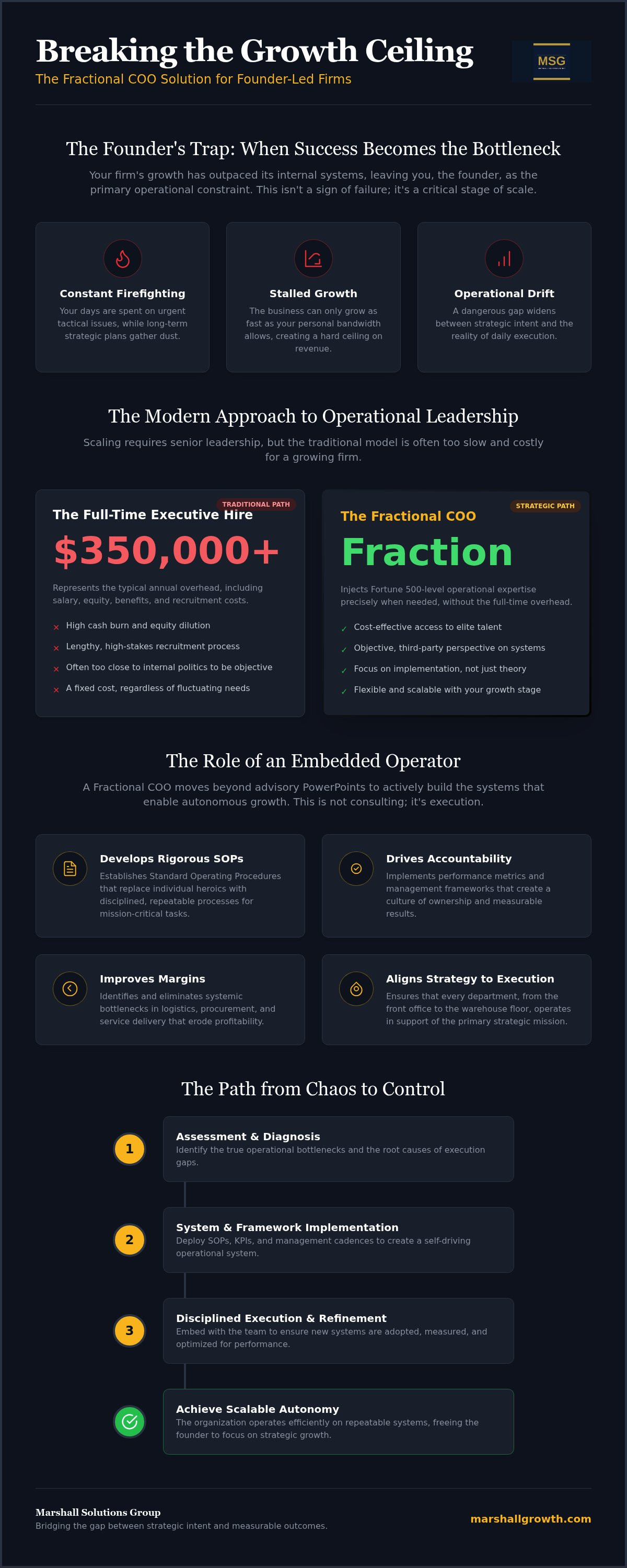
Most founder-led firms don't fail because of a bad product. They stall because the founder has become the ultimate operational bottleneck. You're likely spending your days firefighting tactical issues while your strategy gathers dust. Understanding the benefits of a fractional coo is the first step toward breaking this cycle. This exhaustion isn't a badge of honor; it's a sign that your growth has outpaced your internal systems.
You need a steady hand to install the frameworks that allow for autonomous growth. This article demonstrates how an embedded operator provides the leadership and accountability necessary to stabilize your scaling firm without the $350,000 overhead of a full-time executive. We'll outline the path from operational drift to disciplined execution. We'll focus on SOP development, margin improvement, and the transition from individual heroics to repeatable, scalable systems.
Key Takeaways
- Identify how the "Founder's Trap" creates operational paralysis and learn to reclaim your bandwidth for high-level strategy.
- Explore the core benefits of a fractional coo, including access to Fortune 500-level leadership at a fraction of the cost of a full-time hire.
- Establish rigorous SOPs and accountability frameworks that transition your organization from chaotic heroics to disciplined, repeatable execution.
- Shift from passive consulting to an embedded operator model that ensures your strategic plans actually translate into measurable business outcomes.
Table of Contents
Why Founder-Led Growth Stalls: The Rise of Fractional Operations in 2026
Success often creates a bottleneck. Founders who built their firms through sheer willpower find themselves buried in tactical minutiae. This is the "Founder Trap." By 2026, the shift toward a fractional executive overview model has accelerated as leaders realize they can't scale by doing everything themselves. The business stops growing when the founder's mental bandwidth is exhausted. You're left with a team waiting for instructions instead of a system that drives itself.
To better understand how this role integrates into your team, watch this educational breakdown:
The 2026 market favors the "Lean Executive Suite." Firms are ditching the traditional, $350,000 full-time hire in favor of specialized expertise. One of the primary benefits of a fractional coo is the ability to inject veteran leadership into the organization without the friction of a long-term commitment. It's about precision. You hire for the specific growth phase you're in, not the one you hope to reach in five years. This model prioritizes outcomes over presence. It allows organizations to remain agile, scaling up or down based on the actual demands of the fiscal year.
The High Cost of Operational Drift in Mission-Critical Sectors
Operational drift occurs when the gap between your strategic intent and daily execution reality becomes a chasm. In sectors like defense and federal contracting, this drift is dangerous. It leads to compliance failures and missed delivery milestones. For contractors, a single missed requirement can jeopardize a $500M transformation program. You don't need a coach who talks about vision. You need an operator who understands the mechanics of high-stakes systems and can enforce the accountability needed to secure mission-critical growth.
Core Benefits of a Fractional COO: Bridging the Gap Between Intent and Execution
Scaling shouldn't depend on a $500,000 executive hire. One of the primary Benefits of a Fractional COO is the immediate injection of Fortune 500-level leadership without the burden of equity or full-time overhead. This model provides more than just cost-effective scaling. It offers objective systemization. Founders are often too close to the daily friction to see the systemic failures. An embedded operator identifies bottlenecks in your logistics or procurement chains that have become invisible to your internal team. They don't just point out the fire; they redesign the building to prevent the next one.
Strategic alignment fails when departments operate in isolated silos. Every function, from the warehouse floor to the front office, must support the primary mission. Beyond the financial logic, the benefits of a fractional coo extend to the cultural health of the organization by removing operational friction. This ensures that resources aren't wasted on projects that don't move the needle on your measurable outcomes. If your current operations feel like a collection of manual workarounds, it's time to consider an operator-led assessment to identify where your execution is lagging.
Driving Accountability and Systems Maturity Without Full-Time Overhead
Maturity requires systems that function when the founder steps away. This means establishing Standard Operating Procedures (SOPs) and performance metrics that drive themselves. High-performing teams don't rely on individual heroics. They rely on frameworks. By implementing disciplined accountability, fractional leadership strengthens organizational leadership and creates a culture of ownership. Success becomes a repeatable process rather than a fortunate accident.
Implementing Fractional Leadership: A Framework for Mission-Critical Environments
Theory is cheap. Execution is expensive. Many firms hire consultants who deliver a presentation and vanish. We call this "Deck-and-Disappear" consulting. It leaves founders with a list of problems but no hands to fix them. Real operational maturity requires an embedded partner who stays to implement the solution. Integrating this leadership into your strategic planning cycles ensures that goals aren't just aspirations. They become milestones. This is one of the tangible benefits of a fractional coo: they have skin in the game and own the outcomes alongside you.
For federal contractors, the choice of partner carries socioeconomic weight. Partnering with a veteran-owned firm provides more than just discipline. It offers strategic advantages in federal prime contracting. These leaders understand the rigors of mission-critical environments. They speak the language of the PMO because they've lived it. One of the core benefits of a fractional coo in this space is the ability to navigate complex portfolio risks while maintaining strict adherence to federal standards. You get elite-level coordination without the permanent executive price tag.
The Operator-Led Advantage: Navigating Federal Compliance and Portfolio Risk
Military-rooted discipline isn't about rigid hierarchy. It's about precision and mission success. This background is uniquely suited for PMO support where compliance is non-negotiable and delivery timelines are tight. Moving from a Leadership & Operations Assessment to a sustained engagement follows a methodical path. We begin by identifying the immediate friction points that threaten your current contracts. We then install the accountability frameworks that ensure every team member knows their role and their impact. Finally, we optimize your internal systems for long-term durability. This transition secures your growth and protects your reputation with federal stakeholders.
Securing Your Operational Future in 2026
Scaling a firm through individual heroics is a recipe for stagnation. You've seen how the benefits of a fractional coo allow you to bridge the gap between strategic intent and disciplined execution without the overhead of a full-time hire. By installing mature systems and accountability frameworks, you regain the bandwidth to focus on high-level growth. Marshall Solutions Group brings over 60 years of combined military and enterprise command experience to your organization. As a veteran-owned (SDVOSB) certified partner, we've managed $500M federal transformation programs with the precision of an embedded operator. We don't deliver presentations; we deliver results. Discuss your operational challenges with Marshall Solutions Group to move from planning to performance. Your vision deserves a foundation that won't crack under pressure. Let's build it together.
Frequently Asked Questions
How is a fractional COO different from a business coach?
A business coach focuses on your personal development and strategy through advice. A fractional COO is an embedded operator who takes responsibility for execution. They don't just tell you what to do; they build the systems and manage the people to get it done. It's the difference between a mentor and a partner who has skin in the game.
Can a fractional COO handle federal compliance and PMO support?
Yes, especially when they possess military-rooted discipline and experience in large-scale program management. One of the specific benefits of a fractional coo in this sector is their ability to provide PMO support for mission-critical environments. They ensure your team meets federal compliance milestones and handles portfolio risk. This provides the management-level oversight required for complex transformation programs.
How many hours a week does a fractional COO typically work?
Engagements typically span 5 to 20 hours per week based on your organization's maturity. Some leaders need a steady hand for one day a week to keep projects on track. Others require a more intensive structure for a 90-day operational overhaul. The goal is to provide the exact amount of leadership needed to stabilize growth without unnecessary executive overhead.
What is the typical ROI of hiring an operator-led fractional executive?
ROI is measured through increased margins and the elimination of operational drift. By installing SOPs and accountability frameworks, firms often achieve significant revenue growth without adding full-time staff. One of the benefits of a fractional coo is avoiding the fully-loaded $350,000 cost of a permanent executive. You gain elite expertise that secures your mission-critical growth and protects your bottom line.
Disclaimer
The information provided in this article is for general informational and educational purposes only and does not constitute legal, financial, accounting, engineering, or other professional advice. Marshall Solutions Group, Inc. makes no representations or warranties regarding the completeness or applicability of this information to any specific situation. Readers should consult appropriately qualified professionals before making decisions requiring specialized professional advice.