Strategic Agility in Business: Adapt Without Creating Operational Chaos
By CJ Marshall, President & Founder
Master strategic agility in business to respond to market shifts without creating operational chaos, priority fatigue, or execution bottlenecks across teams.

Article by
Chelvis “CJ” Marshall
Chelvis “CJ” Marshall is President & Founder of Marshall Solutions Group, a management consulting firm specializing in Strategy & Operations, Organizational Leadership & Change, and Program & Project Management. A retired U.S. Navy Senior Chief who advanced from E-1 to E-8 in 10 years, CJ transitioned into Fortune 500 enterprise leadership, where his commercial experience has included more than $20 million in contract value. He brings operator-level experience leading teams, complex programs, and mission-critical operations. His work focuses on bridging leadership and execution—helping organizations translate strategic direction into disciplined execution, stronger accountability, and measurable business results.
A new market signal doesn’t automatically justify a new strategy. Yet when customer demand shifts, costs move, or a competitor changes direction, sticking rigidly to yesterday’s plan can be as risky as changing course too quickly. That tension is where strategic agility in business matters: responding to evidence without turning every new concern into a company-wide pivot.
Frequent strategic resets can leave teams unclear about priorities, decision rights, and which work should stop. To respond effectively, leaders need to distinguish a temporary fluctuation from a change that affects important assumptions or commitments. Then they must decide what to adjust, who owns the response, and how to keep execution aligned. Strategic agility isn’t constant motion. It’s deliberate adaptation with enough discipline to keep the organization moving.
Key Takeaways
- Strategic agility in business means adjusting decisions when conditions warrant it, not reacting to every new signal with a full pivot.
- Assess the evidence, business consequences, and cost of waiting before changing priorities.
- Separate reversible operating adjustments from decisions that affect strategic positioning, resources, or core commitments.
- Turn each change into clear ownership and operating priorities, then check whether it’s being implemented and improving the intended condition.
Table of Contents
What Strategic Agility in Business Means, and What It Does Not
Strategic agility in business is the capacity to adjust choices and operations when relevant conditions change. It connects awareness to action: leaders assess what a shift means, decide whether to respond, and ensure the decision reaches the teams responsible for execution. A useful starting point is the broader idea of business agility, or an organization’s ability to adapt. Strategic agility focuses that ability on decisions about direction, priorities, and resources.
Agility does not mean reacting to every fluctuation. A temporary dip in requests may call for monitoring, not a revised strategy. A sustained change in customer needs that threatens a core revenue stream may warrant reviewing priorities and resource commitments. The distinction matters: acting too soon can divert people from important work, while waiting too long can leave the organization executing a plan whose assumptions no longer hold.
For a related perspective, watch Building Strategic Agility Using Business Acumen from Acumen Learning:
Is strategic agility the same as being flexible?
Flexibility gives an organization options. Agility requires judgment about which option to use, alignment on the choice, and disciplined execution. Strategic agility is the ability to change course when evidence warrants it, while keeping decisions, resources, and execution aligned with the organization’s purpose. It isn’t changing priorities whenever conditions fluctuate.
Nor is agility the same as speed alone. Annual planning can set direction, but it can’t replace ongoing assessment. A rapid response without clear decision ownership can create conflicting instructions: teams move quickly, but not together. Before acting, identify who can make the call, what evidence would trigger a change, and which commitments remain in place. That discipline makes adaptation deliberate rather than disruptive.
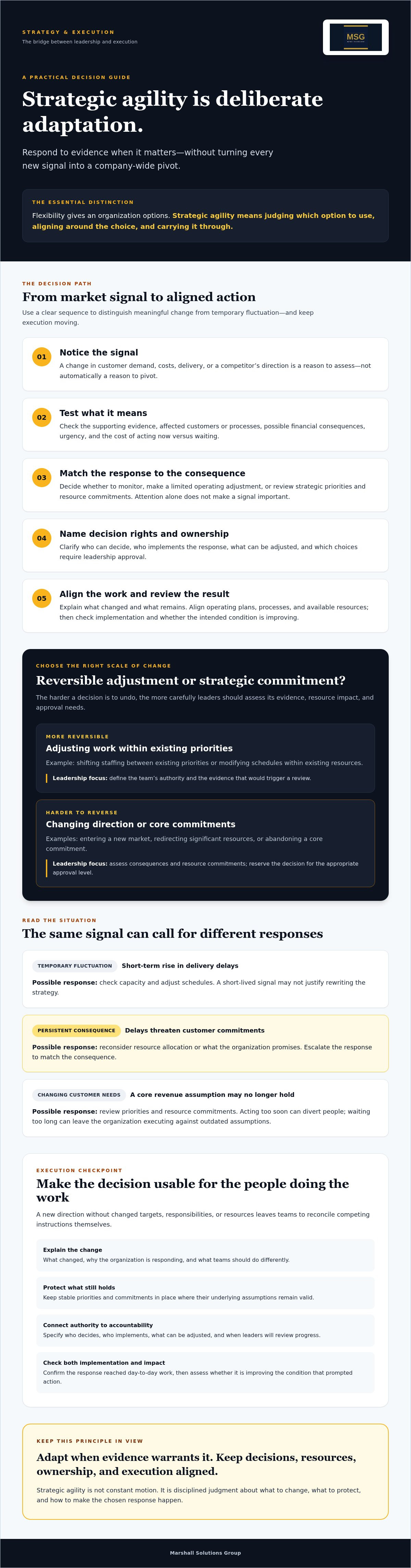
How Leaders Can Respond to Change Without Constantly Rewriting the Plan
Use a decision test before changing direction. What evidence supports the signal? Which customers, processes, or financial outcomes could be affected? How quickly must the organization respond, and what could be lost by acting now or waiting? Name the person with authority to decide. Without that ownership, teams may receive conflicting instructions while leaders continue debating.
A signal matters when it can change a meaningful decision, not simply because it draws attention. For example, a short-term rise in delivery delays might justify checking capacity and adjusting schedules. If delays persist and threaten customer commitments, leaders may need to reconsider resource allocation or what the organization promises. Match the response to the consequence, not the volume of discussion around the signal.
What should leaders assess before changing direction?
Separate changes that are easy to reverse from decisions with lasting effects. A temporary shift in staffing between existing priorities may be reversible. Entering a new market, redirecting significant resources, or abandoning a core commitment can be harder to undo. Compare the cost of testing a limited adjustment with the cost of making a broad change too soon. Under uncertainty, the decision questions in Crisis Management for Small Business: A Practical Guide can also help leaders weigh response options.
Protecting stable priorities doesn’t mean ignoring new evidence. Keep the core plan intact where its assumptions still hold, and assign an accountable owner to test the proposed change. Define what that person can adjust, what requires leadership approval, and what evidence will prompt a review. For example, leaders might authorize a team to modify scheduling within existing resources, while reserving changes to customer commitments or major resource allocations for leadership review. Strategic agility in business depends on this balance: protect execution, but don’t let existing commitments block a necessary response.
Make Strategic Agility Work Through Leadership and Execution
A strategic decision only matters once it changes the work. Leaders need to explain what has changed, why the organization is responding, which priorities remain in place, and what teams should do differently. Then align operating plans, processes, and available resources with the decision. If leaders announce a new direction but leave existing targets and responsibilities untouched, employees must reconcile competing instructions themselves.
How can teams adapt while keeping accountability clear?
Assign three things: who has authority to make or approve the decision, who owns implementation, and when leaders will review progress. Those roles may belong to different people. Make the boundaries explicit, especially when a change crosses departments or shifts resources from existing work.
Clear ownership lets teams adjust execution without creating competing priorities. At the review point, check whether the change was carried out and whether it improved the condition it was meant to address. If implementation is lagging, resolve barriers or clarify responsibility. If the work is complete but the intended result hasn’t improved, reconsider the decision rather than treating activity as success. Set review timing to match the decision’s urgency and the time needed to see a meaningful result.
Leadership alignment is part of that work. The related articles Leadership Team Development Consulting: The Operator Framework for 2026 and Change Management in Business Process Improvement: An Operator-Led Guide address leadership coordination and carrying process changes into practice.
At Marshall Solutions Group, strategic agility in business means carrying leadership decisions through disciplined execution. Strategy needs to reach operating priorities, accountable owners, and performance reviews. The firm’s Strategy & Operations, Organizational Leadership & Change, and Program & Project Management capabilities can support organizations working to connect direction with implementation.
Adapt With Discipline, Then Keep Execution Moving
Strategic agility in business isn’t a choice between holding the plan rigidly and changing direction at every signal. It means testing whether new evidence affects an important decision, matching the response to its consequences, and protecting priorities that still make sense.
Once leaders decide to adjust, they need to make the decision clear: name who can approve changes, who is responsible for implementation, and how the organization will assess whether the response is working. Without those connections, a new priority can become another source of operational noise.
Marshall Solutions Group describes an operator-led approach that stays through implementation with aligned incentives, supported by a leadership team with 60+ combined years of experience. If your organization needs support turning strategic decisions into coordinated action, explore Marshall Solutions Group’s management consulting capabilities.
Adapt deliberately. Keep the work aligned. Your organization can respond to change without losing its footing.
Frequently Asked Questions
What is strategic agility in business?
Strategic agility in business is an organization’s capacity to recognize meaningful change, make deliberate strategic or operational adjustments, and carry those decisions into execution. It isn’t constant pivoting in response to every new signal. Leaders assess whether conditions affect important assumptions or commitments, then decide what to adjust and what to protect. The right approach depends on the organization and the decision at hand.
Is strategic agility the same as business flexibility?
No. Flexibility describes an organization’s ability to adjust; strategic agility also requires judgment about when a change is warranted, alignment on the response, and follow-through. For example, teams might shift how they schedule work without changing strategic priorities. Flexibility without clear priorities or decision ownership can create competing initiatives, leaving employees uncertain about which work matters most.
How can a company become more strategically agile?
Start by identifying relevant signals and the decisions they could affect. Clarify who has authority to decide, assess the tradeoffs of acting or waiting, and assign owners to agreed changes. Then check whether the response is being implemented and whether evidence shows it is working. Revise the approach when the facts support doing so; the process and review timing should fit the decision.
Can strategic agility improve business performance?
It can help leaders align decisions and operations with changing conditions, but results depend on the situation and the quality of execution. A well-chosen adjustment may improve how priorities and resources match the work the organization needs to do. Clear ownership also makes progress easier to assess. Strategic agility doesn’t guarantee financial gains; leaders should evaluate whether the response is producing its intended effect.
Disclaimer
The information provided in this article is for general informational and educational purposes only and does not constitute legal, financial, accounting, engineering, or other professional advice. Marshall Solutions Group, Inc. makes no representations or warranties regarding the completeness or applicability of this information to any specific situation. Readers should consult appropriately qualified professionals before making decisions requiring specialized professional advice.