Healthcare Operations Management: Aligning Leadership, Teams, and Execution
By CJ Marshall, President & Founder
Strengthen healthcare operations management by connecting leadership priorities to daily workflows, fixing handoffs, and establishing clear accountability.

Article by
Chelvis “CJ” Marshall
Chelvis “CJ” Marshall is President and Founder of Marshall Solutions Group, a management consulting firm specializing in Strategy & Operations, Organizational Leadership & Change, and Program & Project Management.
A retired U.S. Navy Senior Chief who advanced from E-1 to E-8 in 10 years, CJ transitioned into Fortune 500 enterprise sales and leadership, generating more than $20 million in commercial sales. He brings extensive operational experience leading teams, managing complex programs, and overseeing mission-critical operations.
His work focuses on bridging leadership and execution, helping organizations translate strategic priorities into disciplined execution, organizational accountability, and measurable business outcomes.
A strategic priority that never reaches the daily workflow isn’t an operational priority yet. Healthcare operations management connects leadership decisions to the work teams actually perform, but that connection can break across departments, handoffs, and unclear decision rights. The result may look like a staffing issue or a missed target when the underlying problem is ownership, process design, or competing priorities.
Leaders know coordination matters. The harder task is locating where execution is failing and addressing the cause, not just the visible symptom. This article explains the scope of healthcare operations management and offers practical ways to assess alignment, clarify accountability, and track whether changes improve day-to-day execution. It focuses on the management systems behind reliable work, not clinical care: how priorities move through teams, where decisions stall, and what leaders can measure to keep execution on course.
Key Takeaways
- Healthcare operations management connects people, processes, resources, and routines to organizational priorities without substituting for clinical decision-making.
- Trace recurring delays and handoff failures to find where ownership, decisions, or operating capacity are breaking down.
- Choose measures that reflect the specific operational problem, rather than relying on generic benchmarks to judge progress.
- Make changes stick by assigning an owner, setting a working routine, reviewing progress, and adjusting when the evidence calls for it.
Table of Contents
Healthcare Operations Management Connects Organizational Priorities to Daily Work
Healthcare operations management is the leadership discipline of organizing people, processes, resources, and operating routines so organizational priorities guide day-to-day work. It translates priorities into decisions, ownership, and coordinated action. Without clear leadership ownership, priorities can remain statements of intent while departments set their own interpretations and routines.
This work is distinct from clinical decision-making, which concerns care for individual patients, and from broad administrative oversight, which may cover many organizational responsibilities. Operations management focuses on how work is organized and carried out across teams. For broader context on leadership and administration in healthcare, see this overview of Health Administration.
Where Healthcare Operations Management Meets Leadership
Executives connect strategy to execution by specifying what must change, who can make the necessary decisions, and how teams will coordinate when work crosses department lines. A priority without an accountable owner often becomes everyone’s concern and no one’s responsibility. Teams also need to know which choices they can make themselves and which require leadership direction.
For example, if an organization wants more reliable handoffs between departments, leaders need to define who owns each transition, what information must be available, and how teams will raise a breakdown they cannot resolve. The process should reflect how work and authority are actually organized. A template copied from elsewhere may add steps without addressing the obstacle.
Design operations management around the organization’s operating realities, not a universal model. Leaders set direction, but the people responsible for the work need a workable role in shaping how it is carried out. Alignment is not a memo. It is a clear priority supported by decisions, ownership, and routines teams can follow.
Diagnose Healthcare Operational Friction Before Choosing a Fix
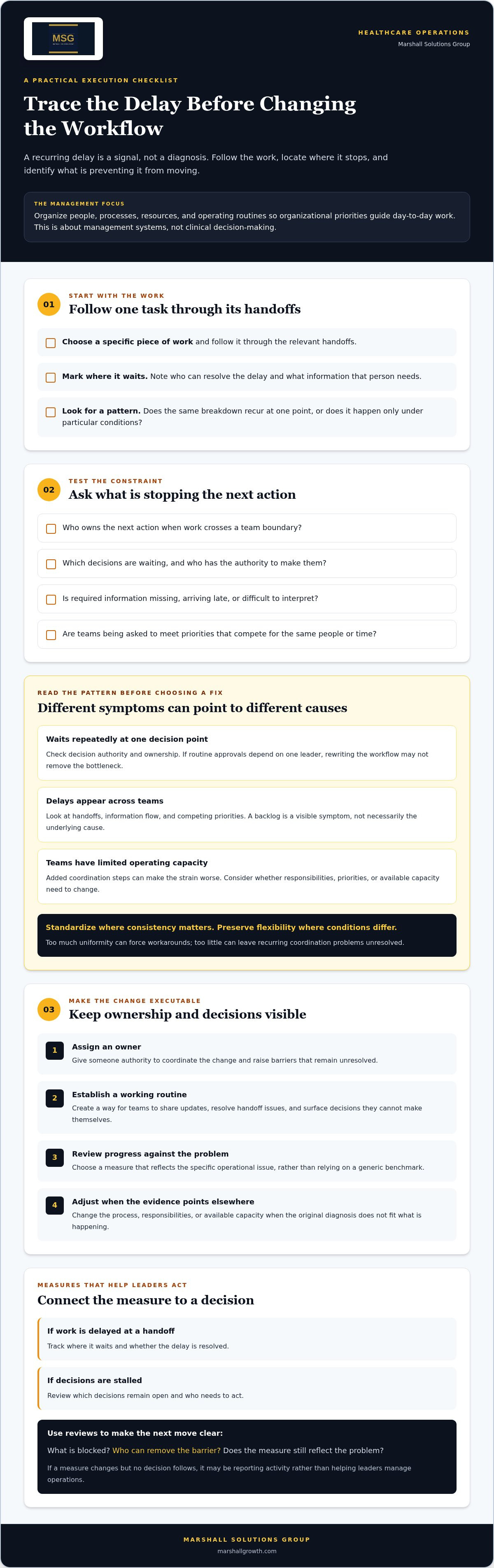
A recurring delay is a signal, not a diagnosis. Before changing a workflow, trace where work stops and what prevents it from moving. Diagnose the constraint before changing the process. A new procedure may add steps without fixing unclear decision rights, competing priorities, or limited capacity.
Which Signals Help Leaders Find the Real Constraint?
Start with a specific piece of work and follow it through the relevant handoffs. Note where it waits, who can resolve the delay, and what information that person needs. Then check whether the same breakdown recurs at the same point or appears only under particular conditions. Repeated waits at one decision point suggest a different cause than delays spread across teams.
- Who owns the next action when work crosses a team boundary?
- Which decisions are waiting, and who has authority to make them?
- Is required information missing, arriving late, or difficult to interpret?
- Are teams being asked to meet priorities that compete for the same people or time?
These questions help distinguish a visible symptom, such as a backlog, from its possible causes. If work accumulates because one leader must approve routine decisions, rewriting the workflow may not remove the bottleneck. If teams lack enough operating capacity, added coordination steps can make the strain worse. The Medical and Health Services Managers overview from the U.S. Bureau of Labor Statistics provides context on management roles in healthcare organizations.
Standardize steps that need consistent ownership or reliable handoffs. Preserve flexibility where teams face meaningfully different operating conditions. Too much uniformity can force workarounds, while too little can leave recurring coordination problems unresolved. An operational excellence framework can help leaders connect the constraint they identify to disciplined execution, rather than treating a process change as the whole fix.
Make Healthcare Operations Improvements Stick Through Accountable Execution
An improvement plan needs an owner and a way to adapt once work begins. Set an execution cycle that keeps responsibility and decisions visible:
- Assign an owner with authority to coordinate the change and raise unresolved barriers.
- Establish a working routine for teams to share updates, resolve handoff issues, and surface decisions they cannot make themselves.
- Review progress against a measure tied directly to the problem being addressed.
- Adjust the process, responsibilities, or available capacity when the evidence points to a different constraint.
Choose measures that help leaders act. If work is delayed at a handoff, track where it waits and whether the delay is resolved. If decisions are stalled, review which decisions remain open and who needs to act. An operational performance assessment guide can help connect measures to decisions leaders can make, rather than treating activity reports as evidence of progress. Healthcare operations management requires leadership participation after launch. Without follow-through, teams are left to resolve competing priorities on their own.
What Leaders Should Review to Sustain Progress
Use regular reviews to identify stalled decisions, unresolved dependencies, and changes in team capacity. Keep the discussion focused: What is blocked? Who can remove the barrier? Does the current measure still reflect the problem? If a measure changes but no decision follows, it may be reporting activity rather than helping leaders manage operations.
Stay involved long enough to reinforce ownership and make timely tradeoffs. That does not mean taking over routine work. It means resolving issues that exceed a team’s authority and adjusting priorities when capacity changes.
Turn Operational Priorities Into the Next Working Decision
The next test for healthcare operations management is whether leaders make execution part of how they lead, rather than treating it as a separate initiative that loses attention once work gets underway. Choose one operational priority that needs stronger coordination. Give it a clear place in leadership discussions, and keep responsibility visible as conditions change. Consistent follow-through makes an improvement usable beyond its launch.
Marshall Solutions Group supports healthcare and regulatory review organizations with management capabilities that connect strategy, leadership, and execution. Its embedded delivery approach continues through implementation, keeping attention on the work required to put decisions into practice. If your organization is working to connect leadership priorities with day-to-day execution, explore how MSG connects strategy with execution.
Frequently Asked Questions
Is healthcare operations management the same as healthcare administration?
No. The terms overlap, but healthcare operations management focuses on how priorities are carried out in routine work. Administration can also include organization-wide governance and resource decisions. The distinction helps clarify accountability: a recurring workflow issue may need an operations owner, while a decision about organization-wide policy or resource allocation may require executive or administrative authority.
Does healthcare operations management include clinical decision-making?
No. Operational leaders can support the conditions in which clinical decisions are made, but they shouldn’t set clinical judgment or treatment choices. A useful boundary is to separate decisions about how work is scheduled or resourced from decisions about patient care. If a proposed operational change could affect clinical practice, involve the appropriate clinical leadership in evaluating and approving it.
How can healthcare leaders prioritize operational improvements when teams have competing demands?
Choose improvements by comparing the consequence of leaving the problem unresolved, the organization’s current priorities, and the capacity needed to act. Make the tradeoff explicit: identify which work will pause or receive less attention if a change moves forward. This prevents leaders from treating every initiative as equally urgent and helps teams understand why some work must wait.
Can healthcare operations management improve coordination between clinical and administrative teams?
Yes. It can help teams agree on shared definitions and the information needed to make operational decisions. For example, if teams use different meanings for a status such as “ready,” leaders can clarify the criteria and who records them. A common understanding reduces avoidable confusion and gives clinical and administrative leaders a clearer basis for reviewing how work is progressing.
Disclaimer
The information provided in this article is for general informational and educational purposes only and does not constitute legal, financial, accounting, engineering, or other professional advice. Marshall Solutions Group, Inc. makes no representations or warranties regarding the completeness or applicability of this information to any specific situation. Readers should consult appropriately qualified professionals before making decisions requiring specialized professional advice.