Fractional COO Support: How to Decide Whether It Fits
By CJ Marshall, President & Founder
Evaluating fractional COO Seattle support? Learn how to assess operational authority, decision rights, and whether an executive role fixes execution gaps.

Article by
Chelvis “CJ” Marshall
Chelvis “CJ” Marshall is President and Founder of Marshall Solutions Group, a management consulting firm specializing in Strategy & Operations, Organizational Leadership & Change, and Program & Project Management.
A retired U.S. Navy Senior Chief who advanced from E-1 to E-8 in 10 years, CJ transitioned into Fortune 500 enterprise sales and leadership, generating more than $20 million in commercial sales. He brings extensive operational experience leading teams, managing complex programs, and overseeing mission-critical operations.
His work focuses on bridging leadership and execution, helping organizations translate strategic priorities into disciplined execution, organizational accountability, and measurable business outcomes.
Operating friction doesn’t automatically call for a new executive role. For leaders searching for fractional COO support through Marshall Solutions Group, the key question is whether recurring execution problems stem from a lack of senior ownership or from a narrower issue that can be addressed directly. Choosing the wrong response can add another management layer without changing how decisions get made.
This article offers a practical way to assess the fit. You’ll examine the authority the role needs, how it should work with existing leaders, and which measures can show whether execution is improving. The aim is a clear decision about the operating support your organization needs and the conditions that will help it work.
Key Takeaways
- Look past missed commitments to identify whether unclear decision rights or overloaded leaders are driving the execution problem.
- Assess fractional COO support by its authority and ownership, not simply by the hours it covers.
- Set clear boundaries between decisions the fractional COO owns and those that remain with the executive team.
- Build the engagement around implementation and observable progress, while addressing competing priorities and leadership resistance early.
Table of Contents
When operating friction points to a leadership gap
A fractional COO fits when execution problems keep recurring because no senior leader owns the operating system behind the work. Missed deadlines may be the visible symptom. The deeper cause could be unclear decision rights, overloaded managers, or handoffs that leave teams waiting for approval. Additional leadership capacity makes sense when these issues affect multiple priorities and require ongoing authority to resolve.
A bounded initiative is different. If one defined process needs redesign or a discrete project needs coordination, a focused intervention may be enough. Look for a persistent leadership constraint, not simply a difficult quarter or a single delayed project. The general Fractional Executive model provides context, but fit depends on the work and authority the role requires.
For a practical view of how this role can support growth, watch:
Diagnose the operating constraint before choosing a role
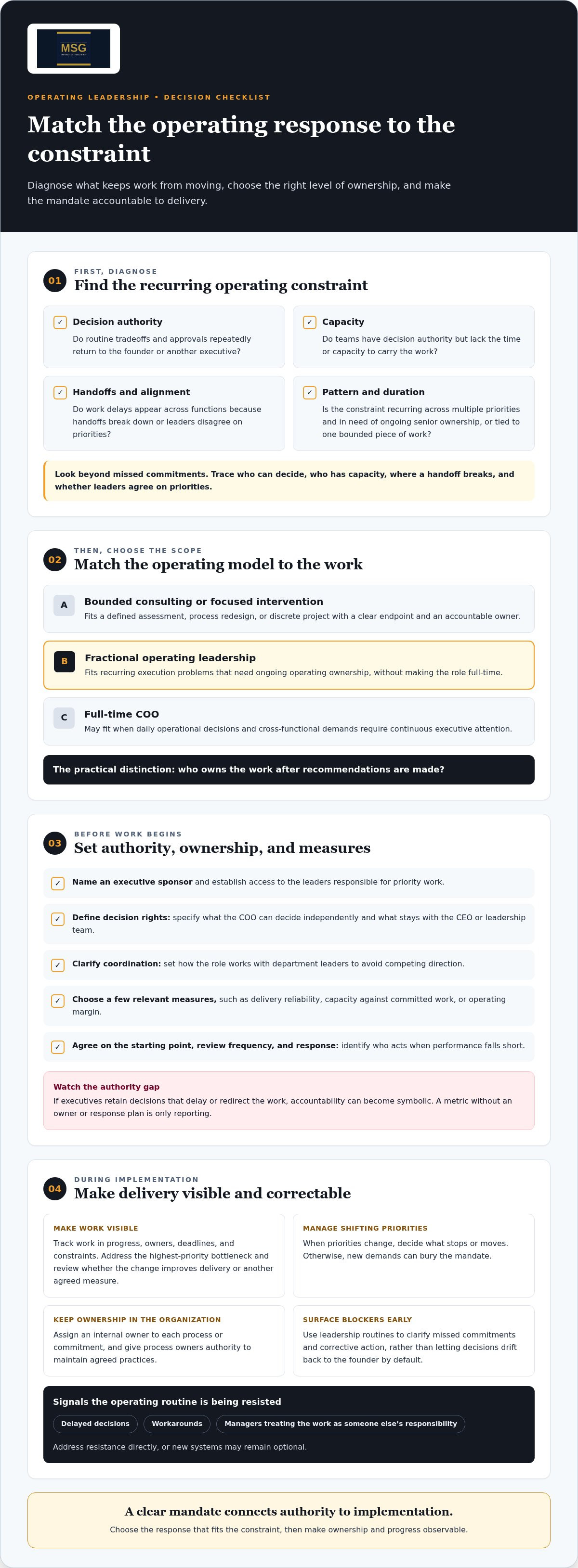
Track which decisions, handoffs, and commitments repeatedly return to the founder. If routine tradeoffs wait for one person, decision authority may be the constraint. If teams have authority but lack time or capacity, the issue is different. Delays across functions can also point to process design or leadership misalignment. Trace the pattern before assigning a title to the solution.
Ask what specifically keeps work from moving: who can decide, who has capacity, where a handoff breaks, and whether leaders agree on priorities. A broader operational assessment checklist can help structure that review. If the constraint recurs across the business and needs sustained senior ownership, fractional operating leadership may fit. If it has a clear endpoint and an accountable owner, keep the intervention bounded.
Evaluate fractional COO support by authority, scope, and measures
Choose the operating model by how much continuity and ownership the work requires. Bounded consulting can address a defined assessment or project. Fractional leadership provides ongoing operating ownership without making the role full-time. A full-time COO may be a better fit when daily operational decisions and cross-functional demands require continuous executive attention. The practical distinction is who owns the work after recommendations are made.
Define the mandate in working terms. Identify which decisions the COO can make independently, which stay with the CEO or leadership team, and how the role coordinates with department leaders. Clear boundaries prevent competing direction and reveal whether the organization is prepared to give the role enough authority to be accountable for execution.
Set decision rights and success measures before work begins
Name an executive sponsor and establish access to the leaders responsible for priority work. Then select a few measures tied to the business need, such as delivery reliability, capacity against committed work, or operating margin. Agree on the starting point, how often leaders will review progress, and who will act when performance falls short. A metric without an owner or a response plan is just reporting.
Limited authority creates a real tradeoff. A fractional leader may be expected to coordinate execution while executives retain decisions that delay or redirect the work. Accountability then becomes symbolic rather than operational. Set boundaries before the engagement starts, and revisit them if the mandate no longer matches the organization’s needs. A fractional COO operating partnership should connect authority to implementation, not stop at recommendations.
Design an engagement around implementation, not recommendations
A sound engagement turns agreed priorities into operating changes the team can sustain. Begin by confirming the mandate and decision boundaries. Establish a clear view of work in progress, ownership, deadlines, and constraints. Then address the highest-priority bottleneck and review whether the change is improving delivery or another agreed business measure.
Keep the sequence visible to the leadership team. If priorities shift, decide what work stops or moves; otherwise, new demands can bury the mandate. Assign an internal owner to each process or commitment, and bring unresolved blockers into leadership discussions. Without these routines, a plan can be complete while daily work continues unchanged.
Make the operating partnership accountable to delivery
Follow-through depends on both the operating leader and the organization. Leadership routines should surface missed commitments early, clarify who owns corrective action, and prevent decisions from drifting back to the founder by default. Process owners need authority to maintain agreed practices, while executives reinforce priorities when teams face competing demands. Resistance may appear as delayed decisions, workarounds, or managers treating the engagement as someone else’s responsibility. Address it directly, or new systems may remain optional.
Chelvis “CJ” Marshall, President & Founder, previously led a 137-person engineering department in the U.S. Navy. This is his prior experience, not an MSG client result. For details on how fractional operating leadership is structured, see the fractional COO operating support page.
Make the next move with a clear mandate
Before changing the org chart, write down the operating constraint you need to remove and what should look different once it’s addressed. That gives your leadership team a practical basis for deciding whether fractional COO support fits, and a way to keep the engagement focused as priorities shift.
The right operating partner should help turn that mandate into action alongside your team, not leave you with another plan to implement alone. Marshall Solutions Group’s model is built around embedded delivery that stays through implementation. If you’re ready to explore whether that approach matches your organization’s needs, explore fractional COO support.
Frequently Asked Questions
What does “fractional” mean in fractional COO?
“Fractional” means an organization engages a COO for ongoing executive support without making the role a full-time position. The level of involvement should reflect the operating mandate, not a reduced standard of responsibility. A retainer-based arrangement can provide continuity across leadership routines and implementation, while the agreed scope clarifies where the executive focuses their time.
Can a fractional COO work alongside an existing leadership team?
Yes. The role can complement functional leaders rather than replace them. Department heads may continue to own their teams and results while the COO coordinates dependencies between departments and surfaces decisions that need executive attention. Make reporting relationships and responsibilities explicit so the COO strengthens coordination instead of creating a competing chain of command.
How should executives measure whether fractional COO support is working?
Choose measures that show whether the original business constraint is easing. If delivery delays were the concern, track commitments completed on schedule alongside rework or quality issues. If capacity was the problem, compare available capacity with accepted work. Useful measures show operational change and its relevance to business priorities, not just meetings held or tasks completed.
When is a full-time COO a better fit?
A full-time COO may be the better fit when the organization needs sustained executive ownership across a broad range of daily operations, with frequent decisions and close coordination throughout the week. It may also suit a business whose operating demands have become continuous rather than tied to a defined set of priorities. The decision should reflect the workload and authority the role must carry.
Disclaimer
The information provided in this article is for general informational and educational purposes only and does not constitute legal, financial, accounting, engineering, or other professional advice. Marshall Solutions Group, Inc. makes no representations or warranties regarding the completeness or applicability of this information to any specific situation. Readers should consult appropriately qualified professionals before making decisions requiring specialized professional advice.