Fractional COO for AEC Firms: A Practical Buyer’s Guide
By CJ Marshall, President & Founder
Hiring a fractional COO for AEC firms requires a focus on execution. Learn how to structure authority, resolve capacity limits, and drive project delivery.

Article by
Chelvis “CJ” Marshall
Chelvis “CJ” Marshall is President & Founder of Marshall Solutions Group, a management consulting firm specializing in Strategy & Operations, Organizational Leadership & Change, and Program & Project Management. A retired U.S. Navy Senior Chief who advanced from E-1 to E-8 in 10 years, CJ transitioned into Fortune 500 enterprise leadership, where his commercial experience has included more than $20 million in contract value. He brings operator-level experience leading teams, complex programs, and mission-critical operations. His work focuses on bridging leadership and execution—helping organizations translate strategic direction into disciplined execution, stronger accountability, and measurable business results.
A fractional COO who only recommends changes won’t fix execution. The case for a fractional coo for aec firms is strongest when project delivery, staffing, and leadership decisions are pulling executives in too many directions, and someone needs clear ownership of the work that connects them.
Growth can bring more coordination without better visibility or clearer accountability. Fractional support can help, but only if the role has a defined mandate and stays involved beyond making recommendations. The right fit depends on the operating gap, the authority the leader will have, and the work your team needs them to own.
This guide will help you assess whether fractional COO support fits your firm, compare candidates on execution and relevant experience, and define responsibilities and measures before an engagement begins. The goal is practical: a leader who helps move decisions into disciplined action, not another layer of advice.
Key Takeaways
- Fractional COO support should provide operating leadership and implementation, not just recommendations. Define the decisions and execution work the role will own.
- Assess fractional coo for aec firms candidates on how they approach project coordination, staffing capacity, operating visibility, and performance measures.
- Confirm the candidate will have meaningful access to the leadership team and enough authority to move agreed priorities forward.
- Structure the engagement around the firm’s main operating constraint, named responsibilities, decision rights, and a small set of measurable milestones.
Table of Contents
What a Fractional COO for AEC Firms Should Own
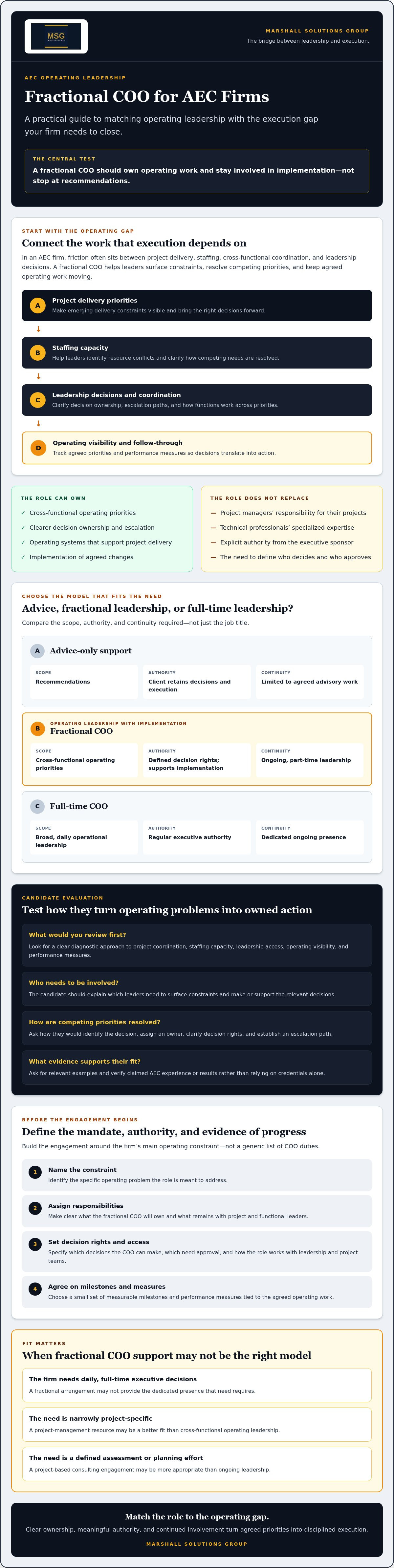
A fractional COO provides part-time senior operating leadership. Unlike advice-only consulting, the role stays involved as leaders put agreed changes into practice. For an AEC firm, that can mean connecting project delivery priorities with staffing capacity, cross-functional coordination, and a clearer view of operating performance.
The Chief Operating Officer role generally connects executive direction with an organization’s operations. A fractional version should have a similarly clear remit, scaled to the firm’s needs and the authority the executive sponsor grants.
For broader context on fractional COO responsibilities, watch this overview:
Where fractional operating leadership meets AEC project delivery
Execution friction often appears between projects and functions. Project leaders may lack timely access to people or decisions, while executives may not see emerging conflicts until delivery is affected. A fractional coo for aec firms should help establish how leaders surface constraints, resolve competing resource needs, and track operating priorities across the business.
An AEC fractional COO is the operating leader responsible for connecting project priorities, people, and leadership decisions to consistent execution. That responsibility depends on explicit authority. The executive sponsor should define which decisions the COO can make, which require approval, and what access the role has to project and functional leaders. Without that agreement, the COO may be held accountable for outcomes without the ability to influence them.
The boundary matters. A COO can align leaders, clarify decision ownership, and improve the operating systems that support delivery. The role doesn’t replace project managers, who remain responsible for managing their projects, or technical professionals, who provide specialized expertise. It coordinates the conditions for their work; it doesn’t take over their professional responsibilities.
How to Evaluate a Fractional COO for an AEC Firm
Choose a fractional COO based on the operating gap, not the title. Ask how the candidate will assess project coordination, staffing capacity, leadership access, and performance visibility, then stay involved as agreed changes are implemented. A useful reference point is Deltek’s discussion of ways to improve your AEC firm's operations. Ask candidates to connect those kinds of challenges to a specific diagnostic and execution approach. For example, ask what information they would review first, which leaders they would involve, and how they would turn a recurring resource conflict into an assigned decision and follow-up.
Test authority directly: “How would you clarify decision rights among owners, project leaders, and functional managers when priorities compete?” Strong candidates should explain how they would identify the decision, assign an owner, and establish an escalation path. Ask for examples relevant to complex operations, and verify any claimed AEC experience or results rather than accepting credentials without evidence.
Match the engagement to the actual need
Use this comparison to distinguish operating leadership from advice or project-specific support:
| Model | Scope | Authority | Continuity |
|---|---|---|---|
| Advice-only | Recommendations | Client retains decisions and execution | Limited to agreed advisory work |
| Fractional COO | Cross-functional operating priorities | Defined decision rights; supports implementation | Ongoing, part-time leadership |
| Full-time COO | Broad, daily operational leadership | Regular executive authority | Dedicated ongoing presence |
A fractional coo for aec firms may be a poor fit if the business needs an executive available full time to make daily decisions. It may also be more than the problem requires if the need is a narrowly scoped project-management resource. Match the role to the gap, then agree on access, authority, and evidence of progress before work begins. If the main need is a defined assessment or planning effort rather than ongoing leadership, a project-based consulting engagement may be more appropriate.
How to Structure a Fractional COO Engagement for AEC Execution
Start with the operating constraint, not a generic list of COO duties. Is delivery visibility weak? Are leaders making conflicting demands on the same people? Is a recurring decision stuck with the owner? Define the constraint, the leaders responsible for addressing it, the COO’s decision rights, and the first implementation priorities. A fractional executive works part time, so the engagement needs deliberate access to decision-makers and a clear path for resolving issues between scheduled reviews.
From operating diagnosis to accountable implementation
Move from diagnosis to execution in a defined sequence:
- Establish a baseline: Agree on what the firm can currently see about delivery, resource coordination, or the operating issue in scope.
- Assign owners: Name the leader accountable for each change and clarify decisions the fractional COO can make or escalate.
- Execute agreed changes: Set practical milestones, responsibilities, and leadership check-ins so recommendations don’t stall after discussion.
- Review measures: Use the available data to assess progress and adjust priorities with the leadership team.
Keep measures tied to the firm’s goals and available data. A useful measure might track whether leaders review delivery constraints consistently or whether agreed operating milestones are completed. Don’t import benchmarks that don’t fit, or promise outcomes before understanding the baseline. The diagnostic questions in Leadership & Operations Assessment: A Checklist for Scalable Execution can help leaders clarify where to begin.
Marshall Solutions Group offers fractional COO support, leadership and operations assessment, and strategy and operations consulting. Its retainer-based fractional COO support provides embedded leadership for daily operations and systems, while project-based consulting can address a defined assessment, planning, or program-management need. If your firm has identified an operating gap but needs help establishing ownership and carrying changes through, discuss whether this execution-focused support fits your needs.
Make Operating Ownership Clear Before You Engage
The right fractional coo for aec firms should address a defined operating gap, have authority matched to its responsibilities, and stay accountable through implementation. If your firm needs daily executive availability or a narrowly scoped project resource, choose a different model. Fit matters more than title.
Marshall Solutions Group describes its approach as hands-on operating support that connects leadership decisions with implementation. Before starting, be clear about the work, decision rights, access to leaders, and measures your firm needs. That clarity gives both sides a practical basis for reviewing progress and adjusting priorities.
If you’re ready to assess whether operating leadership support fits your organization, discuss your operating leadership needs with Marshall Solutions Group. Start with the operating gap you need to address and the decisions the role would be expected to own.
Frequently Asked Questions
What does a fractional COO do for an AEC firm?
A fractional coo for aec firms provides part-time operating leadership, connecting executive priorities with delivery across the business. The work may include improving visibility into project constraints, coordinating resource decisions, clarifying who owns cross-functional issues, and helping leaders implement agreed operating changes. The role supports project managers and technical professionals; it doesn’t replace their project or technical responsibilities.
When should an AEC firm hire a fractional COO instead of a full-time COO?
Consider fractional support when the firm needs senior operating leadership on defined priorities but doesn’t require a dedicated executive’s daily presence. A full-time COO may be a better fit if decisions and operational issues require continuous executive attention. If the need is limited to managing one project, a project-management resource may be more appropriate than a firm-wide operating leader.
How do I evaluate a fractional COO’s experience with AEC firms?
Ask candidates to explain their direct role in relevant work, the operating challenges involved, and how they moved decisions into implementation. Request references or other verifiable evidence where available. Distinguish experience with AEC firms from broader complex-operations experience, and don’t treat familiarity with industry terminology as proof they can clarify authority, coordinate leaders, or improve operating visibility.
How should an AEC firm measure a fractional COO’s impact?
Start with a baseline tied to the operating problem, then agree on measures the firm can track with available data. Depending on the priority, these might include visibility into delivery constraints, completion of agreed operating milestones, or clearer ownership of resource decisions. Review the measures with leadership regularly. Avoid unsupported benchmarks and promised outcomes; assess progress against the firm’s own goals.
Disclaimer
The information provided in this article is for general informational and educational purposes only and does not constitute legal, financial, accounting, engineering, or other professional advice. Marshall Solutions Group, Inc. makes no representations or warranties regarding the completeness or applicability of this information to any specific situation. Readers should consult appropriately qualified professionals before making decisions requiring specialized professional advice.